A prediction nobody would have made in 1962

Holy Beer!What if the American beer clock had stopped in 1962?

(It’s a silly notion, because there’s that time marches on thing always happening. But stick with me.)

Anheuser-Busch was the largest brewing company in the country, but not by much (it commanded less than 10% of the market). Next were Jos. Schlitz Brewing, Falstaff Brewing, Carling Brewing, Pabst Brewing, Ballantine & Sons, Hamm’s Brewing, F & M Schaefer Brewing and Liebmann Brewing.

The 10 largest brewing companies controlled 52% of the market.

Whatever small breweries there were operated under the radar. This question came to me when I was looking something up in Stanley Barron’s Brewed in America. This is a terrific history of American beer, except it stops in 1962 (when the book was published).

In it Baron describes how hard (almost impossible) it was is for a brewery with capacity of less than 100,000 barrels to compete. He writes, “Probably the smallest of all commercial breweries in the United States is the Earnest Fleckenstein Brewing Co. of Fairbault, Minnesota, with a capacity of around 20,000.” Of course, Anchor Brewing was probably smaller – by the time Fritz Maytag’s investment in 1965 kept Anchor from closing the company brewed only about 600 barrels a year.
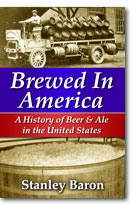
Brewed in AmericaA quick aside: Beerbooks.com has reproduced Brewed in America, making life much easier than when I had to hunt through many used books stores before I found it. Those who chafed when Maureen Ogle left out 200 years of ale brewing history in Ambitious Brew – for perfectly logical reasons already discussed more than enough – will like this book better.

Like Ambitious Brew and Beer & Food, but long before, Baron nicely details how lager beer, then lighter lager beer became the American alcoholic beverage. Perhaps those of us who enjoy beer outside the mainstream wouldn’t consider the beer future as bright as he did, but that’s another matter.

His final words are particularly interesting:

“If any changes occur in the product it will be because they contribute either to swelling the sales total or slimming down the cost of manufacture without compromising the product.

“Curiously, one of the means by which beer sales have been pushed to record levels in recent times has been the successful campaign to bring beer back to its original social position: a universal beverage. It is no longer the workingman’s drink, it is no longer a German drink, it is no longer exclusively a man’s drink … most of those temporary labels have been removed by one method or another, and the acceptance of beer is closer than ever to where it was at the beginning. The kettle in the kitchen has given way to the tremendous factory covering several blocks, but the drink in the glass fills the same purpose it always has.”

That was 1962. Beer’s image took a beating, and it’s taken the work of mostly small brewers – now joined by Anheuser-Busch’s Here’s to Beer campaign – to begin to restore it.

But what if the clock had stopped? Baron knew it wouldn’t. In his introduction he writes of expecting without making real predictions:

“There is no telling what sort of beer will be most popular in 1975 (two years, it turns out, before Jack McAuliffe sold his first New Albion beer). Though imported lagers constitute only a tiny fraction of the American market, even that small popularity may indicate that a taste for more of the hop-flavor is reawakening. The rise in sales of ale may prove a significant factor. It has taken a hundred years to arrive at the beer most popular today, and it may take just as long to develop any noticeable difference. This is an industry which has never been given to tampering with its product and changes dictated by consumer preference have been cautious and slow.”

Seems like he was on to a few things there – but wrong about it taking 100 years.

That’s because of breweries smaller than anybody could imagine in 1962, and brewers who weren’t thinking first about “swelling the sales total or slimming down the cost of manufacture.”
The Session #5: It’s all about atmosphere

The SessionThe guys at Hop Talk have set the theme for the next round of The Session (in which dozens of beer enthusiasts blog to the same theme one day a month).

The theme is atmosphere, and Al explains:

Beer is about more than flavor, IBUs, and the debate over what is a craft beer and what isn’t. It’s about Life. It’s the proverbial icing on the cake.

So, we want to know about the “Atmosphere” in which you enjoy beer. Where is your favorite place to have a beer? When? With whom? Most importantly:

Why?

Because while life isn’t all about beer, beer is all about life.

Be there July 6. Meanwhile, more about The Session.

SABMiller, Lost Abbey ’round table’

Tomme ArthurIf you haven’t already read Fortune magazine’s interview with SABMiller CEO Graham Mackay then you don’t have to hurry over to the CNN Money site to do so, because …

Only on the Internet could you have the brewer from Lost Abbey Brewing and the CEO of the world’s second largest brewer in a round table discussion (OK, with two guys maybe the table isn’t round). And only when Tomme Arthur (Lost Abbey) is blogging. (He, not Mackay, is the one pictured here.)

Arthur has taken the interview and added his own comments along with Mackay’s. For example:

How would you characterize the company’s fiscal year just ended?

The SAB Miller Answer- The year gone by has been very successful. Latin America was amongst the strongest regions of growth, but Europe was as impressive. And we also had very strong volume growth in Asia, so our performance all around is strong.

Tomme Responds- Well, we’re still in business after our first year. I think that’s pretty kick ass. We made a bunch of new beers and we didn’t kill anybody. As for Latin America, it was our weakest region but Europe was awesome.

How do you think this would have gone had Matthew Boyle (the Fortune writer who did the interview) had started with Arthur and invited MacKay to elaborate in MacKay’s blog? Oh, wait, he doesn’t have one.

Pucker up for the Great American Beer Festival

Beer judgeThe Great American Beer Festival has added two more categories – actually one category and one sub-category – for sour beers in the 2007 competition.
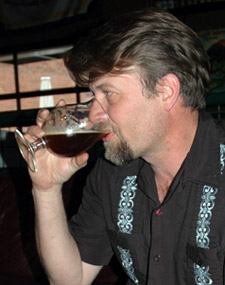
American-Style Sour Ales will compete with German-Style Sour Ale (Berliner Weisse) in Category 13. Wood- and Barrel-Aged Sour Beer (Category 16) “is aged with the intention of imparting the particularly unique character of the wood, the micro flora present in the wood and/or what has previously been in the barrel.”

Would you call that beer terroir?

Changes and additions for the competition at listed at the GABF website (scroll down to “Letter from the Competition Director”). They include both “small” and “big” beers. A category was added for Other Low Strength Ale or Lager, basically balancing Other Strong Ale or Lager. And the Imperial Stout category now includes a sub-category for American-style Imperial Stout.

Director Chris Swersey’s letter detailing the changes is interesting for another reason.

As long as I’ve been going to the GABF (only 14 years) there’s always been sniping about brewers making special batches for the competition, with added pop (more alcohol, more hops) to stand out in the blind judging. That’s the background. Here’s the message.

During the past four years, the style descriptions for the American-style pale ale family of beer styles have evolved to the point that the essential differences reflect alcoholic strength more than any other single quality. We have received numerous comments from brewers, judges, and consumers, which indicate that there is confusion regarding the alcoholic strength of beers entered in particular categories, with respect to the brand name of the beers themselves. For example, a brewery could intentionally under-enter a strong pale ale in the pale ale category, with the idea that the beer might outclass the competition.

The GABF has no intention of policing entries for compliance by alcoholic strength. Analyzing entries is impractical and expensive, and more importantly, this role would subvert the function of the judge panel. Over the years, the judge panel has told us what makes great beer, and we plan to continue to let them. With this in mind, the judge orientation this year will include a taste calibration session that focuses on alcoholic strength, along with a reiteration of the comments that we have received regarding alcoholic strength. Please be sure to enter your beers in the appropriate category based on alcoholic strength as well as other factors.

That pretty much speaks for itself.

10 years of Falling Rock

Chris BlackDon Younger is going to stop by. Will you?
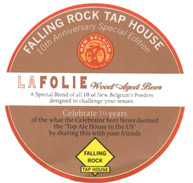
Granted, Younger – the venerable Portland, Oregon, publican who founded the Horse Brass Pub in 1976 – has his own stool at Falling Rock Tap House in Denver, but he seldom uses it in June.

He’ll be in Denver this week because Falling Rock celebrates its 10th anniversary.

The circumstances will be grander than when the multi-tap (69-75 tap handles operating, depending on the day, and “No Crap on Tap”) opened June 9, 1997. Chris Black (above), one of three founding brothers, didn’t realize that many of the distributors would deliver beer warm, so the bar was open for about four hours that day, then closed to organize and cool beer for the next day.

Black has different special beers planned for each days the celebration, and Belvedere Belgian Chocolate Shop is creating different chocolates to go with each beer. The first 50 customers each evening get a bar with a label that list the participating brewery as well as how many days the Falling Rock has been open.

Chris BlackThe beers are all locally brewed, and Black helped in production of several. For instance, Saturday he’ll be pouring a batch of La Foile he helped blend. New Belgium Brewing typically uses beer from two or three of its 10 foders (four 60- and six 130-hectoliter wood tuns) for a La Foile release. Black sat down with Eric Salazar of New Belgium to taste samples from all 10 tuns, and together they came up with a special batch.

The party kicks off the day before with Mr. Hoppy, made by Twisted Pine Brewing in Boulder. Gordon Knight founded Twisted Pine, where he brewed on New Belgium’s original five-hectoliter brewhouse. He later sold the company, but eventually was reunited with the brewing system when he started the Wolf Tongue Brewery in Nederland. That’s where he created Mr. Hoppy, a beer that Jim Parker (then the Wolf Tongue GM) called “hop water.”

There are a lot of reasons to post this at Appellation Beer (as opposed to Beer Travelers), but the best might be to remember Knight. He epitomized what I want to write about.

Knight was a Nebraska native who earned a Purple Heart as an Army helicopter pilot in Vietnam. He moved to Boulder in 1988, and soon turned from homebrewing to professional brewing. He also worked as a professional helicopter pilot, most often in fire fighting. He died in 2002 when his helicopter crashed while he was fighting a fire near Rocky Mountain National Park in Colorado.

Reflecting on Knight’s life, brewer Brian Lutz said: “Gordon didn’t have jobs, Gordon had passions. Gordon’s job was his passion and visa versa. That’s a good way to live and I thank him for challenging me to do the same.”

Let’s hope a few Coloradoans with good memories raise a glass of Mr. Hoppy in his memory on Friday.

Just a few of the others beers:

– Great Divide’s Hades (strong, golden and Belgian) makes its official debut on Sunday.
– Black Triple 6’s from Wynkoop on June 12. This is a variation on a beer brewed 6/6/06 by Wynkoop, which Chris helped make this time. Brewed in the manner of a Belgian tripel but with coffee in the recipe.
– Chris brewed a batch of Odell Double IPA with Doug Odell on the brewery’s five-barrel pilot system for June 15. The recipe includes a new high alpha (18.8 AA) hop called Apollo.
– June 16, Avery Salvation (a Belgian strong golden) aged since September in Eagle Rare Bourbon barrels.

The celebration runs through June 17. Then we can start resting up for the 20th anniversary of San Francisco’s Toronado in August.