It’s never over until the Fat Squirrel sings

The theme for this month’s session is The Brew Zoo. Rick Lyke is your host and will compile the recap.
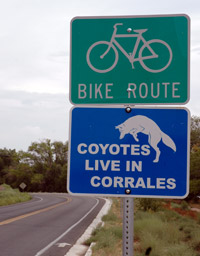
Coyotes Live in CorralesI live in a town where (as you can see) visitors are greeted with a sign that touts our coyotes, and this time of year you hear them howling away throughout the night although we don’t see much of them.

But I’ve never been able to buy a Wilie E. Coyote Ale, and I’m still waiting for Cask Corrales Coyote (“Oh, that firkin road runner!”) at the brewery I can walk to.

By the time I’m done typing this entry one or two road runners will have strolled by my office window. Yet I’ve also not met a Road Runner Stout (or IPA).

If you lived in New Mexico wouldn’t you want to be able to buy a coyote or road runner beer? Or even something with Lobos in the name. Lobo Lupilin has a nice ring to it. Were there such a beer, making a choice for this month’s Session would have been so much easier.

Last week I did have a Jack Rabbit IPA at Chama River Brewing. And a jack rabbit will occasionally hop across our yard of sand, rocks and desert sage, but only occasionally. Besides I’ve already written about a couple of Chama beers in past Sessions.

We don’t get many dogs in our yard (dogs wander from their homes at their own coyote risk). Too bad, because what might be New Mexico’s most famous – and this one even comes in a bottle with a label – beer features a bandito dachshund, a cartoon likeness of a dog whose name was Petey. Petey went on a chicken killing spree when Santa Fe Brewing was still operating in the village of Galisteo. When he was done 22 chickens were dead and the brewery had the name for its barley wine.

I judged barley wines (for breakfast) in the recent New Mexico State Fair Pro-Am and it turns out the beer we gave the silver medal to was a 2004 vintage of Chicken Killer – creamy, luscious and full of orchard fruits. But 22 ounces of Chicken Killer (why do so many breweries put their strongest beers in the biggest bottles and everything else is in six-packs?) followed by typing has more appeal sometimes than others.
The SessionYes, I could celebrate The Session with any of several Flying Dog beers in the garage fridge, or head to a nearby store and find a variety of beers with critters on the labels. (Even a few with critters inside – and The Session seems like a good enough excuse to buy a sixer of Jolly Pumpkin Bam Biere with that Jack Russell on the front. Which it turns out Alan tried for the first time in The Session.)

But I’m still thinking local, real local. In fact, I just wanted to see a particular live animal before talking about my animal choice. Anyway, honest, a squirrel finally arrived to steal from one of our bird feeders (aren’t you glad there might finally be a point?). Now we can talk about Fat Squirrel IPA, a beer from Turtle Mountain Brewing. Turtle Mountain is just a couple of miles up the hill from our house, farther if you go by road.

In New Mexico brewing IPAs is a competitive sport, both among amateurs and pros, and Turtle Mountain comes to play. Wednesday there were three IPAs on tap, and Fat Squirrel was available both on draft and cask-conditioned in a firkin. The brewhouse itself smelled of grapefruit and pine, since Centennial hops fresh from the bines and delivered overnight from the Yakima Valley were being added to New Mexico’s first fresh hop beer. (Check back in a few weeks.)

Turtle Mountain describes Fat Squirrel as “in the British style” – but it is more of a hybrid, the Northwest hops muted (at least compared to TMBC IPA) but present. British malts and yeast soften the beer on the palate, but I don’t think Roger Protz would call this a British IPA.

The beer takes its name from when it was first brewed at the original Turtle Mountain pub a few blocks away. One day a then-skinny squirrel was hanging around the back door to the brewery and the brewers offered him some spent grain. At first he’d come running for the treats. Eventually he slowed to a waddle, and there were times he’d loll in the shade of a car out back, looking indifferently at another meal.

The brewery has moved to bigger quarters. The squirrel has disappeared. The legend lives on in the glass.

About the session.

Heineken Light vs. every U.S. brewpub

Some numbers take longer to sink in than others, or maybe it is because this past week was awfully busy, but back on Aug. 29 Brew Blog reported Heineken Premium Light will miss its ambitious volume targets.

From the Financial Times:

“One blemish on the performance was Heineken premium light, a low calorie and low carbohydrate beer, that will not turn a profit in 2007 in the US, where it was launched last year.

“While volumes rose 30 per cent in the first half, Heineken admitted it had been ‘a little too bullish’ in setting a goal of selling 1m hectolitres, blaming the weather and higher prices.”

One million hectoliters. That’s more than 850,000 barrels, the measure usually used in the U.S. beer business. Or put another way, going on 11.7 million cases.

How much is that? Sierra Nevada sold 640,000 barrels in 2006.

Magic Hat, Bell’s, Shipyard, Abita, New Glarus, Stone, Kona, Great Lakes, Sweetwater and Victory – 10 breweries that each grew at a rate of 20% or more in 2006 – combined for 536,000 barrels.

All the brewpubs in the United States combined to sell 697,000 barrels in 2006. Total.

How could Heineken Premium Light, invented little more than a year ago, hope to rocket to 850,000 barrels?

By spending $55 million on marketing in 2006 (that’s just for HPL, not Heineken itself) and $70 million more in 2007.

Just something to think about.

Beer & wine: The dark side

Ah, yes, the Dark Side.

Hugh Sisson of Clipper City writes in his blog about positive parallels between the craft beer and small winery industries, but also suggests “there are some developments that have taken place in the boutique wine industry that do not, in my opinion, bode well long term for craft beer. Should the craft beer industry follow the wine industry in these areas, I believe we could see some problems down the road.”

Thus the Dark Side.

First and foremost, consolidation in production. Many of the more successful California wine properties have over the years gone from being founder owned and operated to part of much larger corporate entities. This certainly improves marketing efficiency as well as developmental working capital and potential economies of scale in purchasing of some commodities. And with the wine industry, this potentially can work – principally because the “boutique” wine industry is tied to the land, and as long as the managing entity respects the unique character of the property, quality is usually maintained or actually improved upon. There doesn’t necessarily seem to be a problem with XYZ Corporation producing 15 different chardonnays from 15 different microclimates under 15 different labels – the products really are different – and the differences are seen as a “strength” and a marketing positive.

But I am not sure the same kind of approach would be successful for craft beer.

I’m certain it would be bad.

And there are those in the wine community who would be glad to tell us what’s wrong with consolidation, and that nuance is disappearing from everyday (reasonably priced) wines.

Todd Wernstrom of Wine News last year wrote that beers that capture the essence of what once made wine special had become more common than such wines.

Pointing to beers from “micro-size” breweries he wrote:

– They are unique.
– The embrace their terroir – which he defined as a function not of where beer is made but of the choices made by the brewmaster.
– They convey their sincerity and genuineness in their marketing efforts.

Sisson is spot on when he writes “a major factor in the success of craft beer is the broad range of personalities in the industry and the way they interact and enhance one another.”

Losing that range would land us smack on the Dark Side.

Added Sept. 6: There are paths that wine has gone down we know beer shouldn’t, such as beer as an investment. Last night I read The New Yorker’s story about The Jefferson Bottles (it’s a long puppy online, and there’s lots of other good reading in the issue so you might want to grab the actual magazine). It’s an intriguing look into a world where people pay crazy amounts for bottles they’ll never open, have cellars with thousands of wines, and try to overlook the fact that many are likely fakes. Scary, quite scary.

Which of these beer leagues has more taste?

More Taste LeagueAnd the latest advertising for Miller Lite introduces something called the More Taste League.
It features a Commish, played by actor John C. McGinley.

In “Interception,” McGinley catches a non-Miller Lite bottle that one beer-drinking buddy is attempting to toss to another. A podium, women dressed as referees and a large backdrop emblazoned with the words “More Taste League” suddenly appear. As McGinley lightly chastises his pals for drinking “non-sanctioned light beer,” they realize the error of their ways. When they ask which beers are sanctioned, McGinley replies in his trademark faintly exasperated (and sarcastic) tone, “Beer. Singular. Miller Lite.”

Compare, and contrast if you want, this to a GABF Fantasy League being organized on the beermapping.com discussion boards.

Shouldn’t Miller be happy just to call it the Less Filling League?

The saxophonist will have Chimay

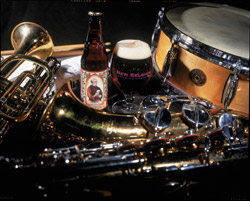
New Belgium AbbeyWhat do jazz musicians drink?

Yes, it does sound like a question Michael Jackson would have asked, but this time it was Martyn Cornell in a perfectly delightful post about the Bull’s Head at Barnes, which features Young’s beer on a handpump in the same room where live jazz is featured.

He concludes:

* drummers, being straight-ahead guys, prefer real ale, particularly Young’s Ordinary.
* bass players go for a beer with some (allegedly) perceived style, such as draught Leffe blonde.
* saxophonists are teetotal, at gigs, anyway, choosing mineral water or tea.
* trumpeters drink Beck’s from the bottle (something to do with exercising the embouchure?).
* piano players choose red wine.

And in the comments we get a dissenting vote: “My brother-in-law, a saxophonist, is especially partial to Chimay.”

Anyway, go read about a 30-year-old LP “inspired” by real ale and real ale breweries.

(About the photo: It is one that New Belgium Brewing shipped out in 2000 when the brewery released the “Worthy Glass” for its ales.)