GABF: Last call (all the news that didn’t fit)

It’s time to bid a fond farewell to Great American Beer Festival coverage, so a few notes from the tattered pieces of paper I found in the pockets of my jeans after their official post-GABF washing:

No, it won’t be GABF East: Ten years after the Great American Beer Festival on the road didn’t play well in Baltimore (at the time Stephen Beaumont wrote “What If We Gave a Beer Fest and Nobody Came?”) the Brewers Association will give it another try on the East Coast, but not with something that looks like at all like GABF.

Plans for (savor) an american craft beer & food experience were announced just before the awards ceremony Saturday. The event is May 16-17 (2008) at the Mellon Center in Washington, D.C. One brewer said he had heard it will be a “high end, food-oriented event.”
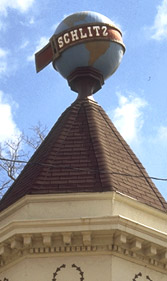
Three BrothersSchlitz retro rumor: Word is Pabst will re-launch Schlitz beer using a throwback recipe. Pabst and Schlitz, of course, were two of the breweries that made Milwaukee famous in the 19th century.

Now Pabst, itself a contract brewer, owns the Schlitz brand. Schlitz was the second largest brewing company in the world in the early 1970s and still second in the U.S. (to Anheuser-Busch) in 1976 when the company made two incredibly stupid decisions. By 1982 it was out of business, although the brand has continued to be brewed at other breweries and sold as a low-price beer. The resurrected recipe is said to be from well before the 1976 missteps.

More wood at New Belgium: Brewmaster Peter Bouckaert of New Belgium Brewing seemed on the verge of giggling at the thought that a) his crew can finally take charge of the new bottling line and b) they have new barrels to play with.

Barrels? Like the four 60-gallon bourbon barrels a brewery near me is picking up? Like the first wine barrels he began infesting with critters back in 1998?

“No, 130 hectos,” he said smiling broadly. Most of us would call the 130-hectoliter vessels tanks, since they’re the same size as six other 130s the brewery added in 2001. They hold about 3,400 gallons each.

Overheard: Volunteer after being asked a question by a festival goer. “It’s fermented with Brett. Does that make it a barley wine?”

Best post I haven’t linked to yet (Because it wasn’t up yet): From Matt Van Wyk of Flossmoor Station.

You don’t want it to end (b/c work awaits you Monday), but I hadn’t seen my two kids since they groggily dropped me at the airport Tues. at 6 AM, waving at me the whole time the train departed for the city. It’s funny that no matter how many medals I win, no matter how many colleagues I meet or made anew, no matter what I did wrong this weekend, Nick and Ella sprinted to me shouting “Daddy, Daddy, Daddy”. I love that gold medal I won this weekend, but I’d surely trade it for that experience coming home Sunday afternoon. (I told you it was a roller coaster of emotions-now go ahead and cry, you big tough guy!)

Alpha King results: Bell’s Two-Hearted Ale, the original Alpha King winner, returned to the victory stand this year by placing second. Pliny the Elder from Russian River was first, and El Camino IPA from Pizza Port San Clemente second. None medaled in the GABF judging.

Beer I enjoyed most: AngelsShareCeriseCasseZwickelbier-
IchBinEinBerlinerWeisseKiwandiCreamAleOrodeCalabazaBlindPigIPA-
GoldenArmPilzHopSueyWatermelonFunkSigdasGreenChiliPrimaPils

or maybe it was

OtisAltTheGreatPumpkinRed&WhiteBoscosFlamingStoneBeer-
InterludeSaisonBrettPennWeizenStormcloudIPABeerHunter-
Brooklyner-SchneiderHopfen-WeisseOompahLoompahChocolateBeer

There were others as well.
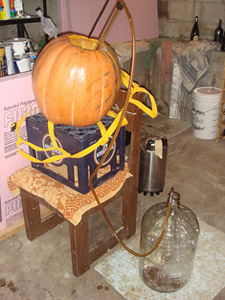
The ultimate pumpkin beer – photo story

Pumpkin beerIf a picture is worth a thousand words then 27 photos (at flickr) might be worth a million.

The Interstellar Galactic Brewery team carved one pumpkin to create a mash tun, then fermented in another.

What could be cooler? A three-tier pumpkin system, I guess. And maybe one in which the lid didn’t collapse into the beer during fermentation. Looks as if they might end up with a wild pumpkin beer.

The search for a definition of beer terroir continues, but this could be part of it.

Thanks to Eric Trimmer at Trouble Brewing for spotting this.

Comparing the price of one beer to one wine

We all know that the best beers in the world cost less than the best wines. However you can buy a quality wine for less than a quality beer.

Why?

I didn’t really get an answer following a presentation by Dogfish Head founder Sam Calagione and wine maven Marnie Old at the Great American Beer Festival, but maybe you can connect the dots.

Beer vs. WineIn all fairness that wasn’t what they were there for during a presentation for GABF attendees on Thursday and the press on Friday. Calagione and Old certainly make a meal entertaining — combining humor, he vs. she, and beer vs. wine — and I’m sure their upcoming book, He Said Beer, She Said Wine, will be a delight.
When they were done I put this question to Old: Why can I buy a bottle of Charles Shaw wine (also known at Two Buck Chuck) at Trader Joe’s for $2.99 and a six-pack of Mission Street Pale Ale costs $5.99?

(I had hoped to have the speakers taste the two blind — maybe straight from brown paper bags — and comment, but this wasn’t the time or place.)

Old would argue about the quality of Two Buck Chuck, but the 2004 Chardonnay won double gold in the California State Fair. Firestone Walker crafts Mission Street. It is the “base” beer for the award-winning Firestone Pale Ale, the difference being that it doesn’t contain a portion (the Firestone Pale Ale has about 3%) of beer that ferments in wood barrels.

“Quantity and quality don’t go together,” Old said, making it clear what she thinks of Two Buck Chuck, which one wine writer at the press luncheon referred to as “a box wine in a 750ml bottle.”

Old is not anti-beer. She talked openly about wine’s image (“snobbishness”) problem. “It’s obvious to me wine and beer are more alike than they are different,” she said, contrasting them as fermented beverages to distilled spirits. Saturday the Brewers Association gave her one of its Beer Journalism awards for “Beer Takes the High Road” published in Sante magazine.

But my question seemed to leave her a little defensive, perhaps because she clearly does not want Two Buck Chuck carrying the banner for “fine wine.”

She repeated a point she made during her talk that the quality of less expensive wine has been improving for 50 years, and the quality of beer (less expensive than most wines to begin with) has been improving for more than 30. A way to compare the two is to consider the cost of a single serving.

In a restaurant that is as simple as looking at the menu. At home figure that a bottle of wine yields six servings and a 12-ounce bottle of beer one. This doesn’t suit higher-alcohol, labor-intensive beers, but works just fine for our Trader Joe’s comparison.

Thus a serving of Two Chuck Buck Chardonnay costs 50 cents and one of Mission Street Pale Ale costs $1.

This would suggest that it is more expensive to reach some minimum standard of excellence in beer than it is wine.

And before you start blasting with both barrels I recognize all the “ifs” here. Does Two Buck Chuck really qualify as quality? How can Mission Street Pale Ale be on (or beyond) the verge of world class and also some sort of “new minimum?”

This is not intended to pit beer versus wine. To have winemakers argue that they can offer more of a “deal” or beermakers that drinking beer isn’t always choosing the “cheap” product.

I’m just noting that at Trader Joe’s a wine that’s always a deal and wins awards is $2.99, and a beer that’s always a deal and wins awards if $5.99.

An observation.

A million dollars worth of beer?

Free Beer here25,000 gallons of beer, 1884 beers on the festival floor, 39,000 bottles and cans to be recycled, etc. etc.

That’s the Great American Beer Festival by the numbers, according to the Brewers Association, which has even more figures for you to read at the GABF site.

So how much do you think all that beer was worth? Enough that everybody who paid $45 for entrance got his or her money’s worth? Lord knows that I saw plenty of people trying to make sure they did.

The following paragraphs originally contained a painful amount of arithmetic. Like number of attendees and volunteers, one-ounce servings (potentially more than 3 million; had to pass that one along), the price of tickets, street value of the beer and more.

You don’t care. So I’ll justify the headline, note the total value of beer dispensed likely was north of $1 million, and get to the point.

Breweries are not compensated for the beer they serve on the floor, but few were shy about serving the really good and sometimes really expensive stuff. They could have kept it at home for themselves or sold it for more than the average pint. So it seemed almost outlandish for Samuel Adams to dole out shots of its ultra-expensive Utopias. And way too generous for Flossmoor Station’s brewers to part with their last keg of Killer Kowalski.

And then there was The Lost Abbey, dispensing Cuvee de Tomme ($15 for 375ml), The Angel’s Share ($15 for 750ml), Veritas 002 ($20 for 750ml), Cable Car ($30 for 750ml) and 10 Commandments ($12 for 750ml). Five beers that are impossible or next-to-impossible to find, ones that would sell out at the brewery door at the brewery door were they available.

“There might be $10,000 worth of beer there,” brewmaster Tomme Arthur said in passing on Friday.

He did the math Monday when he got back in the brewery, and sent the numbers along.

“Total value of beer on the floor at the GABF = $9,084.

“Winning third Brewer of the Year award = Priceless.”

Miller+Coors=More of the same?

Week 2 of the [Edited to reflect the point of order Stonch makes below: U.S. operations] merger between Molson Coors and SABMiller — both themselves the results of mergers and acquisitions — and you probably just want to know if this is going to make it harder or easier to buy your favorite beer.

Which, by the way, is no brewed by either.

Yes. Do a Google news search and you’ll find a thousand stories (really a few stories repeated hundreds of times), but they’ll explain the importance of this to wholesalers, stock holders and a variety of other interested parties. Some predictions will be right and others wrong.

But here’s something else from the press release:

Capturing Synergies and Improving Productivity
The combination of the businesses is expected to result in identified annual cost synergies of $500 million, to come from optimization of production over the existing brewery network, reduced shipping distances, economies of scale in brewery operations and the elimination of duplication in corporate and marketing services.

Does that sound to you like some Miller might be brewed in a Coors brewery and Coors’ products (Blue Moon even?) in Miller plants?

This is not a matter if they can do it well — Miller has brewed Samuel Adams products, for instance. It’s a matter of brewing a beer that comes from a particular place.

And that’s not a part of the the MillerCoors business plan.

Added later in the day: A great suggestion from Maureen Ogle.

Added 10.19.07: Garrett Oliver contributes to the New York Times Op-Ed page. “MillerCoors is not a threat to craft brewers but a warning: we should not walk the road of overexpansion or be tempted by the lowest common denominator of the mass market.”

Added 10.19.17: Boomberg.com reports the deal will lift sales of Miller Chill. I don’t know about you, but this gets me pretty excited.