The Session #10: Let it snow, let it snow

The SessionTed Duchesne at Barley Vine has announced the theme for The Session #10: “Let it snow, let it snow, Winter Seasonal Beers.”

The basics:

# Pick any Winter Seasonal beer you want. Or a sampler if you’d like (think the Sam Adam’s one I picked up earlier this week).
# If you select a single beer, let us know why you choose this beer.
# Extra credit for pairing your winter seasonal beer with a winter meal, or better yet a recipe based on the beer of your choice.
# Post your contribution to The Session on Friday, December 7. Send the links to your post and a few short days later Ted will post a round up of everyone’s contributions.

You don’t have to take the “let it snow” part literally. Just the beer.

Cottage brewing, circa 1912

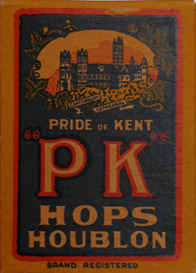
Hops boxThink homebrewing is difficult? Here’s a recipe for Cottage Beer:

“Good wheat bran 1 peck, water 10 gallons, hops 3 handfuls, molasses 2 quarts, yeast 2 tablespoonfuls; boil the bran and the hops in the water until both bran and hops sink to the bottom; then strain through a sieve, and when lukewarm put in the molasses and stir until assimilated; put in a cask and add the yeast; when fermentation ceases bung, and it is ready in 4 days. This is an excellent beer.”

Doesn’t look too hard, although I’m not vouching for the end result. The recipe comes from a book called Lee’s Priceless Recipes, which included “300 secrets from the home, farm, laboratory, workshop and every department of human endeavor.”

The book was published in 1912, and I expect that all the pages in Beverages section were stamped “NOT LEGAL TO MAKE” when Prohibition came into full force in 1919.

Not sure why Corn Coffee would have been illegal, other than it sounds disgusting. Cherry Cordial, Egg Wine and Peruvian Bitters I can understand.

As you can tell by the Cottage Beer recipe, most of these were kitchen-size batches. But the one for Home-Brewed Ale? That takes 8 bushels of malt, 12 pounds of hops and 5 quarts of yeast. It calls for straining the cooled wort through a flannel bag into a fermenting tub.

My point? That ingredients grown and processed specifically to use in beer make better beer. And better ingredients make it better still.

Pabst, Southampton deal announced

Exhibit A: At the recent Great American Beer Festival, Pabst Brewing Co. won four medals and Large Brewing Company of the Year. Southampton Publick House on Long Island won a silver medal for its Double White Ale and a bronze for its Saison.

Which do we think it cooler?

Exhibit B: Wednesday Pabst Brewing announced (you may have to give them your age, then click on “News” to read the press release) that it has entered into a strategic alliance with Southampton Bottling to market and distribute its award-winning line of craft-brewed ales and lagers.

Remember Exhibit A.

Farmhouse AlesI’m sorry, but beyond that I’m not prepared to connect the dots. I do know that this does not mean that Pabst will be brewing a saison. Anywhere. Anytime. Pabst doesn’t own a brewery. It has Pabst, Lone Star, Pearl, Ranier, Blatz, Schlitz and a raft of others brewed under contract.

So a little more from the press release:

– The agreement is expected to take effect by year’s end with shipments to commence in the second quarter of 2008.

– “Success in the craft industry today requires three key components: High quality beers, a strong distribution network, and excellent marketing capabilities. This alliance combines all of these necessary elements. We are excited and energized by the prospect of working with a partner whose standards for quality and excellence are consistently recognized as world-class,” said Kevin Kotecki, CEO of Pabst Brewing Company.

– “The opportunity to distribute Southampton products to a wider base of consumers is something we have been interested in for quite some time,” Southampton President Don Sullivan noted. “Pabst Brewing’s extensive sales and distribution network and its ability to provide superior marketing support ensures that our brands will have the ingredients for continued success.”

– As part of the agreement, Southampton brewmaster Phil Markowski will continue to oversee production of their beers. He will work closely with Pabst Brewing’s Robert Newman. Markowski is author of Farmhouse Ales (pictured above), and one of the country’s most respected brewers.

Anyway, this it is doubly intriguing to pair this news with the rumor I heard at the Great American Beer Festival that Pabst plans to re-launch Schlitz using a throwback recipe.
An ending to the ‘Dalmnation ad’ you won’t see

You can read more that you’d ever want about this commercial and the return of “Beer Wars” just about anywhere.

So I won’t comment.

But in case you missed it, AdvertisingAge reported this little gem:

According to attendees of a wholesalers’ meeting in Dallas today, A-B execs showed their sales force Miller’s ad – with a new ending.

In Lite’s version, the Dalmatian cruises off happily into the sunset in his new brand wheels; Bud’s version shows the Dalmatian defecating on a case of Miller Lite. Sadly, as it was intended for internal use only, none of us will ever see the spoof spot.

If you find out it’s made its way into public — and how can it not end up on YouTube? — be sure to let the rest of us know.

Book review: Beer & Philosophy

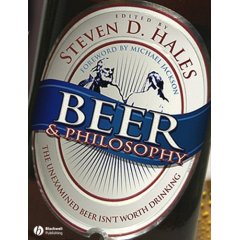
Beer & PhilosophyWould you trust a philosopher with your beer?

Is that in itself a philosophical question?

To tell the truth, even though I was careful to bite off portions of the book in small chunks, after reading Beer and Philosophy: The Unexamined Beer Isn’t Worth Drinking I’m not exactly sure about either. I seem to have reached philosophy overload.

Which is not to say I didn’t enjoy myself throughout.

This is a great collection for a book club to tackle. Read a chapter a week and discuss at the local pub. After after finishing this book the club could move onto to the other two in this “Epicurean Trilogy,” Food & Philosophy and Wine & Philosophy. I’d suggest discussions continue at the local pub rather than moving on to a wine bar.

And after that? Southpark & Philosophy and 24 & Philosophy should be out. Really. It seems publisher Wiley-Blackwell has quite a franchise going here.

Philosophers who have a certain affection for beer wrote most of the essays. There’s also Alan McLeod from A Good Beer Blog representing the blogosphere, as well as philosophical brewers Sam Calagione and Garrett Oliver.

The topics include many — quality, pricing, authenticity, etc. — that pop up here. Also some you don’t see in your basic beer blog. Such as an inspection of Immanuel Kant’s transcendental idealism through beer goggles.

I particularly liked editor Steven D. Hales contribution. He uses the philosophy of John Stuart Mill to examine this question: If you had $30 to spend on beer, would you be better off spending it on a single case of Pilsner Urquell or two cases of Miller Lite? Don Russell recently covered this in nice detail. Take a look and come back. Carefully consider Hale’s argument that quality is the density of pleasure. Could be a New Beer Rule.

And if you don’t have a book club to share thoughts with? Jeff Alworth has suggested this book will provide blogging fodder for quite a while. I have to agree.

Perhaps that’s what Michael Jackson was predicting in the foreword (a delightful surprise to find at the outset) when he wrote: “When I grow up, I want to be a philosopher.”

As Hales points out in his introduction it all comes down to Plato — degrees Plato or the guy who keeps popping up in this book.