Session #56 announced: ‘Thanks to the big boys’

The SessionReuben Gray has announced the topic for The Session #56. He’s calling it “Thanks to the big boys” and explains . . .

What I ‘m looking for is this. Most of us that write about beer do so with the small independent brewery in mind. Often it is along the lines of Micro brew = Good and Macro brew, anything brewed by the large multinationals is evil and should be destroyed. Well I don’t agree with that, though there may be some that are a little evil….

Anyway I want people to pick a large brewery or corporation that owns a lot of breweries. There are many to chose from. Give thanks to them for something they have done. Maybe they produce a beer you do actually like. Maybe they do great things for the cause of beer in general even if their beer is bland and tasteless but enjoyed by millions every day.

There is an alternative: “If you honestly have nothing good to say about a large brewer, then make something up. Some satire might be nice, It will be a Friday after all.”

October 7, as a matter of fact.

Book review: The ‘sideways’ view

Wine WarsIf I’m going to finish a book or magazine article (or blog post, for that matter) I expect the author to tell me something new or provoke me to consider something I thought I knew about in a different way.

(Of course it should be well written and focus on a topic that interests me. I sense I’ve read as much about Lady Gaga as I ever will, although I’m sure there’s plenty more that will amuse somebody else.)

I was reminded of this well into Mike Veseth’s Wine Wars when he wrote:

“Well, in wine tasting you learn that sometimes it can be helpful to tilt your glass at an angle and look at the edge of the wine. Sometimes this ‘sideways’ view provides information about the past and clues to the future. It’s time to take a sideways look at the future of wine.”

I was that far into the book (page 195) because Veseth takes a sideways look when discussing “The Curse of the Blue Nun, The Miracle of Two Buck Chuck, and the Revenge of the Terroirists” (the sub-title of the book and the three sections in which is it divided). The first two parts help understand what’s different about shopping for wine at Trader Joe’s and Costco, and that was enough to keep my attention. Veseth is an economist and that’s one of the reasons I subscribe to his blog feed.

(And maybe the history of Blue Nun is special because way back when a friend who knew much more about wine than I did at the time actually sent back a bottle of Blue Nun. Who the hell knows when a bottle of Blue Nun is “off”?)

I wish there were more books like this focused on beer. If you look at Amazon’s list of best selling beer books the “how to” theme is pretty apparent. (The same is true of wine, but those aren’t the books I read.)

That’s why I plan to break away from drinking beer long enough at the Great American Beer Festival to listen to the discussion of “The Evolution of Beer Scholarship” in the Brewers Studio Pavilion (scroll down).

The writing and editorial team of the newly published The Oxford Companion to Beer, will discuss the developing resources in beer education. Compared to a well-defined wine academia, beer education has always been pretty thin, but that’s changing fast. Discussing resources from oral tradition to iPhone apps, Editor-in-Chief, Garrett Oliver, will lead this conversation on the current demand for genuine information and scholarship on beer, and what’s been happening to meet that demand and make brewing studies deeper and more interesting than ever before.

If I don’t make it and you do please tell them you’re pretty sure there is a demand for more information about hops.

Ask for Zimmer 3: Hopfen

Zimmer 3: Hopfen

Fritz TauscherThe guest rooms at Brauerei und Gasthof zur Krone in Tettnang in the southwest of Germany are thoroughly modern, with hardwood floors, whitewashed walls and sleek amenities; yet properly spare. The building, on the other hand, has been around since before the last Montfort, Count Anton IV, lived here in the 18th century.

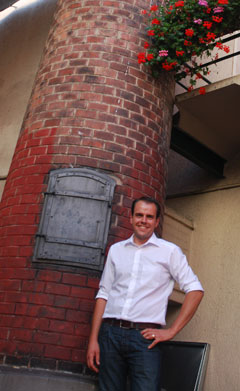
The Tauscher family bought the brewery, which sits directly behind the hotel, in 1847 and Fritz Tauscher (right) is a seventh generation brewer. The Kronen-Brauerei is the last of 26 breweries that used to operate in Tettnang. It produces about 6,000 hectoliters (something more than 5,000 barrels) a year, about 60 percent of that sold in bottles labeled “Tettnanger.”

Tauscher is one of nine brewers in a group they call “Brauer mit Leib and Seele” (Brewers with body and soul). “All are owners of breweries in the hands of the their families,” he explained. “The beers are brewed with our hands.”

Tradition obviously matters, but Tauscher talks as much about the importance of quality. He buys his hops directly from two nearby farms, one organic and the other not. He uses only cones, storing the bales in one of four lagering rooms eight to nine meters below the brewery yard. He begins fermentation of his lagers between 8° C and 9° C (other breweries might start higher to speed the process). He lagers his beers for six to eight weeks (Berliner Kindl Pils lagers for two weeks). He uses less efficient (smaller and horizontal) tanks because he can taste the difference.

Tauscher attended the Craft Brewers Conference in San Francisco last spring. He drank plenty of new wave American beers, packed with alcohol and aromatic hops. He’s not just being polite when he talks about how much he enjoyed them.

“I can imagine I will brew one or two beers with those (sort of) hops,” said Tauscher, who is 31 years old. “But not yet. The German beer drinkers are not ready for the explosion of flavors.”

Tauscher adds only Tettnang Tettnanger hops to the beers he sells (he recently brewed a special batch for hop growers that included four additions of Tettnanger and then Saphir at the finish). Tettanger has served perfectly well for special celebration beers, such as for Tettnang’s 700th anniversary party and the brewery’s 150th anniversary (a “fresh hop” beer in 1997).

When Tauscher does begin using other varieties they will still be from Tettnang. Tettnang farmers also grow Hallertau Mittelfrüh and Tradition, Perle, Saphir and Herkules, and there will be others. One might well be a variation on Tettnanger. The German hop research center at Hüll this year began a project in partnership with the Tettnang Hop Growers Association and Baden-Württemberg Ministry of Rural Development to breed a new variety with Tettnang Tettnanger as the mother. If a new hop results it will still be 10 years before it’s ready for brewers to use.

At Brauerei und Gasthof zur Krone that doesn’t seem like such a long time. It sits in the center of town, on a square that will be overflowing for a band concert on a Wednesday evening in summer. Although the town may be best known for hops its population is growing because of high tech businesses and tourism. Old world and new world coexist comfortably.

The hotel serves tourists and business travelers equally well. Each room has its own name — thus Bierbrauer, Bärenpltaz and Brau Wasser as well as Hopfen — decorated to that theme.

You can probably guess which one I stayed in.
Session #55: When bits of paper come with memories

Curtis at HopHeadSaid hosts The Session #55, asking contributors to to write about “fabulous world of beer art found on coasters, labels and caps.” This is my contribution. Check out what everybody else has to say in his roundup.

The liquid is gone. Bits of paper and vivid memories remain.

As much affection as I have for table tent from Bell’s Brewery that reads “Pierces your tongue without the nasty metal taste” and sits on a bookcase in the corner it doesn’t soothe my soul like the coaster pictured below. Make no mistake, we love Bell’s beers and during our grand adventure they let us camp in the brewery parking lot. But the table tents (the other reads, “Not tested on animals. Probably because we get so many volunteers.) are not connected to a specific memory.

Where in the beer world?

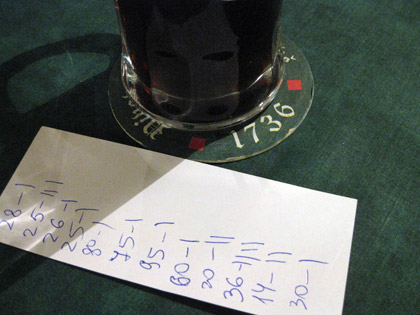
This one is. The photo first appeared “Where in the Beer World?” nearly three years ago, and you’ll find the basic story there. It was taken during a memorable evening with Evan Rail that included several stops. This was the special one, and we might have lingered longer. However, when the conversation in Russian behind us started to get louder Evan suggested it was time to move on. “I think they might be in the mob,” he said.

Anyway, we’ve still got the coaster.

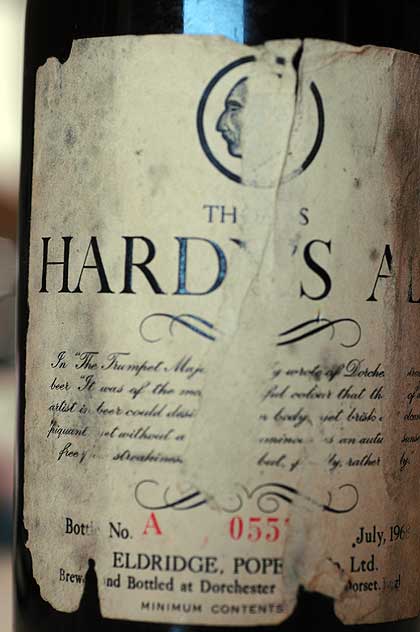
We don’t really collect coasters. We grab them along the way, toss them in a drawer, use them, weed them out from time to time. It would be even more dangerous to collect bottles (and the labels), so the rule is “new one in, old one out.” The only permanent fixture is the empty bottle of Thomas Hardy’s Ale from 1968.

1968 Thomas Hardy's label

I wrote about opening the bottle here and here. It was produced at the Eldridge Pope Brewery, which is connected to still more memories for us.

The SessionI’ve already taken a look at the roundup (growing as I write) and some of the artwork is wonderful.

For instance, the new labels Left Hand Brewing introduced in 2010 are flat out stunning. But we’re not ready to throw out our old-style Left Hand coaster. Got it at Mike O’Shay’s Restaurant in Longmont.

But that’s another story.