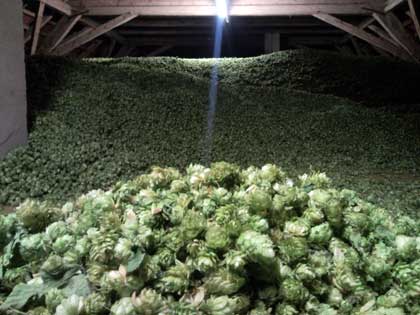
These hops will be headed from Germany to St. Louis soon enough, although not in this form. More about that below.
Last month Tony Redsell, who is now in the midst of his 63rd hop harvest, interrupted our conversation to answer a phone call. He patiently and quickly explained the basics of hop harvest, both past and present. “We’re coming to the silly season,” he explained after he hung up. “Every editor thinks, let’s have an article on hops. ‘Hopping down in Kent.'”
Redsell is one of England’s best and best known hop farmers, although hops cover just 200 of the 3,000 acres that make up his various farms in Kent, southeast of London. “I’m not known internationally for my cherries,” he said, laughing. He might have added they are consider some of the best in Kent, also known at “The Garden of England.”
Not everybody agrees how romantic it was for Londoners to “hop on down to Kent” each year to live in huts and pick hops until their hands were black with resin. But it makes a nice story and hops are a great visual, including video.
It makes me realize “Romancing the Hop” might make an even better title for a book than “For the Love of Hops.” My Twitter feed is littered with news about harvest (or “fresh hop” or “wet hop”) beers right now – like this. And the stories aren’t just out of traditional hop growing areas. Jeff Alworth did a nice job of summarizing several yesterday. Throw San Diego to the mix, then consider Jeff’s conclusions.
It’s great fun and exciting. Those hops at the top will be pelletized before they are shipped to St. Louis, but freshly cut (thus “wet”) hops will soon by on the way from Yakima. Next week brewers in several small St. Louis brewers will toss them into kettles, producing beers for the Fresh Hop Beer Festival Oct. 22 at Schlafly Bottleworks in Maplewood.
Just to be clear, I marked the date on our calendar more than two months ago. We plan to be there, but I’m just as excited about finding out what the Urban Chestnut Brewing beers made with Hallertau Mittelfrüh hops from the Seitz farm outside of Wolnzach taste like.
Before winemakers co-opted the word terroir it meant something more general. Grand dictionnaire universel du XIXe siècle, Pierre Larousse’s nineteenth-century French dictionary, defines terroir as “the earth considered from the point of view of agriculture.” It describes le goût de terroir as “the flavor or odor of certain locales that are given to its products, particularly with wine.”
 Not a month ago Florian Seitz led me up hills and under hop trellises on his family’s farm. His great grandfather first planted hops on it in 1869, and it was a farm even before that. As well as hops they grow corn, wheat and other cash crops, and trees (some become chips, others wood for logs). Florian took over the farm in 2008, but his father still walks the fields regularly and takes charge of drying the hops during harvest.
I’d be a liar if I suggested that in a blind tasting I could say, “This Mittelfrüh came from land I walked on and that one didn’t.” (Heck, Redsell’s East Kent Goldings regularly medal in the Annual Hop Awards and he’ll admit he can’t always tell the difference between his Goldings and those of a neighbor.) But to me it makes a difference that I walked through the hop yards and that the wood beams in the drying barn were hand-crafted in 1904.
I first met Seitz last March in St. Louis. Representatives of the association of German Hop Growers visited Urban Chestnut Brewing after attending the Craft Brewers Conference in San Francisco, Seitz included. It was a good excuse for UCB to throw its first festival, called Hopfenfest. At the time, UCB co-founder and brewer Florian Kuplent contracted to buy Mittelfrüh from Seitz.
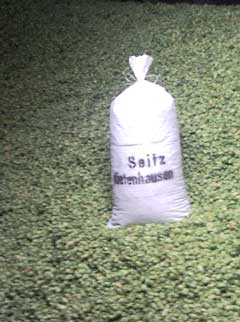
Most of those will arrive as pellets, but Seitz is also be shipping a relatively small bale of cones (second photo). “As a grower you are proud when you see what happens with your hops, when the product made from your product is good,” Seitz said.
“For the brewers it is good to see where your products are grown,” he said.
Likewise for us drinkers.
————
Thanks to Florian Seitz for sending the fresh photos.
 Reuben Gray has announced the topic for The Session #56. He’s calling it