In case you missed this, this, and this.
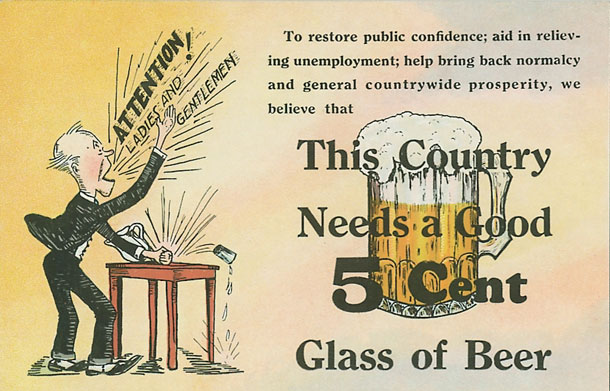
a) This story about Narragansett’s “moment in the sun” may or may not end up in next Monday’s beer links, and b) Try as I may I couldn’t condense the quote to 140 characters and do it justice, so here it is in full.
But these days, there’s little that’s authentically Maryland about Natty Boh, a beer brewed in North Carolina under contract to a multinational corporation based in Los Angeles with a Texas post office box as its address.
Got a better one?
When you begin forgetting about your history is when you're at highest risk of selling it out. That's today's "craft" beer observation.
— Roger A. Baylor (@newalbanian) September 29, 2015
Elysian, Anheuser-Busch, and the Fight for the Soul of Seattle’s Beer.
A profile of Dick Cantwell. “He was the sole nay vote in Elysian Brewing’s sale to Anheuser-Busch. Now the brewer’s legacy is at the center of the battle for the soul of Seattle beer.” Drop it in Pocket, take the time to enjoy it. [Via SeattleMet]
‘What Beer Costs’ — Why we need more flexibility in the market.
It looks to me as if there is a fair amount of flexibility in the market as is, but I don’t see the point of people complaining about the price of any particular beer. As Stephen Beaumont pointed out one of the times this debate popped up years ago there are people out there willing to pay these high-end prices. That’s the bottom line. [Via Good Beer Hunting]
How Brewers Are Churning Out Inexpensive Tangy Sours.
Beware the kettle sour beer.
We begin the sour portion of these links with two views of kettle souring. People get really worked up about this. [Via Denver Post and OBP]
Why Brew Gose Instead of Mild?
During the GABF awards ceremony a week again Saturday Jonathan Cutler from Piece Brewery in Chicago leaned back after he saw that there were 111 entries in the German-style sour ale category and said, “There were about a dozen when I judged them a few years ago.” In fact, there were only 13 entries in 2009. This reflects more interest in brewing Berliner Weiss as well as Gose. [Via Boak & Bailey]
Power Of Sour: How Tart Is Reclaiming Turf From Sweet.
How wild is your beer?
Two more parts to the story of “wild and sour.” Food and what does it mean to call a beer wild? (The second story links back to the NPR one, bringing us full circle – pretty impressive, right?) [Via NPR and All About Beer]
Dear Guinness: Here’s How Not to Debut Your Crappy New Guinness Nitro IPA.
Brilliant. [Via fooboz, h/T Stephen Beaumont]
The story behind first Alabama beer to win a Great American Beer Festival medal in 5 years.
Somewhere Fred Eckhardt is smiling. [Via AL.com]
2 Beers 2 Pops – Kids are drinking in Germany.
“Finally, I awakened to this surreal experience going on next to me. The oldest youngster had a beer in front of her bigger than mine, or so it seemed. She looked like she was 14, 15? I have no idea but she was clearly not 21. Kids can drink beer as early as 16 in Germany – and this is the basis for my story.” [Via SommBeer, h/t Joe Stange]
Whalez Bro: A big problem for beer geek culture.
“You will never learn more about beer if you treat it as an item to be collected, rather than a beverage to be enjoyed.” [Via The Portland Phoenix]
Great American Beer Festival versus BeerGraphs.
I’ll cut right to the question in the conclusion: “As much as these are well-respected judges with well-trained taste buds, they come with a much smaller sample than the statistics on our leaderboards. They move faster and can tell you something in a smaller sample, but once you get thousands of people to weigh in on a beer… would you still take the opinion of a small group of judges over thousands of ratings?” But I really like this in the comments: “This is like comparing a baseball players WAR to his fantasy value.” Definitely written from deep in the rabbit hole looking up. [Via BeerGraphs]
Beer as an agent of change.
“It takes bricks and people to build a neighborhood, but don’t forget to bring along the beer.” [Via Joe Sixpack]
And a new game that can be played in the US as well as the UK …
Sold murky beer? Call it out on social media with #murkshaming, says guest blogger Quinno http://t.co/Or6tsFBsiB pic.twitter.com/rFo6VVh4Mf
— JJB (@jeffreyjohnbell) October 3, 2015
 Alan McLeod has posted the roundup for The Session #104 with a headline that asks “Eulogy Or Revival?”
Lots of nice words in there and it would appear the answer to the question is b) Revival. If you flip on over to the lineup of Sessions past and Sessions future you’ll see five volunteers have stepped up to host, suggesting that we’ll all have something to do the first Friday of each month if we want.
So I think what Alan wrote at the end is appropriate.
It doesn’t demand everyone post every month – even though I have. It doesn’t even demand that everyone reads every post. It doesn’t demand anything in fact. It just keeps rolling along, noticing the flow of ideas, tracing the track of a discourse organically. I like it. I hope it continues. It it doesn’t continue I might continue it anyway. It’s not like anyone can turn it off. And it’s not like beer blogging was ever popular or was ever going to be. Remember: no one ever promised that being popular was going to be part of thinking about beer more than the next guy and then writing openly about it … for free.
I look forward to seeing what everybody brings to the conversation Nov. 6.
Alan McLeod has stepped in at the last moment to host the 104th gathering of The Session. And he expects an answer to this question: If we just “take the philosophical approach, that the Session has run its course”* aren’t we really admitting that beer blogging is a massive failure?
* That’s me being quoted.
I think the answer is no. Obviously, or I wouldn’t compile a weekly list of links to good reading (not all are blogs, of course). Or otherwise post here.
When I suggested to a group of bloggers, including Alan, that The Session might be fun I wasn’t thinking a year down the road, let alone eight-plus. If it lives on (I voted yes in the poll Jay Brooks posted) I will continue to participate, and volunteered to play host again. But if it goes away beer blogging is no less successful than it was last month.
I don’t know how “success” should be defined in this matter. But for starters, the blogging platform has made a bunch of people more aware of the work of Ron Pattinson and Martyn Cornell. That in turn has raised the bar for writing accurately about beer history. However that’s blogging, not The Session.
If this is part of a wake, as was suggested somewhere (but I lost the link), then here’s a pleasant memory. It is the first entry from the roundup of the first Session.
Young’s Oatmeal Stout
a head tall and firm
like whole wheat pancake batter
atop darkest stout
Oak Aged Yeti Imperial Stout
the old Yeti howls
as he breaks from his oak cage
and threatens to bite
Beer Haiku Daily ceased publishing March 9, 2013, and ceased to be daily before that. It was not a failure.