A story about sales of lager beer in St. Louis ending for the year in September of 1854 was repeated in numerous newspapers, and later in a variety of books. It was a reminder that at the time lager beer was seasonal and it also served as a benchmark when measuring future lager sales, including in comparison to what was referred to as common beer.
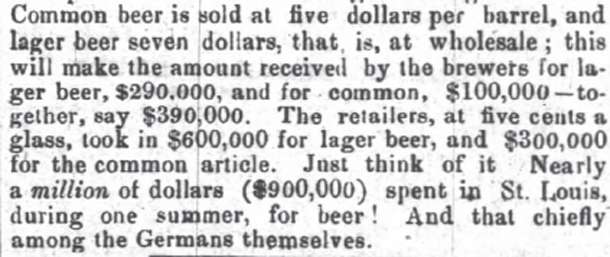
The other day I found the original story in the Daily Missouri Republican, and although it doesn’t include any facts not otherwise reported it does add wonderful context. It seems that back before there were imperial stouts brewed under a full moon and aged along with the cremated remains of John Wayne in the wagon he drove in Stagecoach to stand in line for there were, well, lagers.
So here’s the report:
“‘The last days of Pompeii’ is a romance of Belwer [Edward Bulwer-Lytton], known to the world; but ‘the last days of Lager Beer in St. Louis,’ is a romance yet to be written. We certainly will not pretend to write it, for we claim no merit as a novelist; but we will give facts, plain facts, and if any one feels interest enough in them to use them for a theme of romantic literature, we most cordially allow him the privilege of doing so.
“With last Sunday, September 17th, the last drop of Lager Beer in St. Louis went down to – posterity. It was, and is no more. During the past extremely hot summer, it must have been some sort of gratification to our German population to have resorted to a good glass of Lager Beer, and freely did they make use of it. At places where, as we are told, the best of that article was kept, scarcely enough hands could be procured to serve the daily increasing number of consumers. But the extraordinary demand, occasioned by the extraordinary heat, soon exhausted the supply. One house after the other announced to its customers, that next day ‘the last barrel of Lager Beer’ would be tapped. This direful news brought grief unto many, and not a few were this person: stopped at street corners by inquisitive friend, with the often-repeated query ‘Where is good Lager Beer yet to be had?’ At last, two places only remained where the needful could be got – one, a spacious bar room, was the Mecca, during the day; the other, being a garden, in the evening. But days hurried on. The demand, having been concentrated to these two places, was too great for their supply, and finally, the bar room gave out. Matter now seemed to wear a gloomy appearance. ‘Mr. K. has shut his house,’ was sad tiding indeed. However, the consolation remained. The delicious fluid could yet be obtained at the garden, as so it went on for a few days. But, alas, only for a few days. One fine morning, as a social company were gathered under the beautiful acacia trees in that garden, the otherwise very kind and affable host, with one glass full of Lager Beer, in his left ‘fist,’ advanced toward the company, and handing, it to one of them, pronounced it to be positively, ‘the last drop of our last barrel!’ Great consternation followed this announcement, because it then became evident that the days of Lager Beer in St. Louis for this summer were numbered. But soon a report was spread, that a certain Mr. G. had two kegs of needful yet left for his particular friends. It did not take long for that report to make the round of the particular friends of this benevolent gentleman, numerous as they are, but it embraced even foes, and the two kegs had only a bare existence, for soon after they were tapped a deep, hollow sound, in answer to a nick at the bottom, gave satisfactory evidence that they were empty.
“In the afternoon of that very same day it was discovered – how we cannot tell – that at a certain brewery downtown, a few barrels were still left to satisfy the wishes of our German community; and, in pursuance of this information, a perfect migration of our German citizens took place to the popular spot. But there, as we are informed, the Lager Beer is also gone ! and so we have recorded ‘the last days of Lager Beer in St. Louis.'”
 Host Mark Ciocco has announced the theme for The Session #105 will be