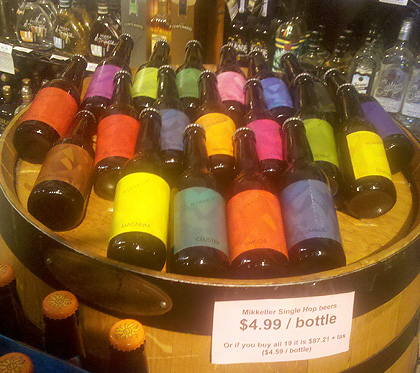
Think you know where in the beer world this photo was taken?
Please leave your answer as a comment.
Mine would be that as long as Mikkeller was going to make 19 single hop beers why not go for 24 and assemble an entire case?
Think you know where in the beer world this photo was taken?
Please leave your answer as a comment.
Mine would be that as long as Mikkeller was going to make 19 single hop beers why not go for 24 and assemble an entire case?
Here’ the scientific study.
Here’s the key finding:
Water consumption had no effect on human attractiveness to An. gambiae mosquitoes, but beer consumption increased volunteer attractiveness. Body odours of volunteers who consumed beer increased mosquito activation (proportion of mosquitoes engaging in take-off and up-wind flight) and orientation (proportion of mosquitoes flying towards volunteers’ odours). The level of exhaled carbon dioxide and body temperature had no effect on human attractiveness to mosquitoes. Despite individual volunteer variation, beer consumption consistently increased attractiveness to mosquitoes.
No, seriously. Because “these results suggest that beer consumption is a risk factor for malaria and needs to be integrated into public health policies for the design of control measures.”
But moving on to a bit of whimsy. What if mosquitoes have some form of quick communication, à la Twitter? You think one might buzz his or her fellow biting buddies that “the one is the red shirt is balanced toward malt” or the “arms of the one nearest the beer cooler taste of citrus and pine”?
And, from a public health standpoint, wouldn’t it be good to know of mosquitoes prefer hoppy beer drinkers, extreme beer drinkers . . .
Eldorado makes at least one.
 Some people will actually tell you they hate New Belgium Fat Tire Amber Ale. It’s complicated, and I really just want to pass along a few numbers, so I’ll simply says it seems silly to me, but it’s their energy.
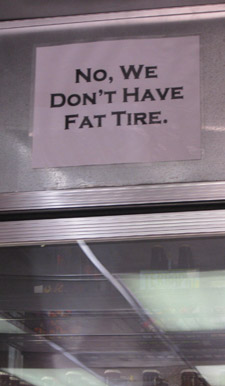
Fact is that as New Belgium drives deeper into the East Coast this year it will be Fat Tire drinkers ask for first. (Witness this photo taken in South Carolina before New Belgium entered the state. The owners posted the sign in self defense.)
Some interesting figures emerged last week in the run up to the brewery’s twentieth anniversary on Tuesday. Although overall production increased 13% last year, to 661,000 31-gallon barrels, Fat Tire sales grew only 2%.
According to Impact Databank, Fat Tire accounted for 70% of New Belgium sales in 2008, 67% in 2009 and 60% in 2010. The biggest change last year was the introduction of Ranger IPA. New Belgium sold more than 50,000 barrels in 2010, 8% of production, more Ranger IPA than its well known neighbor, Odell Brewing, made in total.
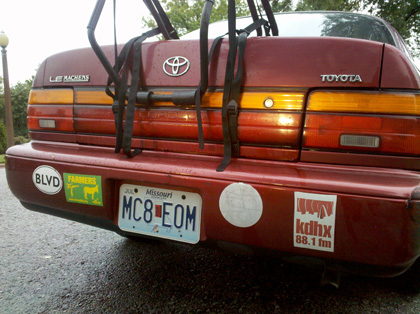
Last Saturday after I parked the car and before Sierra and I went foraging at the Tower Grove Farmers’ Market we came across the car pictured above. The bumper stickers represent Boulevard Brewing, Farm Aid and KDHX, an independent radio station that play Chris Knight as often as he pops up on my Chris Knight Pandora station. (Yes, there is another, but it is faded beyond my recognition.)
I told Sierra, “I think we’re in the right spot.”
Moving to a new city is different that visiting a new city every few days, as we did in 2008 and 2009. Then when we needed propane, for instance, we didn’t do much comparing and contrasting. We found a spot, we filled up, we headed down the road. Now I want a handy place to refill my tank (for grilling and brewing), one that charges a fair price (found it, thank you).
 The beer part is pretty easy. I was following STLHops and Evan Benn’s Hip Hops column even before we knew we’d be moving back to the Midwest. Between the reconnaissance Daria did, the dining and drinking stops we made when Sierra and I visited and the St. Louis Brewers Heritage Festival (the week after we arrived) we’re feeling almost “caught up.”
Almost, because my St. Louis list on Twitter includes daily announcements of beers hitting town, new local releases, special events. And, like everybody else, we’re braced for the next wave.
Ultimately, though, my goal isn’t to find the best farmer’s market or Italian restaurant on The Hill or food truck any more than I worry any more about the “perfect pint.” I’m in the right place if I’m in a good place for me. And, just as when I was a sportswriter and somehow always ended up at the high school gym without asking directions, finding good places for beer is one of my few natural talents.
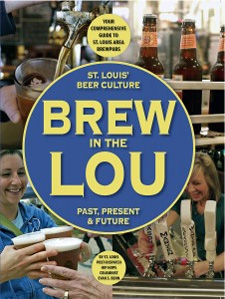
Two books that recently landed on my desk — “Brew in the Lou” St. Louis’ Beer Culture, Past, Present, Future and Brewed Awakening: Behind the Beers and Brewers Leading the World’s Craft Brewing Revolution — were not written with me in mind, but for those still navigating the noise generated by so much new in beer. To help drinkers find the right place, or perhaps be reassured they actually have.
Brewed Awakening isn’t due until November, so I’ll write about it later. Brew in the Lou is about where we live now. But why, other than the amazing picture of Stephen Hale on Page 32, is it worth my time? I’d want this book for my library if we still lived in New Mexico because Evan Benn looks at beer and beer “in the Lou” through a new set of eyes. This is interesting to those reading from afar but even more useful for those intrigued or overwhelmed, or perhaps landing somewhere between, by the new.
A couple a national publications recently carried stories about the outbreak of new breweries in and near the city, new specialty beer focused bars, and growing attention to beer in “better” restaurants. They suggest a cause and effect between InBev taking over Anheuser-Busch (i.e. A-B is no longer “locally owned”) and more interest in beer that isn’t called Bud. Perhaps, but I’m pretty sure what’s now obvious was already underway. Either way, Benn began working for the Post-Dispatch in 2009, after the sale, and wasn’t yet much of a “beer guy.”
Thus the fresh eyes. He’s a journalist — he decided he wanted to work for newspapers when he was in middle school; I didn’t know such people still existed, bless his heart — and he found a story that tracks from the mid-nineteenth century to probably somewhere in the middle of this one and makes sense. In the introduction he writes, “My goal: To tell the tale of beer’s past, present and future in the Gateway City, with an eye toward how we got to where we are today, and where we’re going tomorrow.” Last weekend 55 people showed up for a sold out brewpub tour he guided through St. Louis. That’s a pretty good crowd, so somebody’s listening.
Physically, the book reminds me of the guides from Cogan & Mater (Tim Webb’s brainchild), for instance Around Brussels in 80 Beers. It’s full of lush photos that look particularly nice printed on heavy, glossy stock. Unlike the C&G books or the Stackpole state breweries guides that began with Lew Bryson’s Pennsylvania Breweries this does not appear to be the beginning of a franchise. It’s a local production. But it sure seems like something similar in Chicago or Austin or Denver would help locals or tourists find just the right place.