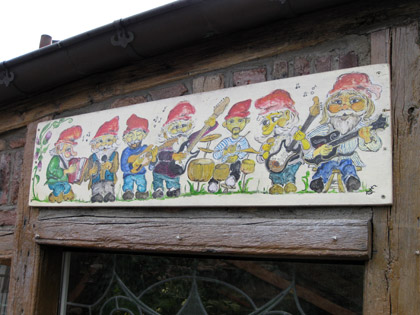
File this postcard under “beer nightmares.”

File this postcard under “beer nightmares.”
In a few weeks, the Brewery History Society will honor Peter Mathias, author of The Brewing Industry in England, 1700-1830, making him its first Honorary Life Member.
You, like I, probably won’t be in London April 19-21 for the society’s annual meeting and surrounding events, but you should wish you were. The schedule is here. The official meeting is at Fuller’s Brewery, which is cool enough in itself. But the following day there’s the “North Kent Meander.” Beer meandering. The best kind.
The news for those you can’t be there is that a special issue of Brewery History, the society’s journal, will include a reproduction in full of Mathias’s The Anchor Brewery: Park Street, Southwark. Written in 1953, this was unpublished until now.
Ken Thomas, curator of the Courage archives, explains in the introduction why the work goes beyond simply telling the story about another brewery. He writes, “although ‘The Anchor Brewery’ is important as it opens a window on the early stages of the study of business history, it is also much more than that. It tells the story of the rise of one of England’s largest breweries against the backdrop of the industrial revolution.”
The society website has information about subscribing to the journal or ordering the special issue.
Sometimes beer and blogging mix and sometimes they don’t. This past weekend I was way too busy at the Bluebonnet Brew-Off in Dallas to write deer diary notes on Twitter, let alone blog. And that’s a good thing.
I’m not sure that you’d say an easy way to get a treasured stein from Bluebonnet is to make the keynote speech and return the next morning with a technical presentation, but it somehow seems easier than winning one. The Bluebonnet had 1,805 entries this year. Steins go to first place winners. You need to brew a really good beer and be equally lucky to win one of these.
The Bluebonnet is, in fact, the biggest one-site homebrew competition anywhere, but really bigger than that. Texas big, for sure. Something like 800 people attended the Friday night tastings (commercial beers, followed by the “room crawl,” some not so good homebrews and many you’d be happy to find packaged it your local beer store). They needed five large buses for the Saturday afternoon pub crawl.
I’m back in the air tomorrow, so it will likely be a while before I can mentally organize some thoughts about homebrewers, or really the culture surrounding homebrewing, and to steal an idea from my friend Evan Rail, why they matter.
Earlier this month Lew Bryson mentioned skepticism about “the vaunted impact of homebrewers on American craft brewing.” Alan McLeod ran with it a bit, and Lew added some clarification.
I don’t disagree that some homebrewers occasionally get carried away, about almost anything and everything, and sometimes not always in a charming way. But the view from here, imperfect as it may be, is that homebrewers are an essential part of the evolving beer culture, changing beer landscape (tectonic plates and all), however you want to characterize what’s going on.
More on this . . . eventually. Please be civil with comments, since my ability to participate will be limited.
Damn you, Eric Asimov. My plan was to follow the lead of Jeff Alworth and avoid posting the rest of the week, but sometimes words are written that demand conversation. Today in his blog and in a story (well, the story would be tomorrow if you prefer newsprint) Asimov writes about the 1982 vintage in Bordeaux.
I care not about that vintage. Actually, I’d love to taste those wines, but ain’t happening, so we can move on. Instead, notice the point he makes about how the wine world changed in 1982. “It’s a clear dividing line between the end of the old way of making and thinking about wine, and a new way that, for better or worse, defines our current age,” he writes. And there’s more.
If you could transport yourself back to 1982, you’d find a much more constrained world, where great wine meant Bordeaux and Burgundy, with perhaps some Champagne thrown in. The Rhône? In a great shop you might find Rhônes in a section marked “country wines.” Italy? Straw bottles of chianti, perhaps some dusty bottles of Barolo and a lot of awful Lambruscos and Soaves. California? Just moving out of the jug wine era into the age of white zinfandel.
Except for the great names, wine was still largely a local business. As had been true for centuries, most of the different wines of the world would be sold within 100 miles of where they had been made.
Beer was a local product in 1982 and it was not. Heck, by 1882 in the United States local was in trouble.
So was there a year that changed beer?
On second thought, maybe this is a local question. Perhaps there was a year that changed beer globally, but as likely different years in the UK, in Bavaria, in Bohemia, in the north of Germany, in Flanders, in . . .
I’m leaning toward 1918 myself.
How can you not love a story that includes a sentence like this?
The second-generation Vietnamese-American became interested in Belgian ales while studying for his doctorate in theology in Scotland.
It gets harder when the very next sentence goes astray.
Belgian beers often have a distinctive sweet flavor profile that sets them apart from beers brewed elsewhere, and are intended to be consumed with food to aid as a digestive.
There’s a difference between between a beer being “digestible” a term I’ve heard several Belgian brewers use and a digestive, because well-attenuated beers, often dry, are not sweet. Conceding to myself I can be a little anal about these facts, I read on. Until . . .
European monks traditionally brewed beer or other liquor to sustain them during their lengthy devotionals.
Not exactly. Monks live by the rule of Saint Benedict, written about A.D. 530. It calls on monks to be self-sufficient through their own labor. It also requires them to offer hospitality to travelers, making production of beer essential when water was unsafe to drink. Monastery breweries pre-date the rule of Charlemagne (742-814), and led the way when large-scale production of beer in Europe began. Monks consumed most of the beer themselves, but eventually sold a portion to members of the surrounding community. Their beers likely tasted much like those made in homes, where the bulk of brewing still took place, and not at all like today. What eventually set them apart was the scale and method of production, and their practices served as a model for commercial breweries.
As well as sustaining themselves, modern Trappists contribute to multiple charities and to local economies. For instance, Chimay, with 150 employees in its brewery and cheese making facility, is one of the largest employers in one of Belgium’s poorest regions. Westvleteren sells its beer in wooden crates manufactured in a “shielded workplace” for those not able to in a mainstream environment.
So that’s why I quit reading. However, I remain charmed by that one sentence, a reminder that beer is multi-cultural.