I commented, on Twitter, about the length of lines to get into the Great American Beer Festival last week, in front of a few brewery booths at the festival, and outside of Falling Rock Taphouse.1 Most responses, both in public and via privates messages, suggested they were “suckers” (that one is a direct quote).
And I didn’t even mention the lines for cheese (that’s the zigzagging one below, just minutes after the Friday session began, and before it got much longer), that people stood in to get their pictures taken, or for the restrooms.
So I typed the headline for this post Saturday afternoon and started thinking about answering the question. As a matter of fact, I did stand in line for a Cigar City beer, a line that was more than 50 deep when we stepped to the rear (I never saw it shorter during three sessions). And I had the Cucumber Saison, which happens to be extraordinary. I was in goof off mode toward the end of the Thursday session, shooting the breeze with a friend who has a crush on the Cigar City beers.
We still had maybe 20 people in front of us — the line moved quickly — when brewmaster Wayne Wambles strolled by, pouring everybody in line a proper ounce of Oktoberfest. That made things go even quicker. We talked. Wayne said to get the saison. I did.
Sometimes standing in line works out rather well.
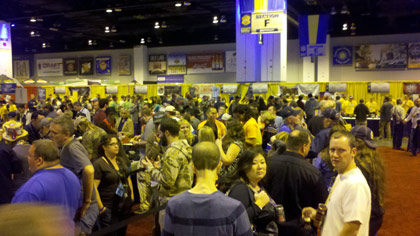
It certainly seemed to suit plenty of people in Denver. That’s a complete thought, but should you want to venture on please take a few minutes to read A 10 Point Plan To Improve The GABF or A Few Thoughts On GABF 2012 from Andy Crouch. He raises reasonable concerns and makes solid suggestions, although if you read through the comments, including mine, you’ll see not everybody had the same experiences.
His headline might lead readers to believe that the GABF is somehow “broken.” In fact, commenter Bill writes, “I believe the GABF has outlived its usefulness.” That simply is not true. An important word to notice in the name of the event is festival. The first time we attended the New Orleans Jazz and Heritage Festival in 1990 we fell into conversations with regulars in which they lamented how much more crowded it had become in the last five years. He nodded knowingly, at the same time thinking, “This is great. What is there to complain about?” And five years later we were the ones telling newcomers how much it had changed since 1990.
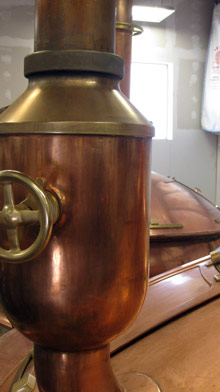 Were I to visit a beer psychologist she’d likely diagnose me as a beer schizophrenic. I’m perfectly happy to sit on a bench at a long table at Prost, Denver’s rather new brewery/beer hall, paying just a bit of attention to what’s in my maß and catching up with a friend I haven’t seen in 10 years (that was Thursday afternoon, and the photo is one of several I shot geeking about in the beautiful brewhouse). But I also take joy in learning rather specifically about some beers, their ingredients, the way they are made.
I was quite pleased that the program for the Hood River Hops Festival reported what hops were in the beers, and further delighted when laminated sheets on the tables provided still more information. But I would like know even more, like when the hops were picked in relationship to the ideal2 harvest date — a day or two before, right on the date, a week later? There’s every chance I’m not normal.
So, yes, I like it when there is somebody around who can answer a question or two about the beer I’m drinking. I’ll settle for laminated sheets on the table, particularly when a brewer is painfully busy. I’ll declare the GABF phone app finally useful when that’s included.
That would improve my personal GABF experience. I type this while admitting that I don’t stand in that many lines. A media pass allows me to step behind the tables and talk with brewers (if they are there, of course).
Meanwhile, I don’t give a hoot about karaoke or the silent disco or learning to be a beer judge or a variety of other things that interrupt tasting and talking about beer. But, know what? I ran into lots of people who do. It’s a festival, a mini-vacation for those who set aside the date on a regular basis and travel from some distance. They stand in long lines and track down the most esoteric beers. They visit breweries in the surrounding region and stay out late at night drinking with friends they don’t see all that often. They go Estes Park to see the elk. And they love the silent disco.
What I saw at GABF were a lot of happy customers. Most were with friends. Most were feeling festive. A few perhaps a bit too festive.
So to return to the question at the top. It’s a silly question, whimsical if you will.
But there are worse things than standing in line and having Wayne Wambles show up with a pitcher of beer. Even if he does pour you only an ounce.
*****
1 Falling Rock seemed to have a line no matter what time of day. On Thursday evening, the crew from Sun King Brewing showed up about 10:30 to pour beer at a special event. The guy at the door stopped them, and not until Falling Rock owner Chris Black came out to assist them were they allowed in.
2 Farmers measure dry matter to determine the optimal date for harvest, but recently both growers and brewers have begun to question just what is “optimal.”