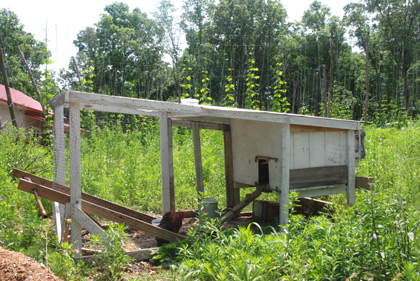
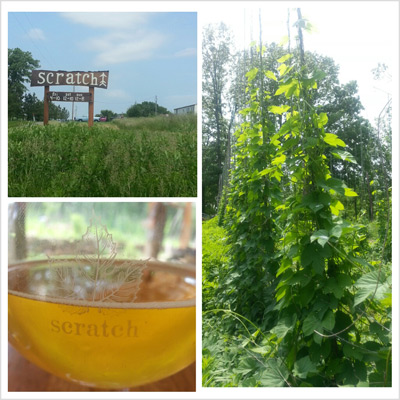
Think you know where in the beer world this photo was taken?
As always, please leave your answer as a comment.
OK, a hint: That’s a rooster in the coop in the foreground.
Added May 29, after Matt correctly identified Scratch Brewing.
They are open Friday through Sunday, and post an updated beer list each week. Many, heck most, of the beers are made with unusual ingredients. But there’s every chance you’ll walk out thinking something like, “Nothing quite like dandelions done right.”
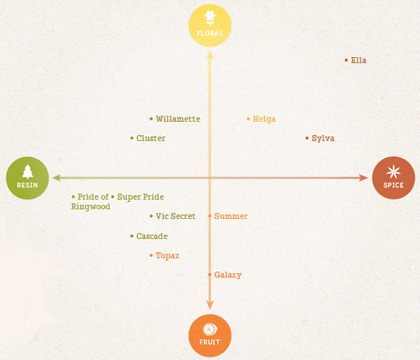
HPA (previously known as Hop Products Australia) has unveiled another way to look at hop flavor (or flavour in Australian), which of course includes aroma: the Hop Flavour Spectrum.
The emphasis is on the end result, that is a drinker’s sensory experience.
It’s not an exact science. This Hop Flavour Spectrum is not based on data generated from a comparative tasting of experimental beers, nor is it based on analytical and technical descriptions, the hops chemical profile or growing conditions.
It comes from our experience. In our view we have found chemical analysis alone provides limited understanding or direction of how the hop will impact beer flavour. How and when hops are used in the brewing process ultimately impacts on the dominant flavour profile.
Read that again. It’s not an exact science. That’s a good thing. How and when hops are used in the brewing process ultimately impacts on the dominant flavour profile. Definitely.
No surprise, the chart features hops grown in Australia, including the currently fashionable variety Galaxy. I particularly like this sentence: “A protagonist in her own right, Galaxy is not to be mistaken for Citra.”
Boulevard Brewing in Kansas City released this video to promote Smokestack Saison Brett, its Brettanomyces-spiked delight that is headed for store shelves this week. I draw your attention to it for two reasons:
1) Steven Pauwels talks about the aroma and flavors you’ll find in the beer right now, but also those that emerge as it ages. If you want more funk, he says, let it sit. I think we might have to open a 2011 bottle tonight.
2) Just yesterday, The New York Times suggested saisons might be the perfect summer beer. This inspired a riff from Alan McLeod (“Is It Really Pronounced say-ZOHNS?”) you should take the time to read. And the author suggested five beers to try, including Saison Brett.
However, if you want Saison Brettdo not hesitate. It is released but once a year, and ne’re do wells like myself tend to grab an extra bottle or two from the shelf to stick in the cellar, you know, just like Mr. Pauwels suggests. So one more tip, in case you don’t see any Saison Brett. Tank 7 Farmhouse Ale, which Pauwels also mentions, is much easier to find (there are joints around me where it is always on tap), and is an excellent alternative.
“The inspiration came from some of the great Belgian saisons and also from my childhood when I grew up on a farm in Belgium. We would help out farmers during hay harvest. The dusty smell of hay when we were loading it on the field and the barn smell when we were unloading it are completely different but very unique. The beer doesn’t smell like these memories but I tried to get the fresh hay smell through dry hopping and the barn smell with the Brett.”
Back to the story. It’s good to call for balance in beer, and too bitter is too bitter. Although perhaps there could have been a little more, well, balance. Maybe more about why there’s more to “hoppy” than bitterness. I suggest you go look for yourself.
And consider the nut graph.
That’s when I realized that I had a problem. In fact, everyone I know in the craft beer industry has a problem: We’re so addicted to hops that we don’t even notice them anymore.
She’s not drinking with the same people I am.3
*****
1 If you email the story the recipient gets this headline: Hops Enthusiasts Are Ruining Craft Beer for the Rest of Us. And if you save it the bookmark reads says: Hoppy beer is awful — or at least, its bitterness is ruining craft beer’s reputation. Somebody just couldn’t decide which snarky headline was best.
2 There are several practical reasons for this, and a conversation about them is exactly like the others the author pleads for at the end of her story.
3 Of course, I don’t consider myself a member of the craft beer industry. Observer, yes. Member, no. But I do drink with card carrying members.