Belgian ales, theology, Scotland; this story has it all, but . . .

How can you not love a story that includes a sentence like this?

The second-generation Vietnamese-American became interested in Belgian ales while studying for his doctorate in theology in Scotland.

It gets harder when the very next sentence goes astray.

Belgian beers often have a distinctive sweet flavor profile that sets them apart from beers brewed elsewhere, and are intended to be consumed with food to aid as a digestive.

There’s a difference between between a beer being “digestible” — a term I’ve heard several Belgian brewers use — and a digestive, because well-attenuated beers, often dry, are not sweet. Conceding to myself I can be a little anal about these facts, I read on. Until . . .

European monks traditionally brewed beer or other liquor to sustain them during their lengthy devotionals.

Not exactly. Monks live by the rule of Saint Benedict, written about A.D. 530. It calls on monks to be self-sufficient through their own labor. It also requires them to offer hospitality to travelers, making production of beer essential when water was unsafe to drink. Monastery breweries pre-date the rule of Charlemagne (742-814), and led the way when large-scale production of beer in Europe began. Monks consumed most of the beer themselves, but eventually sold a portion to members of the surrounding community. Their beers likely tasted much like those made in homes, where the bulk of brewing still took place, and not at all like today. What eventually set them apart was the scale and method of production, and their practices served as a model for commercial breweries.

As well as sustaining themselves, modern Trappists contribute to multiple charities and to local economies. For instance, Chimay, with 150 employees in its brewery and cheese making facility, is one of the largest employers in one of Belgium’s poorest regions. Westvleteren sells its beer in wooden crates manufactured in a “shielded workplace” for those not able to in a mainstream environment.

So that’s why I quit reading. However, I remain charmed by that one sentence, a reminder that beer is multi-cultural.
Which one of these does not belong?

Which of these five does not belong?

a) Micheladas
b) Pink beer
c) Green beer
d) Purple beer
e) Fizzy yellow beer

There is a context here that would make it easier to provide the answer otherwise obvious to me. But starting with that would take away all the fun.

(Hint added 3/18. See comment below.)

Take a deep breath – It’s only beer

This morning Adrian Tierney-Jones asks a series of questions. My first thought was, dude, you need to include the English-speaking former colony a few miles to the west.

What is it about British (I ask myself if it is English but really think it’s anyone in the English-speaking isles off Europe) cultural mores that throw out this you’re-either-with-us-or-not argument that for me chucks a dead diseased camel down the wells of debate. Chill. But then beer is relatively uncontroversial and worth a few slaps around the rhetorical face: imagine the debate around more weightier subjects: capital punishment or not, gallows or guillotine, sharia or chocolate?

Omar or Stringer Bell?

Monday morning: You do the beer musing

Fodder for thought and a photo just for fun:

* The obligatory ST. PATRICK’S DAY IS COMING! ST. PATRICK’S DAY IS COMING! story from The Street delves into the wonders of nitrogen dispense. I’m linking to the third page of the story because of a gem of a concluding quote from Fergal Murray of Guinness: “It’s the greatest beer innovation of all time. It transformed the brand Guinness and made us the lighthouse beer that you have to craft behind the bar.” As I remarked on Twitter when I saw this Saturday morning, glad that’s settled.

* Speaking of innovation. The Chicago Tribune profiles the Goose Island barrel program and John Laffler, who runs it. It’s fair to ask how innovative each of the 285 “innovation projects” really is, given that 285 is a big number. But he says most will never see the light of day. That’s they way it’s supposed to work. Brewers experiment. They dump the failures. Rather than, say, declaring them special and charging a premium. Two gems from Laffler, who previously worked as a psychologist with at-risk youths for 6 1/2 years:

“This is my area. I share it with the barrels. I get really persnickety about people touching (them).”

“I really reject the notion that beer is meant to be collected.”

* Speaking of collecting. If you missed the story about the millionaire fleecing other millionaires out of millions of dollar by selling counterfeit wine the best place to find the latest details is from Mike Steinberger. Money just plain spends different in wine that beer.

Today in Decanter, Andrew Jefford begins what appears will be a two-part investigation into the financial implications of Robert Parker re-scoring the 2009 Bordeaux vintage and declaring it is even better than the 1982.

“I’ve been talking to those who understand the figures more comprehensively than I do, and considered opinion is that Robert Parker’s re-scoring of the 2009 Bordeaux vintage will have added at least £100 million to its ‘value.’ In the two trading days which followed the release of the scores, both Berry Bros and Farr Vintners sold around £3 million’s worth of top 2009 Bordeaux. Some claim that Robert Parker’s influence is waning. They are the wine world’s equivalent of creationists: folk prepared to ignore all evidence because they wish it so.”

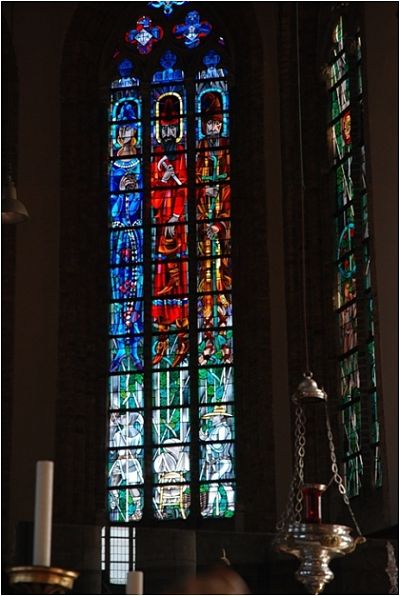
Have I showed you this photo before? It was taken in a church in Poperinge, Belgium. You don’t see hop pickers immortalized in stained glass all that often.

Hop pickers, stained glass, Poperinge, Belgium

Where beer is cheaper than gas (revisited)

KegWorks tackles the question “Is beer really cheaper than gas?” with a rather elaborate analysis and infographic.

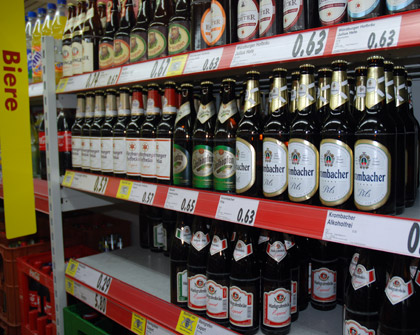
Made me think, “Hey, I’ve got a photo and a different data set.” So from this post in 2008 (when gas prices had ratcheted up during the summer and were beginning to fall, everywhere, along with the U.S. economy):

Beer in Wertheim, Germany

The photo was taken at a small grocery store in Wertheim, Germany (at the junction of the Main and Tauber rivers, and with terrific castle ruins). Beer was .66 euro (or less) for .5L. That’s 1.32 euro if you bought two (in other words a liter). The cheapest we’d seen gas for at the time was 1.39 for a liter of diesel (the cheapest gas in Germany, as opposed to the silly flip-flop in the U.S. where diesel costs more).