‘Craft’ beer: A little compare and contrast

Curious timing. Pete Brown has a thoughtful post today titled “Two contrasting responses to the growth of craft beer from two different big brewers.”

And yesterday, although I only noticed it today via Twitter, DRAFT magazine posted a profile of Keith Villa that I wrote for the the current issue: “Being Keith Villa.”

Brown’s story is not easily summarized, so I won’t try. It’s a Big Picture think piece. Here’s a paragraph from near the end. It hope it motivates you to read the whole story.

Talking to the guys who run this, there’s a philosophy of enlightened self-interest. It’s only going to work if it’s done right – and that means not doing it the MC (Molson Coors) way. But if it’s done well, it might just create a halo effect that makes people think a little bit more of beer in general, in relation to wine and other drinks. And that would, ultimately, help the rest of the MC business.

Villa, of course, works for MillerCoors (a joint venture between SABMiller and Molson Coors). Fast Company recently had a story explaining how “MillerCoors Took Taste Out Of The Equation And Made Cold Unique” (Subhead: “MillerCoors knew that nothing distinguished its marquee beer from the competition. So it made something up.”)

But the breweries in its Tenth and Blake division — including Villa’s baby, Blue Moon, as well as AC Golden and Leinenkugel’s — they focus on flavor. And their sales are booming.

Were the beer world only that simple.
Of course, a beer change is gonna come

I apologize up front if my suggesting that the uplifting message in “A Change is Gonna Come” has anything to do with beer, but when a press release arrive this morning from Versuchs- und Lehranstalt für Brauerei in Berlin (more often referred to as VLB) Sam Cooke’s beautiful voice echoed in the background.

***

Immediately preceding this year’s Brau Beviale the first European MicroBrew Symposium – Market, Trends and Technology takes place on the 12th and 13th November in Nuremberg, Germany. The symposium addresses craft and micro brewers mainly from Europe. The language is English.

Basically emanating from the USA, a popular trend is evident in many European countries towards individual and craft-made beers. In line with this trend the first European MicroBrew Symposium takes place on the 12th and 13th November 2012 in Nuremberg, Germany – directly preceding the Brau Beviale. The symposium addresses owners, technical managers and brewers from European and German micro breweries and pub breweries as well as their suppliers. In line with the symposium’s international character the presentation language is English.

Besides an overview of the international market trends in this segment the symposium focuses primarily on technical/technological aspects of beer production. In addition to general concepts for small-scale brewery plants the rich variety of products available by variations to the raw materials, process parameters and yeasts as well as the necessary quality control will be presented and discussed. Furthermore representatives of Firestone Walker Brewery (USA), Bell’s Brewery (USA) and the Brauhaus Lemke (Berlin) present insights into their successful concepts. A visit to the Steinbach Bräu in Erlangen completes the symposium. Subsequently all participants have the opportunity to visit the Brau Beviale which is the world’s leading capital goods trade fair for the brewing and beverage industry in 2012. The symposium is a joint project of the Brau Beviale and VLB Berlin.

***

There’s that phrase again: “Basically emanating from the USA, a popular trend . . .”

You can see the agenda here, and that Matt Brynildson (Firestone Walker) and John Mallett (Bell’s) will talk on the second day.

Now, it’s time for Oktoberfest bier

Cannstatter Volksfest

We can quit complaining now about how early some breweries rolled out their Oktoberfest beers.

Oktoberfest begins in Munich tomorrow. The Big One. About seven million people will visit during the next two weeks.

Oktoberfests across the U.S. during the next month (some even in October) will attract more in total. There’s something about them, don’t you think? Here in St. Louis, Urban Chestnut Brewing and Schlafly (Saint Louis Brewery) and hold their first co-celebration this weekend at Urban Chestnut. Next month’s Soulard Oktoberfest is the big one in these parts, with multiple tents, multiple bands (including once again Brave Combo, who seem to be on sort of an Oktoberfest trail), multiple vendors.

Beer is pretty much an essential element, although for years Cullman, Alabama, held a beer-free Oktoberfest.

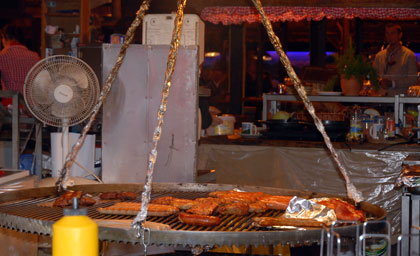
Anyway, here are a few photos from when we visited the Cannstatter Volkfest in Stuttgart in 2008. Imagine the Wisconsin State Fair without the agricultural displays but a lot more beer. It’s billed as the second largest beer festival in the world, smaller than only Munich’s. As in Munich just a few local breweries sell beer. Unlike Munich, most are not beers available internationally, or even nationally. And the breweries offer more than a single festbier in their respective tents. You can cleanse your palate with a pils distinctively more bitter than you usually find nearby in Bavaria or choose a refreshing weisse beer to wash down typical Swabian dishes.

Cannstatter Volksfest

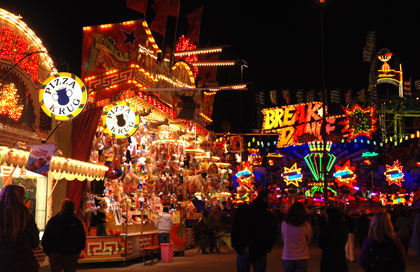
The festival began in 1818, occurs annually at about the same time as the Munich celebration, and attracts four million visitors over the course of two weeks. Three of the beer tents accommodate 5,000, and smaller ones pack in thousands. Outside food and crafts vendors share the midway with rides more impressive than those at the average U.S. state fair or seaside boardwalk, witness the photo at the top.

Cannstatter Volksfest

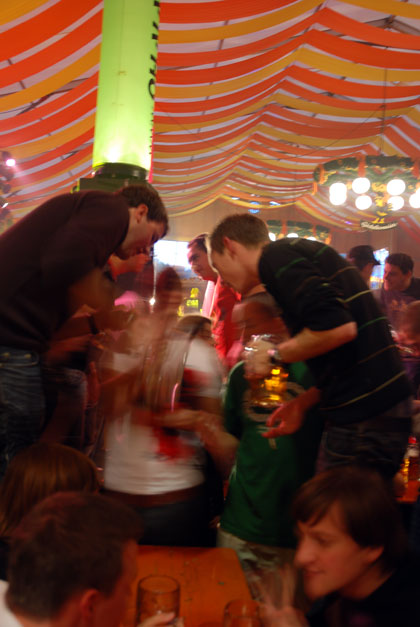
Those are young Germans — you know, the ones who no longer find beer relevant — standing on benches lining long beer tables, hoisting one-liter mugs, banging them together, singing along to songs like “YMCA” and boogying big time.

Earlier in the day we listened to brass bands like those you’d hear at Americanized Oktoberfest celebrations, playing traditional German tunes. After about every fourth song the afternoon bands stopped to sing “Ein Prosit” and lead thousands of revelers in a toast. Ohlala-Partyband, the group on the stage when the drinkers were on the benches, followed the same formula, but then quickly returned to belting out another pop song that doesn’t sound all that different in German.

Perhaps the best definition of craft beer you’ll read today

“What I’d say is, if you can identify exactly where it was brewed, name the brewer and it has great aromas and good strong flavours (and perhaps a silly name), it’s probably craft beer.”

From a lengthy look at “a thing called ‘craft’ beer” in The New Zealand Record.

Of course there is a downside for those in the U.S. who’ve discovered how much they like New Zealand hops. This is why more of them will be staying at home.