American Brewer: The Brewer as Rock Star

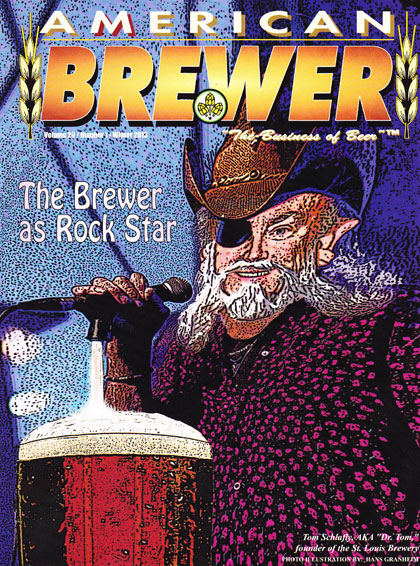
Yes, I too am stunned that the current issue of American Brewer magazine is not dedicated to Alan McLeod (yes, you should click that link and cruise through a rather extensive discourse on the topic of “brewer as rock star”).

American Brewer: The Brewer as Rock Star

Anyway, that’s Tom Schlafly on the cover, co-founder of one of my hometown breweries. I’m about to open a Schlafly beer, wishing they bottled the Hop Trial: Rakau (a lovely 4.1% beer), and read about some rock stars.

Surreal Beer. The book. Brace yourself.

Max Bahnson “leaked” this news this morning. He and Alan McLeod are discussing the possibility of writing a book together.

What we are sure of, though, is that it will be something completely different to anything that’s so far been written about beer. The topics we are going to deal with, well, I guess those that follow our blogs can pretty much figure them out, and they will all be wrapped in a fun and perhaps rather surrealist narrative.

Surreal Beer? Beer Surreal? Not sure which is a better title.1 Anyway, can’t wait for the table of contents, let alone what follows.

P.S. guys. Scoop up that www.surrealbeer.com domain name while it’s available.

*****

1 Of course, the next question is: Will this lead to a new consumer group called The Campaign for Surreal Ale?

Hold it, which Blind Pig beer was one of the first Double IPAs?

Cheers to Martyn Cornell for calling out a list of the most influential” beers that was both embarrassingly America-centric and lacking in historic perspective and replacing it with his own “The REAL 20 most influential beers of all time.”

Given that I’ve sworn off railing against lists I thought I might sit back and enjoy, but reading through more than 100 comments I’m surprised that the inclusion of Russian River Blind Pig IPA has not been questioned. Look, I love Blind Pig. It is one of my favorite beers on earth. Drink it it next to a Double IPA, even one as good as Pliny the Elder, and the phrase “less is more” makes perfect sense. But there seems to be some confusion about chickens and eggs (or, in this case, IPAs and DIPAs) at Blind Pig Brewing.

Let’s start with the entry at First We Feast (where the silliness began):

RUSSIAN RIVER BLIND PIG IPA
From: Santa Rosa, CA
Style: IPA
ABV: 6.1%
Website: russianriverbrewing.com

Joshua M. Bernstein says: “Beer geeks rightfully praise Vinnie Cilurzo’s Pliny the Elder, the double IPA against which all others are judged. Thing is, the path for Pliny was blazed by Blind Pig, an IPA brewed to compensate for a flawed brewery [the beer was originally brewed by Cilurzo at Blind Pig before he brought it to Russian River]. Blind Pig’s equipment was so antiquated, off flavors were all too common. To compensate, he added heaps of hops, setting a bitter template that brewers worldwide now follow.”

Then consider how it ends up in Cornell’s “REAL 20.”

Sierra Nevada Pale Ale I’m prepared to consider, as the pioneer of “hop forward” American pale ales, and the same consideration may be due to Blind Pig IPA, the first “double” IPA.
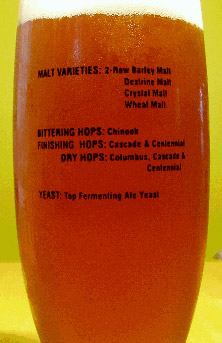
Blind Pig Double IPAAnd now revisit the story that Cilurzo has told many times about over his first “double IPA.” He brewed a beer he called Inaugural Ale in June 1994, the very first batch he made at Blind Pig Brewing1 in Temecula, California. Indeed, he said, “Our equipment was pretty antique and crude, so I wanted to start out with something that was big and, frankly, could cover up any off flavors.”

The beer contained between 6.5 and 7% alcohol by volume and Cilurzo calculated it had 100 International Bitterness Units (the actual number would have been much lower). It was aged on oak chips for nine months and served on the brewery’s first anniversary. He had special glasses made for the occasion, with the ingredients printed on the side. He described it as a “double IPA.”

“After that, we made it a tradition to make DIPAs for our anniversary. At our second anniversary, the beer was 120 (calculated) BUs. This was almost undrinkable at the time of bottling, but there was a small market for it,” Cilurzo says. “We had a tasting room at our brewery. Customers would bring their Blind Pig growlers back for refills, etc. The last drop of Second Anniversary Ale, out of the brewery’s last keg, filled (Stone Brewing Co. co-founder) Greg Koch’s growler.”

Quite obviously, this was a very influential beer, was one of the first Double IPAs,2 and is the parent of Russian River Pliny the Elder.3

But Blind Pig IPA was a different beer — brewed after Inaugural Ale, first simply called India Pale Ale, with 6% ABV and 75 calculated IBU (Cascade and Columbus), and later They Passed This Way IPA. It was an excellent beer from the get-go, but it did not blaze the path for Pliny or other Double IPAs.

*****

1 “Vinnie Cilurzo left Blind Pig to brew at Russian River Brewing in northern California, owned at the time by Korbel (the sparkling wine producer). When Korbel decided to get out of the brewing business, Natalia and Vinnie Cilurzo bought the brand name and opened a brewpub in Santa Rosa, later a production brewery. Cilurzo continues to brew Russian River IPA, but revived Blind Pig IPA after moving to Santa Rosa.

2 Mitch Steele revisits the discussion about who brewed the first commercial IPA in “IPA: Brewing Techniques, Recipes and the Evolution of India Pale Ale.” Recommended.

3 Pliny the Elder is 8% ABV and is made with several hop varieties not even available when Cilurzo first brewed Inaugural Ale.
Another beer flavor/flavour wheel

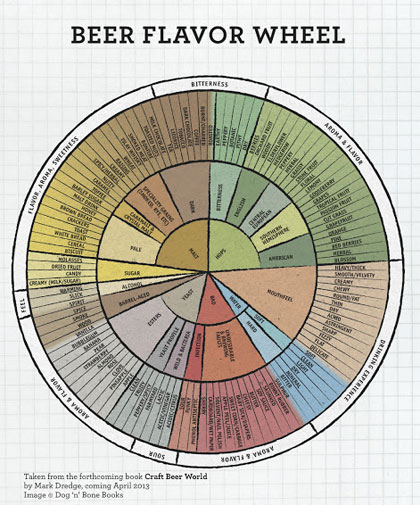
Beer Flavor Wheel, Beer Flavour Wheel

Mark Dredge posted this new Beer Flavor Wheel today at Pencil and Spoon. (If you click on the image you’ll head over to his blog, where the wheel is a bit larger).

This is a much more drinker friendly wheel than the traditional one, created for Dredge’s new book, Craft Beer World, which just went to the printer. As mentioned here before, the beer flavor wheel was developed in the 1970s by the Master Brewers Association of the Americas and the American Society of Brewing Chemists following the lead of Danish flavor chemist Morten Meilgaard. It was one of the first such wheels. A wine aroma wheel came later, as did the Flavour Wheel for Maple Products, a South African brandy wheel, and a variety of other fun dials.

The Beer Wheel was not designed for consumers but to provide reference compounds that can be added to beer samples to represent the intended flavors. It continues to grow in size, and there is every possibility that the committees working on its redesign will settle on several subwheels.

Also mentioned here, and pictured in For the Love of Hops
the Hochschule RheinMain University of Applied Science created a Beer Aroma Wheel (actually two wheels) with the goal of providing terms more suitable for communicating with consumers and focusing less on defects.

Panelists who helped develop the terminology used aromas of fruits, spices, everyday materials, and other foodstuffs to describe their sensory impression. Because there is the rare occasion where 4-vinyl guaiacol is appropriate in conversation, but rare remains the best adjective. Clove works much better in mixed company (geeks and non geeks).

So this is why they called their first born ‘Wheat Ale’

Co-founder Tom Schlafly, and I guess everybody else at the St. Louis Brewery (which makes Schafly beer), suddenly put this brewery-turning-21 stuff into an entirely new context.

In this case as well as the importance of context there’s the matter of repercussions. Schalfly Beer turned 21 years old last week. Sometime after that a child would have been conceived under the influence of likely more than one Schlafly beer. The company would like to make sure that bit of history isn’t lost, as Schlafly explained in the employee blog.

As most remaining ARs (adult readers) realize, Schlafly Beer celebrated its 21st birthday on December 26, 2012. Thus, according to my calculations, the first baby conceived by one or both parents under the influence of our beer is likely to celebrate his or her 21st birthday sometime in the fall of 2013. The obvious way to recognize this individual would be to buy him or her a beer on his or her birthday. The problem, however, is that this person is not yet old enough to drink legally. As a socially responsible company we are not allowed to market to this person, whoever he or she may be. We can, however, reach out to the conceiving parents, which is exactly what we’re doing.

If any of you amorous readers (yet another kind of ARs), think you may be the parents of the first baby conceived under the influence of Schlafly Beer, we encourage you to share your story by sending it to questions@schlafly.com. I’m not exactly sure what kind of recognition we plan to give to the individuals involved (conceivers and conceived) and would welcome recommendations on this point from other ARs. Depending on the response, we may post parental recollections of moments of conception on line and let ARs help us decide what kind of recognition would be appropriate. It might even be worth posting maternal and paternal memories separately and comparing them for consistency. Embarrassed offspring will not be allowed to comment until after they’ve celebrated their 21st birthdays, by which time their parents’ stories will have gone viral and it will be too late.

Benjamin Braddock: Goddamn, that’s great. So old Elaine Robinson got started in a Ford.

*****

Why “Wheat Ale” rather than “Pale Ale”? See Stephen Hale’s explanation.