German beer drinkers: Here come Americans to the rescue

Who will decided what the next generation of German beer drinkers likes?Why would a German beer drinker pay the equivalent of $4.20 for a 12-ounce bottle of Brooklyn Lager? It’s an excellent beer, but that’s quite a markup over what it costs in the United States and considerably more than Germans pay from any of several outstanding beers.

I don’t have an answer.

Maybe it is somehow related to the fact Berlin Is a Haven of Hip. Consider this from a Washington Post story that got a lot of attention last week: “At a recent tasting in one Berlin bar, guests sipped craft beers out of special vessels shaped like wineglasses that helped concentrate the aromas of the brew. The bar was furnished in a decidedly Berlin style — it was a subterranean lair where beakers of bubbling fluorescent liquids served as decoration, the tables appeared to be made from welded-together car parts, and fake stalactites hung from the ceiling.”

Not quite like drinking beer in Franconia.

That’s not actually what struck me first when I read the story, and compressed a bunch of words into something almost meaningless on Twitter. It was the simple arrogance of this.

“The German beer industry has to reinvent itself in a hurry, or it’s going to be a small fraction of what it is now,” said Eric Ottaway, the general manager of Brooklyn Brewery, which has been expanding in Europe and has been exporting its beer to Germany through Braufactum, which sells a 12-ounce bottle of Brooklyn Lager in upscale grocery stores for the equivalent of $4.20 — almost three times its typical American price.

And this.

“This was simply to fill a void,” he said. “We feel as if we’re teaching a lot of Germans things about their own beer culture that they’ve forgotten.”

He is Matt Walthall, one of three American expats who have launched a crowdfunding campaign to raise enough money to open a brewery.

German drinkers sure are lucky those guys showed up.

OK, that was snide. Steam blown off. A lot of good in that story, and to be fair, Ottaway has a point. Reinvent itself is a bit strong, but German brewers need to make changes. Oh, wait, some are. Those particular ones just aren’t in this story. So a few links to fill in the gaps:

– Sylvia Kopp’s excellent story from five years ago in All About Beer magazine: Ruled by the Reinheitsgebot?

– The (Real) Beer Nut’s up-to-date report from Munich called The shape of things to come.

– An article in the 2012/2013 edition of Hopfen (a pdf) about the Bier-Quer-Denker workshops gives you a good idea of who well attended they’ve become.
‘Native ales’ and ‘Spokane Style’

Christopher Staten writes about “native ales” in the current DRAFT magazine (March/April, “25 Unexpected Getaways” on the cover). Even though the tagline here reads “celebrating beer from a place” I have to pause when considering his conclusion.

But in terms of the big picture — that “what story will they tell in 200 years?” question — native beers have the potential to define the American craft beer industry’s legacy.

That’s bold.

Although Lakefront Brewery’s Wisconsinite is made with all Wisconsin ingredients this is really a story about yeast.

Case in point: Vinland One. For the series’ first release, [Mystic Brewing founder Bryan] Greenhagen isolated a yeast strain from a Massachusetts plum he bought at a local farmers market. Called Winnie, the wild yeast imparts plum, mango and touches of spice to the saison base, giving it character more akin to wine. Technically, One isn’t an ale or lager; it’s something unique. Greenhagen’s also working on developing yeast cultures from blueberries in Maine for Vinland Two, slated for release this September, and berries and grapes from a family farm in Vermont. While the lack of local ingredients suited for his recipes (mainly noble hops) prevents him from brewing a complete native beer, his use of local, wild yeast makes Vinland exclusive to his region.

“Biodiversity can help us make our own unique beer,” he says. “Even though we work within the Belgian tradition, how can we bring that back to make things that are actually distinctive and, in some cases, beer you couldn’t make anywhere else?”

Hold that thought.

Now consider the news earlier this month that No-Li Brewhouse in Spokane, Washington, successfully lobbied for the “term and beer classification Spokane Style.” Spokane Style beer must be brewed and packaged in Spokane by Spokane residents and use all ingredients exclusively to the region (meaning from within 300 miles).

So just what is ‘Spokane Style’? “Like the Matrix, no one can be told what Spokane Style is”, said [co-founder John] Bryant with a laugh, “but you must taste.”

“When you pride yourself on using only the finest ingredients and the greatest attention to detail”, said co-founder and Head Brewer Mark Irvin, “you know what Spokane Style is. You can taste it.”

Can you taste it?

Why?

Does it matter?

These, in fact, are the questions I’ve been asking here for more than seven years. Maybe it’s time to get serious about finding some answers.

Brewing by hand and by app

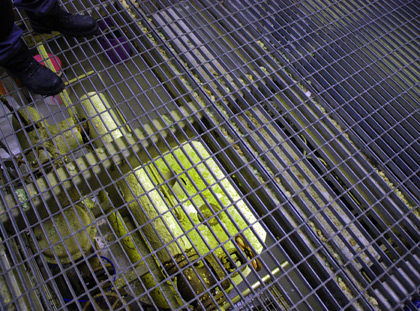
The brew deck at Oakham Ales

That’s hop dust below.

The photo shows the brew deck at Oakham Ales in Peterborough, located an hour (by train) north of London. The green underneath is the hop dust. Much has been automated at Oakham, so automated a brewer can sit in the local pub and use his phone to control some brewery operations, but not everything.

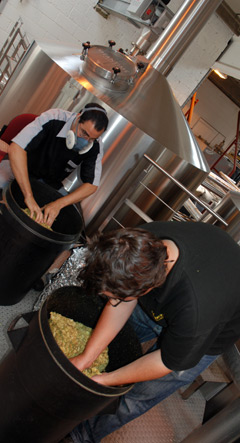
Breaking up hops at Meantime BrewingThat includes adding hops to the brewing kettle and the hopback. Oakham uses a good share of hops, American hops, in whole cone form.
After the hops are shipped to the UK in bales, hop merchant Charles Faram repackages them into 5 and 20 kilogram packages (called freshpacks). About 55 percent of the hops Faram sells are in cone/leaf form (compared to 90 percent in 1989). The hops in the freshpacks end up quite compact, so brewers cannot simply open a package and dump hops into the kettle.

That’s why the workers pictured to the right (in this case at Meantime Brewing in London) have to break up the hops by hand.

And not everything ends up in the kettle.

Oakham is bigger than what’s defined as a microbrewery in the US — production this year should be 14,000-17,000 UK barrels, the equivalent of more than 20,000 US barrels — and soon some of its beers should be available in the US. John Bryan, whose official title is production director, was the first in the UK to brew with Citra, cleverly calling the resulting beer Citra. It has been immensely popular, as has its second all-Citra beer, Green Devil IPA.

With size has come automation, and almost any aspect of the operation that is automated can be controled by mobile phone. For instance, a brewer could start the mill and fill the grist case from home, although Bryan prefers somebody be around in the event there is blockage. Likewise the brewhouse, although heating brewing liquor on a Sunday so it is ready to go Monday morning makes the week start easier (using the large scale supplier for industrial heating parts, quite innovative).

It’s particularly handy for monitoring fermentation, and changing temperatures if necessary.

Even on a Saturday night, or perhaps Sunday afternoon, from the pub. Whether that’s a good idea, and how much you want to show off for the others at the pub . . . it’s best, Bryan says, to take into account how much beer has already been consumed.

The Session #74: Pray for me

The SessionThe topic for the 74th gathering of The Session is “Finding Beer Balance.” Visit This Is Why I’m Drunk to see what everybody else is writing. It will be more interesting than the sad story that follows.

A.J. Liebling — a journalist who ate and drank to excess, and who described himself as bald, overweight, and gluttonous — once wrote: “The primary requisite for writing well about food is a good appetite. Without this, it is impossible to accumulate, within the allotted span, enough experience of eating to have anything worth setting down. Each day bring only two opportunities for field work, and they are not to be wasted minimizing the intake of cholesterol. They are indispensable, like a prizefighter’s hours on the road…. A good appetite gives an eater room to turn around.”

Liebling wrote very well about food. He was not an advocate of balance.

I write about beer. I’m pretty much bald and I can be gluttonous. Food, drink, zydeco, smoked meat, the theater, the theatre, high school basketball (in a previous life), things worth doing seem worth doing to excess.

I’m not sure this is going to end well.

Whatever happened to ‘extreme’ beer?

Did I miss the memo?

Stories about — and therefore praising, because almost all stories about beers not brewed by large corporations include a certain amount of praise — “extreme beers” seem to be appearing less often.

(And, yes, I’m aware that the Beer Advocate “Extreme Beer Festival” recently concluded. That’s one reason for the question.)

Maybe my radar needs adjusting. Or maybe they’ve been drowned about by tales of passionate nano-brewers.

The subject popped up again yesterday when Adrian Tierney-Jones wrote about the Charles Wells/Dogfish Head collaboration beer DNA New World IPA. Sam Calagione (who wrote a book titled Extreme Brewing) was there for the roll out, of course, and Adrian talked with him.

And afterwards I had a few words with Calagione and asked the question that was bugging me. Extreme beer? ‘It wasn’t about strength but innovation and flavour. I’m not hung up on nomenclature.’

And in that millpond the ripples keep spreading.

I’m still trying to wrap my head about this DNA beer, and understand just what “a reduction of our 60 Minute IPA” means, but it sounds like something that would have been called “extreme” not long ago.