Brewing by hand and by app

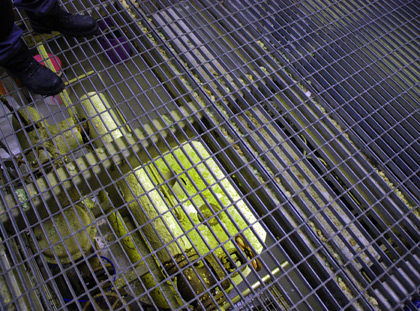
The brew deck at Oakham Ales

That’s hop dust below.

The photo shows the brew deck at Oakham Ales in Peterborough, located an hour (by train) north of London. The green underneath is the hop dust. Much has been automated at Oakham, so automated a brewer can sit in the local pub and use his phone to control some brewery operations, but not everything.
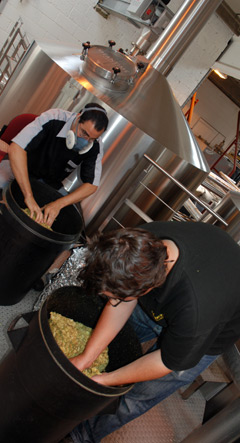
Breaking up hops at Meantime BrewingThat includes adding hops to the brewing kettle and the hopback. Oakham uses a good share of hops, American hops, in whole cone form.

After the hops are shipped to the UK in bales, hop merchant Charles Faram repackages them into 5 and 20 kilogram packages (called freshpacks). About 55 percent of the hops Faram sells are in cone/leaf form (compared to 90 percent in 1989). The hops in the freshpacks end up quite compact, so brewers cannot simply open a package and dump hops into the kettle.

That’s why the workers pictured to the right (in this case at Meantime Brewing in London) have to break up the hops by hand.

And not everything ends up in the kettle.

Oakham is bigger than what’s defined as a microbrewery in the US — production this year should be 14,000-17,000 UK barrels, the equivalent of more than 20,000 US barrels — and soon some of its beers should be available in the US. John Bryan, whose official title is production director, was the first in the UK to brew with Citra, cleverly calling the resulting beer Citra. It has been immensely popular, as has its second all-Citra beer, Green Devil IPA.

With size has come automation, and almost any aspect of the operation that is automated can be controled by mobile phone. For instance, a brewer could start the mill and fill the grist case from home, although Bryan prefers somebody be around in the event there is blockage. Likewise the brewhouse, although heating brewing liquor on a Sunday so it is ready to go Monday morning makes the week start easier (using the large scale supplier for industrial heating parts, quite innovative).

It’s particularly handy for monitoring fermentation, and changing temperatures if necessary.

Even on a Saturday night, or perhaps Sunday afternoon, from the pub. Whether that’s a good idea, and how much you want to show off for the others at the pub . . . it’s best, Bryan says, to take into account how much beer has already been consumed.
The Session #74: Pray for me

The SessionThe topic for the 74th gathering of The Session is “Finding Beer Balance.” Visit This Is Why I’m Drunk to see what everybody else is writing. It will be more interesting than the sad story that follows.
A.J. Liebling — a journalist who ate and drank to excess, and who described himself as bald, overweight, and gluttonous — once wrote: “The primary requisite for writing well about food is a good appetite. Without this, it is impossible to accumulate, within the allotted span, enough experience of eating to have anything worth setting down. Each day bring only two opportunities for field work, and they are not to be wasted minimizing the intake of cholesterol. They are indispensable, like a prizefighter’s hours on the road…. A good appetite gives an eater room to turn around.”

Liebling wrote very well about food. He was not an advocate of balance.

I write about beer. I’m pretty much bald and I can be gluttonous. Food, drink, zydeco, smoked meat, the theater, the theatre, high school basketball (in a previous life), things worth doing seem worth doing to excess.

I’m not sure this is going to end well.

Whatever happened to ‘extreme’ beer?

Did I miss the memo?

Stories about — and therefore praising, because almost all stories about beers not brewed by large corporations include a certain amount of praise — “extreme beers” seem to be appearing less often.

(And, yes, I’m aware that the Beer Advocate “Extreme Beer Festival” recently concluded. That’s one reason for the question.)

Maybe my radar needs adjusting. Or maybe they’ve been drowned about by tales of passionate nano-brewers.

The subject popped up again yesterday when Adrian Tierney-Jones wrote about the Charles Wells/Dogfish Head collaboration beer DNA New World IPA. Sam Calagione (who wrote a book titled Extreme Brewing) was there for the roll out, of course, and Adrian talked with him.

And afterwards I had a few words with Calagione and asked the question that was bugging me. Extreme beer? ‘It wasn’t about strength but innovation and flavour. I’m not hung up on nomenclature.’

And in that millpond the ripples keep spreading.

I’m still trying to wrap my head about this DNA beer, and understand just what “a reduction of our 60 Minute IPA” means, but it sounds like something that would have been called “extreme” not long ago.

This wasn’t in Jack McAuliffe’s business plan

This from the zoning application by The Rare Barrel in West Berkeley (California):

“We will be a gathering place for artisanal brewers, home brewers, beer enthusiasts and food lovers in general. We will bring to Berkeley well-paying jobs both in the brewery and the retail area that do not require an advanced degree.”

The headline on the story: City approves sour-beer brewery for ‘beer geeks.’

This probably made it easier for those sitting on the the zoning board to give the application a thumbs up: “The brewers will contract with several existing breweries to produce wort, an early stage of the beer, in kettles off-site so as to avoid ‘bakery’ type odors associated with brewing.”

Beer innovation #2416: Nip size cans

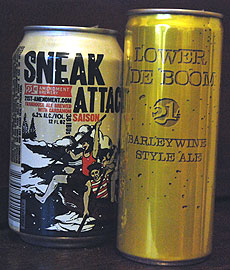
21st Amendment Lower De BoomSee that sleek, gold can on the right that looks like it’s waiting to make an appearance in Super Bowl commercial? Brilliant idea. It contained1 8.4 ounces (248ml) of Lower De Boom barleywine from 21st Amendment Brewery.

Lower De Boom is 11.5% alcohol by volume. I can’t count how many 22-ounce and bigger bottles my local beer shop has full of barleywines and other beers just as strong. No wonder they call them bombers. I get the concept that bigger bottles are for sharing, but Daria and I shared 8.4 ounces.

I don’t have much more to say the De Boom itself — it’s a bit American/pungent on the nose, but a dessert beer; rich, plenty of caramel and some dark fruit character, a little sweet, but it may dry out as it ages, or do you lay down beer in cans? And it comes with a back story. 2

*****

1 Yes, past tense. 21st Amendment spent far more sending the the beer to me than it would cost in a store. If I could buy it in St. Louis I would.

2 Cornelius De Boom was a Belgian-born ship owner who made it to San Francisco in time for the gold rush in 1848. De Boom Street, named for him, is the alley which runs alongside 21st Amendment Brewery. The brewery’s De Boom Street entrance is often referred to as “lower De Boom” by brewery employees.