Budweiser: The search for relevancy

Budweiser has brought Project 12 back for a second go around. The last time resulted in the release of Budweiser Black Crown, but that wasn’t exactly the point of the project. This is a story that I wrote last year for All About Beer magazine (thus the reference to October is October of 2012), but the challenges Bud faces remain the same. Sales were down 4.1% in the first quarter of the year.

On the last Saturday night in October a customer stepped up to bar at Off Broadway, a music venue in a part of St. Louis many still call the brewery district. He surveyed six tap handles, three pouring beer from from New Belgium Brewing, two from locally owned Urban Chestnut Brewing, and one from 4 Hands Brewing, also local.

“You have Budweiser?” he asked the bartender, who shook his head from side to side.

“Bud Light?” he asked. The bartender turned and gestured to the bottle selection, represented by those on a shelf behind him. There were no beers made at the Anheuser-Busch brewery less than a 15-minute walk away.

The customer leaned back, closing and opening his eyes with a theatrical look of surprise. “This is St. Louis, isn’t it?” he asked of no one in particular.

Off Broadway1 is not typical. More often, in taverns, pubs and restaurants that share a ZIP Code, 63118, with Anheuser-Busch signs advertising Budweiser hang prominently and Bud and Bud Light are top-selling beers. However, when establishments feel comfortable not even offering Budweiser it reminds those in charge of the brand the challenges they face. In 1988, when one in four beers Americans consumed was a Budweiser almost every new drinker tasted it at least once. Today, when one beer in 12 is a Bud, that’s hardly guaranteed.

“Until two years ago there were a lot of 21 to 27-year-olds who weren’t drinking Bud,” said Nate Scudieri, Budweiser senior brand manager. “It wasn’t as relevant a brand to them.”

Project 12 – which resulted in a variety pack that will be available into the new year as well as the recipe for the next Budweiser, Black Crown – is one of several A-B initiatives intended to keep Budweiser a part of the beer conversation. “What it (Project 12) does, it gets consumers to look at Budweiser differently,” Scudieri said. “It exists to give people a reason to try Budweiser (itself) again, when they see the sort of things Budweiser is capable of.

“(Drinkers 21 to 27 years old) are interested in finding what’s new in beer. Styles, ABV, color. They want to discover the beers and share them with their friends.”

Mike Kallenberger, who operates Tropos Brand Consulting and previously worked for 30 years at Miller Brewing and MillerCoors, put the challenge in perspective. Smaller brewers have claimed much of that territory, of what those in marketing call share of mind. “It’s much, much bigger (for craft beer) than the percentage of sales,” he said. “Maybe 40 or 50 percent of the quote, unquote, conversation.”

When the plans to release Black Crown early in 2013 were announced, a Huffington Post headline called it a “Stodgy Brand’s Crowdsourcing Play For Hipster Cred.” Although A-B collected feedback from 25,000 consumers before picking three beers for the variety pack, the recipes themselves were the product of the dozen brewmasters in charge of the company’s American breweries.

They collaborated on the beers, creating six that took the names of the ZIP Codes where they were brewed. Consumers tasted them and provided feedback throughout the summer, 10,000 of them at the Made in America Festival – a music extravaganza in Philadelphia headlined by Jay-Z over Labor Day weekend, and another effort to entice drinkers to reappraise how they think about Budweiser.

All 12 brewmasters served samples in Philadelphia. “I poured more beer that one day than I have all the rest of my life,” said Jim Bicklein, who is in charge of the St. Louis brewery. He and Katie Rippel from the Fort Collins, Colo., plant wrote the recipe for 63118. Brewers at smaller breweries often pour beer at festivals, but not those who supervise Anheuser-Busch facilities. “One thing that struck me was all the questions,” Bicklein said. “They were genuinely interested in how we make these beers.”

The common component in the six was Budweiser yeast. One beer that didn’t make it into the three-beer sampler included coriander, orange peel and lemon peel. The package includes four each of three beers: a lager aged on bourbon staves and vanilla beans in Virginia (ZIP 23185), an amber lager brewed in Los Angeles (91406), and the beer brewed in St. Louis (63118).

Budweiser Black Crown will be made using the recipe for 91406. That beer is darker and stronger (6% alcohol by volume compare to 5%) than Budweiser and contains 15 International Bitterness Units (versus 10 in Bud).

When A-B representatives offered sample sizes and collected feedback at participating restaurants and bars in the St. Louis area they talked about bitterness units only when pouring 63118, literally warning drinkers – many of whom had left a pale lager behind at the bar or their table to sample the Project 12 beers – that it came with 18 IBU, compared to 10 in Budweiser.

(In fact, A-B seldom talks about IBU in Bud or its other beers. In 1982, Joe Owades, a legend in brewing circles who is credited with developing the first light beer, estimated the bitterness of Budweiser was equivalent to 20 IBU in 1946, and still 17 in the 1970s.)

For the sake of comparison, Blue Moon Belgian White contains 18 IBU and New Belgium Fat Tire 19, but neither has the “hop presence” of 63118. The bulk of the hops, Mittelfrüh from both the Hallertau and Tettnang regions of Germany, are not added until almost the end of boiling. That preserves more essential oils and results in prominent but delicate floral, spicy and even citrus (but quite different, and more delicate, than the citrus is an America hop like Cascade) aromas.

Bicklein discussed the recipe as he walked along a deck in one of three brewhouses within the St. Louis plant. He talked about brewing something similar to Budweiser in the late nineteenth century, but not simply going to the archives for an old recipe. He included rice because Budweiser sales soared after Adolphus Busch authorized the addition of rice in the 1870s. He used hops from the Tettnang and Hallertau region because those were the hops German immigrants naturally preferred. He added a little caramel malt for color, and like Budweiser itself, 63118 is aged on beechwood chips.

Bicklein motioned toward a large mosaic at one end of the brewhouse, called Germania. Another mosaic, called Americana, used to occupy the wall at the other end, but was moved to a brewery entrance foyer when a control room was added at that end of the brewhouse. He talked about German/American heritage, then paused, considered what he said, and allowed it sounded a bit “goofy.” He smiled sheepishly. “But it’s my story.”

He oversees production of 15 million barrels of beer a year in St. Louis, and more Budweiser than at any of the 42 breweries2 (8 of them in China) where Bud is made. It’s no surprise he knows the beer well. He doesn’t need to have a glass of it beside 93118 to compare the two. His variation on the theme is stronger, 6% ABV, and a bit darker. “I like that caramel note. But it’s also very crisp, (it) has that clean finish, characteristic of Budweiser,” he said, taking a sip of 93118 and setting it down. “The hop character is unique. There’s more of that on the aroma. The esters (some fruity) are not as pronounced as Budweiser.”

Maybe not a beer designed to claim much “hipster cred,” but one that was worth talking about.

*****

1 Off Broadway since added cans of Bud Light Lime-A-Rita and Bud Light Lime Straw-Ber-Rita to the shelf behind the bar.

2 The number is now up to 45.
Monday morning beer fantasizing

The beer world will not revolve around Denver, Colorado, this week. The people attending the Great American Beer Festival and ridiculous number of events throughout the week may make noises like it does, but that’s not the way the beer world works. It’s just too big.

That might be the last bit of real perspective you can expect from me this week, since I’ll be in Denver and be as disoriented as anybody else. Before I head out, one bit of GABF related news.

The GABF Fantasy Draft is back. DRAFT magazine’s version isn’t quite the same as the Fantasy Draught Jonathan Surratt put together at for four years at the The Beer Mapping Project.1 But the prizes are a whole lot better.

Much of the fun, and the pain, the first time around was the draft/draught itself. Waiting for the next pick, hoping that somehow Flying Dog Brewery would make it through the rest of third round and into the fourth (four medals in 2009, as a fourth round pick, you can look it up). This time more than one participant to pick a brewery. Surely everybody will pick Firestone Walker Brewing, Sun King Brewing, Miller Brewing (eight medals in 2008 and six in 2009), Devils Backbone (just one or both?), well, I’m not doing all your homework.

The winner will be the entrant who comes up with the Flying Dogs and La Cumbres (three medals first time out in 2011). Might be a newcomer and might be one that’s be around forever. Thinking about this led me to see look up how many breweries have won medals in all four decades the competition has been held.2 Yes, these are the sorts of things I think of on a Monday morning, cold sober. No predictions will seem like a good topic to explore by late Friday night.

Anyway, there are twelve: Capital Brewery, Sierra Nevada Brewing, Boston Beer, Alaskan Brewing, Full Sail Brewing, Anheuser-Busch, Miller Brewing, Coors Brewing, Marin Brewing, Millstream Brewing (you might have lost that bet, huh?), Goose Island Beer, and Leinenkugel Brewing.

*****

1 For the record, Surratt is also the web director at DRAFT.

2 Blind judging began in 1988, so there were only two opportunities that decade, and so far only two this decade.

Wednesday links: Chicago, and Citra described

Stray thoughts and links for a Wednesday:

– Chicago. Forty-eight breweries? No wonder there are something like 48 stories this week.

* The Battle for Chicago. As somebody who started buying mimeographed copies of Bill James’ Baseball Abstract in the 1970s (yes, Bill James predated Sierra Nevada Brewing) I really need to write something about this concept of “Beers Above Replacement.” Having a problem wrapping my head about the pale ale/first baseman analogy.

* Craft Beer Boom Embraced in Chicago’s Neighborhoods. And now Jonathan Cutler is an elder statesman.

* Chicago’s brew future: new breweries on the horizon. There are fourteen more about to open (suburbs included).

* Man, We’re Gonna Have A Lot of Breweries. The guy who wrote the previous story (for Time Out Chicago) has more to say.

– Paragraphs I could never write, which is probably just as well. From Ben McFarland’s article, “Raising a glass to Britain’s craft beer heroes,” in The Telegraph:

Citra, Oakham Ales, 4.5%

In a derelict warehouse somewhere in Peterborough sits the Citra hop, its arms strapped behind its back, its feet shackled to a chair built from pale malt and wheat. Surrounding it, their eyes a maniacal mix of menace and madness, are Oakham’s brewers going to work with hacksaws and hammers in each hand, the Citra squealing gooseberry, greengage and grapefruit. A superb single-hop beer.

There are more, just as fun.

– A point of order. When you put the word “unique” in the headline my first thought should not be “but what about [fill in the blank]?”

The headline in the Boston Globe: “Beer bistro owner plans unique brewing facility.” The nut: “[Daniel] Lanigan is preparing to build what he says will be the country’s first brewery entirely devoted to contract brewing: the making and packaging of beer to meet the exacting specifications of commercial clients.”

That it will be the first must be news to the investors who’ve put $100 millions behind Brew Hub, which I understand will be open by next summer.

A field report from the beer aisle at Walmart

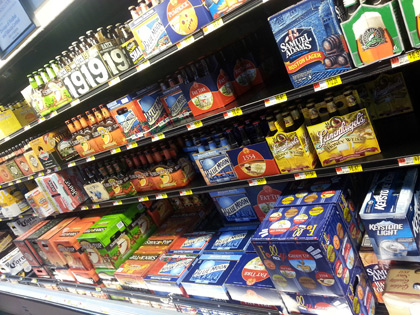
Beer aisle at Walmart

Standing in the beer aisle at Walmart last week I tried to imagine a time when I might see a bottle of Orval or even Goose Island Matilda sitting in the cooler. Not there yet.

I went to Walmart out of curiosity. First, there were a series of stories last month about Walmart getting serious about selling more alcoholic beverages, obviously including beer.

… we do learn that Walmart hosted 500 representatives from the alcohol industry at its Sam’s Club auditorium in Arkansas for a little adult beverage get-together last September. At the Summit, the company’s executives proved to alcohol buyers how serious they were about increasing Walmart’s share in the beer market — and that means doubling its adult beverage sales by 2016.

Then the story resurfaced last week with with a Bloomberg report that Walmart “is so committed to becoming America’s biggest beer retailer that it has been selling Budweiser, Coors and other brews almost at cost in at least some stores.” Alan McLeod had a bit to say, and then even more. He also pointed to a related Beer Advocate discussion.

I found myself wondering if where a beer is sold matters a hill of beans. Despite generally overthinking “beer from a place” this is something I had not really considered. Where’s it is consumed, in situ, sure. But not where it is bought. That’s how I ended up at Walmart. I didn’t come to any conclusions, but now I feel up to date. I already stuck a note on the corkboard I’m looking at as I type, reminding myself to revisit by the first week of December to see if anything has changed.

It was more interesting because I also stopped at my local grocery store, Schnucks, on the way home and took more notes. Schnucks has an excellent beer selection, most of it kept in coolers. While the Walmart selection isn’t as broad as at a gas station in Fulton, Missouri, I ducked into recently, Schnucks has plenty of Firestone Walker beers, Left Hand, Ommegang, Green Flash, and so on. Plus a fine selection from more than a half dozen local breweries.

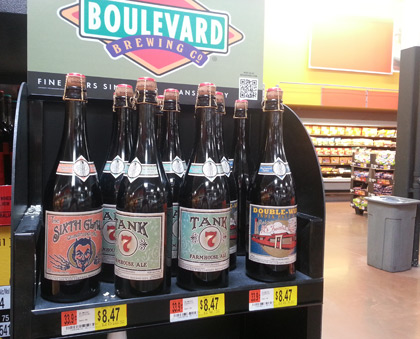
Boulevard Smokestack beers at Walmart

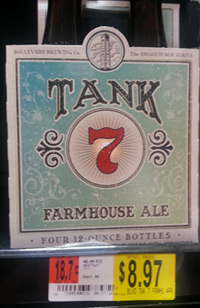
Boulevard Tank 7The price at Walmart includes the cost per ounce, making comparisons easy. At Walmart, at least now, this is mostly a matter of comparing packs of 6, 12, 18, 24 and 30. But — for those who don’t have the Beer Cost Calculator app on their phone that a 750ml bottle of Tank 7 from Boulevard costs 33.9 cents per ounce while a 4-pack of Tank 7 costs just 18.7 cents per ounce could be a revelation. The 750 of Tank 7 costs $8.47 at Walmart and $8.99 at Schnucks (the 4-packs $8.97 and $10.99, with a note at Schnucks that was .70 off the regular price — I usually pay $10.99 at my local beer store).
Will Walmart soon sell more 4-packs, 750ml bottles, maybe 500ml (Urban Chestnut Brewing packages its beer in 500s, in 4-packs and 8-packs)? That’s the implication of these various stories.

Some other observations: a 12-pack of Kräftig Light cans was on sale for $8.97 at Walmart and $9.99 at Schnucks, compared to $10.97 for Bud Light Lime-A-Rita. Kräftig was founded by Billy Busch — yes, one of those heirs — who is promising he will eventually build a very larger brewery in St. Louis. Meanwhile the beer is brewed under contract in Wisconsin. It’s an all-malt beer that does very well is various tastings.

Both Coors Light and Miller Lite 30-packs sell for $17.35 at Walmart at $17.97 at Schnucks. Bud Light Select and Budweiser are both $18.37/$18.35 (Walmart is always listed first).

Samuel Adams Boston Lager (12-pack) is $12.88 at Walmart, $13.99 at Schnucks, while the New Belgium Folly Pack is $12.47/$14.99. Stella Artois is $12.47/$15.99, and Heineken $12.47/$11.99. Schlafly Pale Ale 12-packs are $11.47/$11.99, and the Sample Packs $13.47/$11.99.

Session #80 announced: Is Craft Beer a Bubble?

The SessionHost Derek Harrison at It’s Not Just The Alcohol Talking has announced the topic for The Session #80: “Is Craft Beer a Bubble?”

It’s a good time to be in the craft beer industry. The big brewers are watching their market share get chipped away by the purveyors of well-made lagers and ales. Craft breweries are popping up like weeds.

This growth begs the question: is craft beer a bubble? Many in the industry are starting to wonder when, and more importantly how, the growth is going to stop. Is craft beer going to reach equilibrium and stabilize, or is the bubble just going to keep growing until it bursts?

This discussion will most definitely overlap with the chatter that broke out following Joe Stange’s “Will it fall? A look at America’s brewery boom” article in DRAFT magazine. Given that The Session mostly attracts contributions from the UK and US it’s not realistic to suddenly expect reports from Italy, Argentina, New Zealand, the Czech Republic, Scandinavia, and all the other places (apologies in advance) that small breweries and selling beer beyond the mainstream . . . but that would make good reading.

What is clear is that you don’t want to take anything I write too seriously. Just a year ago Derrick Peterman asked us to predict how many US breweries would be in operation in 2017. I settled on 2,620. Given that by June of this year the number had already grown from 2,126 to 2,620 it appears I might have underestimated the total.

The October Session will convene on the Fourth. Join in and send Derek the information for his recap.