You dont see newspaper leads like this any more. It appeared in the Nashville Union and American in 1871, and was taken from the Cincinnati Gazette (no date given):
It is the custom of the world to honor great inventors and discoverers with a meed of praise proportionate to the importance of that to which they have introduced the human race. We glorify Franklin for bottling up lightning, and sound high the name of Morse because he utilized it for commercial and other purposes. We apotheosize Watt for demonstrating a practical use of steam; Guttenberg, for the invention of movable type; Jacquard, because he gave the world the silk loom, and Friar Bacon for the invention which is said to have blown his student and his laboratory out of existence at one and the same moment. Upon these and other inventors and discoverers all can put we can put our finger, as it were, with a moments reflection; but looking for the man to whom civilization is indebted for its bier, we find this identity wrapped in the mists of uncertainty which which envelop that of the individual who ate the first oyster.”
Local Lagers Looming.
Brewers Association economist Bart Watson provides some very real numbers: “Although amber and pale lagers didn’t stand out in scans, pilsners announced themselves in the first month of 2015 with 56% growth versus a year ago.” And he has more reasons to predict a “new era of local lager.” But we need lagers beyond those brewed with pale malt and hopped to appeal to IPA drinkers. [Via Brewers Association]
How to make an ad as effective as Budweiser’s.
I continue to update the links (pro and con) related to Budweiser’s Super Bowl commercial (now in regular rotation elsewhere), but it seems more appropriate to post this one here. Dan Fox writes that the commercial “nails four keys to creating solid, effective beer-selling messages.” Number 4 is that it communicates Bud’s uniqueness. That got me thinking about the chart Watson showed at the American Hop convention. In 1970, Bud and beers like it accounted for 99% of sales in the U.S. Today, “various domestic” beers have a 24% share and it is still shrinking. Beers brewed by members of the Brewers Association members have stolen 11% of share, but light beers have taken 52%. Of course AB InBev has benefited, because it has the No. 1 selling light beer. Nonetheless, this makes the advertising conversations tricky, doesn’t it? [Via Hey Beer Dan]
$547,035,645.
That’s the dollar value of total sales of IPA in the United States in 2014. [Via CNBC]
18 Things I Learned at New Belgium’s “Sour Symposium.” Excellent and interesting. Just one of the many I like: “The first batch of La Folie, Lauren [Salazar] says, was so sour it could rip the enamel from your teeth. Now, she says, she’s more mature and attempts to formulate the brewery’s sours with more balance. ‘I try other breweries’ sours and I go, ‘Oh, I remember when I was like that!'” [Via Phoenix New Times]
Announcing my next beer book: “What are you drinking?” No really, do you know?
Writer Pete Brown announced his next book — called “What Are You Drinking” — will be published by Unbound, which combines crowdfunding and traditional publishing. That’s if enough people step up with pledges, which should be a slam dunk. I already have, even though reading his book might leave readers with the silly idea they know all they need to about hops. He’s a known quantity. Maybe that sounds simple, but that’s the same reason I’ll download Steve Earle’s latest when it is released tomorrow and James McMurtry’s a week from tomorrow. If you need convincing, there’s an excerpt here — or you can just pledge here (they take PayPal). [Via Pete Brown]
December, 1919 – Chapter 3.
I have already mentioned Oliver Gray’s serialized novel once and promise not to do this every week or even every month. However, a year ago he and his wife braved a long, snowy drive to attend the Craft Writing conference in Lexington, Ky. During preparations for my presentation I exchanged emails with several writers about the future of beer writing, specifically narrative in nature. Pete was one of them, in fact. Interesting to have “What Are You Drinking” and “December, 1919” arrive this quickly. [Via Literature & Libation]
Why We Need More Professional Beer Criticism.
Brewery owner Jesse Friedman, who for obvious reasons would like for beer to get all the attention it can, asks the question “Why don’t major food publications have full time beer critics?” I’m pretty sure “critic” is not actually what he means. [Via Eater]
Advice for young winewriters.
Jamie Goode follows up his amusing takedown on wine writing — which rather easily extrapolates into other drink writing — with some serious advice, which also is relative to all drink writing. [Via jamie goode’s wine blog]
I don’t know about you, but I’m glad I got those links out of the way last week. So to other stuff …
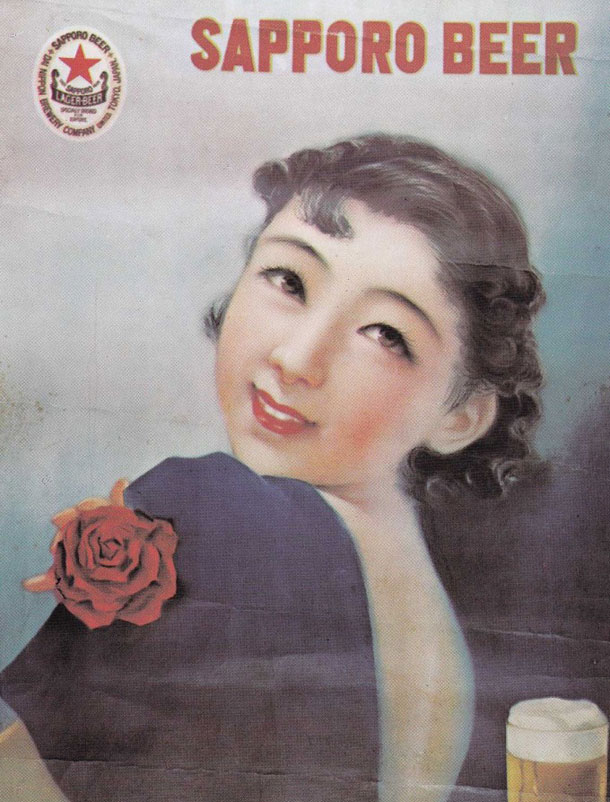
Prewar Japanese beer posters: the most beautiful ads ever made?
Before World War II “Asahi, Kirin, and Sapporo were not known for their richly flavorful product, but could command richly evocative imagery for the posters and postcards that promoted it.” No kidding. Truly beautiful. [Via Boing Boing]
On Local Beer (And A Sudden Recant).
Zak Avery asks a question I don’t know how to answer in his conclusion (sorry, no spoilers). Maybe you can. [Via Are You Tasting the Pith?]
Over a barrel.
Real Ale’s Erik Ogershok tells The Austin Chronicle smaller brewers are finding it hard to obtain barrels in which to age their beers. Several other brewers have been saying the same thing for a while — prices are going up and they are expected to return barrels after using them. This isn’t universal. Ogershok points out breweries with large barrels programs are able to get them in volume. Barrel-aged beers aren’t going away. [Via the Austin Chronicle]
Growers Are Making Bank on This Green, Fragrant Bud. No, Not That One.
Another example of how hops grown outside the American Northwest are attracting attention. Most striking visually is to compare the chart labeled “Where hops are grown” with the one labeled “Hops in new places.” Same data, different scale. [Via Mother Jones]
Lexington Gets a Release.
Jeff Rice on lines. “The craft beer revolution grants us the right to stand in line in order to buy goods to consume like we do elsewhere in capitalist culture. Craft beer therefore, liberates us to be like any other consumer. The most basic aspect of any liberation movement – in theory – is not to overthrow and replace, but to be accepted as the rest. In that sense, craft beer lines equate lines to buy special video game releases or to rush a Walmart cash register the day after Thanksgiving. We’re just the same as everyone else. We like waiting in line.” [Via Make Mine Potato]
Ah, the madness of Budweiser has delivered upon us. Rather that devote another set of Monday links to one topic, as happened two days ago, I’m jamming all the links related to the Budweiser Super Bowl commercial into this one spot. If other water cooler worthy posts show up in the following days they’ll be parked here as well.
Bud's ad trolled the nerds like David Chang and it worked like a charm.
If you spend time with the links that follow you will see that although it is worth being concerned about the underlying context there is definitely some overthinking about the intended message. It is important to remember that AB InBev has an audience it wants to connect with. Reassuring current Bud drinkers it is OK to keep buying the beer is important, as is firing up its sales force. But getting the attention of the forty-four percent of drinkers 21 to 27 who have never tried Budweiser is a priority. I’m pretty sure 44% have tried a beer brewed by a Brewers Association member. I don’t understand how the commercial might convince the beloved millennials to try Bud, but do know they are important to AB InBev.
Not to fall into the over analyzing trap, but . . .
a) Doesn’t it seem AB InBev underestimated the blowback and forgot how fast that can happen on the Internet (including videos)? MillerCoors sure figured it out, as did people selling T-shirts and homebrew kits.
b) Even though you can understand that the company creating the agency wouldn’t know AB InBev was about Elysian Brewing (when the footage was shot) and that Elysian made a pumpkin peach beer that reference still shouldn’t have happened.
and c) how in the world do you not secure the BrewedTheHardWay url in advance? (And cheers to Focus on the Beer for its generosity.)