Continuing beer education

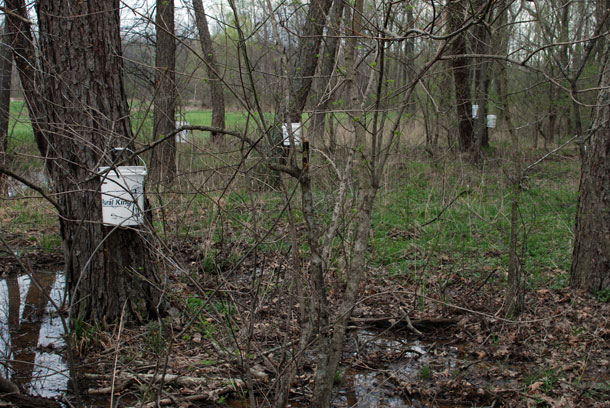
The sap buckets were hung by the birch trees with care.

Harvesting birch sap for Scratch Brewing beer

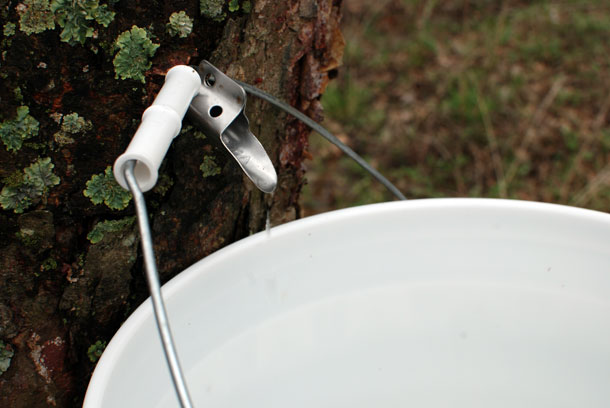
This was the view yesterday in a stand of woods outside of Ava, Illinois. Those are birch trees. If you look carefully in the photo below you will see a bit of sap falling from the tap into a bucket.

That sap will end up in a beer made at Scratch Brewing. As will toasted bark from the trees and Chaga, a crazy an intense smelling, parasitic mushroom that grows on the trees. Chaga is known by the Siberians as “Gift from God” and the “Mushroom of Immortality.”

Visiting Scratch is like enrolling in a Continuing Education class.

Birch sap tapped - will end up in Scratch Brewing beer

The importance of being the local beer

MONDAY BEER LINKS, LIMITIED MUSING 04.06.15

Loving Local Beer.
Brewers Association economist Bart Watson writes: “Typically, I cite studies that suggest the flavor/variety dimension as the primary driver, with local taking an important, albeit secondary role. But there is increasing evidence that local may be rivaling flavor as a motivating factor for craft beer buyers.” And he cites figures from a Nielsen survey that indicate that local is more important for beer drinkers than wine drinkers, and that this is more pronounced for younger drinkers (that makes it an important Trend with a capital T).

Before reflecting on the sea change this represents, Watson suggests the beer/wine part shouldn’t be surprising, given that two thirds of the wineries in the United States are located in three West Coast states. But that’s two thirds of more than 8,000 wineries; there are more than 100 wineries in each of ten states beyond California, Washington and Oregon. There might be another reason that beer does better on the “buy local” front. Either there some stronger connections local brewers are making with consumers or they have done a better job convincing drinkers what they are serving is as good as the drink from elsewhere (the cachet of French and California grapes cannot be discounted). Or both. Probably both. [Via Brewers Association}

Local and variety work well together. [Via Twitter]

Why People are Still Mad at 10 Barrel, Why That’s OK, and Why It’s Also OK to Still Drink Their Beer.
The headline pretty much summarizes what the post is about. But consider this thought that I’ve seen written many times before: “Craft beer culture is not like tech start-up culture or fashion culture, or any of the other businesses where start-ups are expected to work to build something worth being acquired by a larger corporate entity. There are a lot of reasons for that—enough to fill a book—but I think the biggest ones are that American craft beer culture has always defined itself as a group of outsiders.” I’m not sure how that works when these beers constitute 20 percent of the market. [Via Willamette Weekly]

Good things in small packages?
Back in 2007 when The Session began part of the idea was that posts would include, but not be limited to, conversation about specific beers, what some would calling drinking notes or tasting notes. Friday was the 98th gathering of The Session — pretty amazing, but you’ll also notice a host is needed for May — and you’ll not find many drinking notes these days. But you can always count on The Beer Nut for notes done well. [Via The Beer Nut]

The Impending Death of the Beer Festival (as we know it).
Ryan Hannigan worries about the “massive influx of corporate-style beer fests” in Colorado. And that, “Essentially, it’s the suburbanization of beer festivals. Every one looks and feels the same.” [Via Focus on the Beer]

The Wit and Wisdom of Shaun Hill.
Shaun Hill is not simply a brewing savant; lots of interesting stuff in these outtakes gathered reporting another story. But this bothers me:

“The thing is now—with this modern light-speed dissemination of information with the Internet—is that nobody wants to just learn something for themselves. They want you to tell them. ‘What’s going to happen if I do this, this, and this?’ My response is always, ‘I don’t know. Let me know.’ The only time I really discuss that stuff is with friends like Chad Yakobson from Crooked Stave, Gabe Fletcher at Anchorage, or John Kimmich. Friends. We’re working off each other. It’s a give and take. It’s not just a take. If you have something to give me, yeah, I’ll share with you.”

There’s much truth there. The best way to find out what might result when you add x ingredient or try y process is to actually do it. That’s called learning. And part of being smart about brewing is understanding that not everything happens exactly the same way in every brewery. But whatever it is you are particularly liking in the beers you are drinking today — aromas that result from dry hopping, flavors the result from understanding the critters inside barrels, even the subtle cracker-like texture of a spot-on pale lager — there’s every chance that the brewer who made that beer learned a few things directly from another brewer. Or to put it another way, the second brewed shared something with the first without considering the quid pro quo. [Via Boston Magazine]

CAMRA – Heading for a High Wall?
A view from the inside. ([Via Tandleman’s Beer Blog]
The 20 largest breweries, 50 years later

The Brewers Association has released its lists of the nation’s largest brewing companies and the largest companies it classifies as craft breweries. Those are 50 deep, and you can find them many places, including the BA website. There they also list what brands are made by each company, like that Craft Brew Alliance includes includes Kona, Omission, Red Hook, and Widmer Brothers brands.

Two breweries listed were in the top 10 both in 2015 and 50 years ago, but one of them — Pabst — brews none of its own beers today. You might say things have changed. And you might think about what the list will look like in 50 more years.

20151965
1Anheuser-BuschAnheuser-Busch
2Miller CoorsSchlitz
3PabstPabst
4D.G. Yuengling & SonFalstaff
5Boston BeerCarling
6North American BreweriesSchaefer
7Sierra NevadaBallantine
8New BelgiumRheingold
9Craft Brew AlliancePfeiffer
10GambrinusHamm's
11LagunitasMiller
12Bell'sCoors
13DeschutesOlympia
14StoneSchmidt
15SleemanStroh
16MinhausNational
17BrooklynPearl
18Duvel MoortgatLucky Lager
19Dogfish headGenesee
20MattJackson

Before you ask, Yuengling was No. 72 in 1965 and Anchor Brewing was No. 121.

Loading up the Beer Ark with this week’s links

MONDAY BEER LINKS, MUSING 03.30.15

Two by two …

Highland Park Brewery brews Yard Beer from backyard ingredients.
On terroir, and the vine’s microbiome.
Foraging for brewing ingredients in southern Illinois or in the middle of North Carolina is relatively easy to imagine. But in Los Angeles? That’s why Bob Kunz at highland Park Brewery offers a lineup of “predictable” and “unpredictable” beers. I think there’s more to the notion of place-based beers than how terroir may affect the flavor of hops, peaches or cucumbers grown in California versus Missouri, but the new study by the American Society for Microbiology (as described by Steve Heimoff) surely has implications for beer. [Via Los Angeles Times and Steve Heimoff]

This New Feminist Beer Is Waging A Battle Against Sexism In Advertising.
Does craft beer have a sexism problem? Binny’s rejects Happy Ending.
The “big picture” story of the week. Still important. Still not going away. [Via Fast Company and Chicago Tribune]

Going Blind with Pliny the Elder.
Pliny The Elder And Blind Pig: Trophy Beers Within Everyone’s Grasp.
Tasting blind — be it beer, wine or smoked meat — tells us something we may not know about what we are tasting and also about ourselves. However, most of the time when I drink beer knowing where it was brewed and who brewed it enhances the experience. That may be true if you are pursuing the rare and exotic or if you are content with the familiar. [Via All About Beer and The Concourse]

How to Beer Blog.
The Secrets of Book Publishing.
Inside baseball, and well done. Your mileage may vary. You don’t really have to be as focused to blog as Boak & Baley suggest — at least I hope not, because I’m not — but it helps. And, thankfully, my experience with book publishing has been less stressful than Jeff Alworth’s.
[Via Boak & Bailey, and Beervana]

How to Make Your First Commercial Batch of Beer in 75 Easy Steps.
“56: Why did it just shut off? Why did it just stop and shut off?”
The second list here could be any of several “best” compilations published last week. I might have come to peace with the fact these lists exist but it doesn’t mean I am inclined to link to one. [Via Beer Flavored Ales]

Working with a living beer community

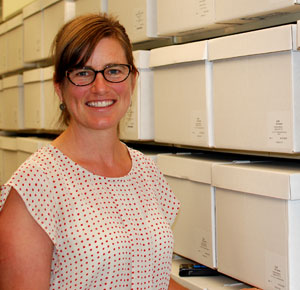
Tiah Edmunson-Morton, Oregon Hops & Brewing ArchivesThe March/April edition of DRAFT magazine has a lovely little story about Tiah Edmunson-Morton and the Oregon Hops & Brewing Archives. (Full disclosure: I wrote it.)

I’ve pointed to her Tumblr blog on several occasions, first because I thought you might be interested, and second, perhaps selfishly, because we need to encourage this sort of activity. In one sense it is easier to collect history as it is happening; in another it is harder because you don’t know necessarily know what is going to be important.

Yesterday Alan McLeod wrote, “The interesting thing about the early bits of anything is how little data there is to work with.” Indeed.

So a couple of quotes from Edmunson-Morton (in case your copy of DRAFT hasn’t arrive in the mail):

“The ultimate irony is you can digitize it all, but how to you make sense out of it?”

“You are no longer dealing with people how have died and left their nice box of stuff. You are working with a living community. The power is not just records, but people’s memories. One person fills in a blank here, another person there.”

As I wrote in the story, OHBA makes too much sense to be one of a kind. But, to repeat myself, we need to encourage this sort of activity. Edmunson-Morton is already practicing what Paul Eisloeffel of the Nebraska State Historical Society calls holistic collecting, “thinking outside of the archives box” and gathering artifacts as well as historical documents. This doesn’t necessarily come naturally.

“Dealing with artifacts has always been a problem for standalone archives,” he said. He’s a proponent of the sort of proactive collecting Edmunson-Morton has begun. “It is important for archivists to be able to look at what’s happening in a culture and start collecting now. I really applaud her.”