Still talking beer terrior and watermelon wheat

MONDAY BEER LINKS, MUSING 07.13.15

Can Craft Beer Truly Express a Sense of Place?
Of course the answer it yes. That doesn’t mean I expect every beer will, or even that I think it should. Nonetheless, I’m delighted to see more people joing the conversation. As a whimsical aside, the other day the Wall Street Journal reported that Fox will begin selling Duff beer. And the thought occurred to me that if they are going to claim it tastes of Springfield, The Simpsons will finally have to reveal where Springfield actually is located. [Via Punch}

What do protected origin labels mean to consumers?
There are 1,310 Protected Order of Designation, Protected Geographical Indication, and Traditional Specialty Guaranteed products in EU. No surprise the designations are turning into marketing tools. [Via Food Navigator]

“Faux craft” – a good thing?
Not a new question, but it provoked interesting comments, including this from StringersBeer: “Choice has to be about more than what yr beverage is flavoured with, or what it wears on the label. A choice of who we get to deal with – of what kind of organisations, with what ethos – that’s a good thing.” Indeed. You are not required to care if a beer is locally brewed or if it comes from a conglomorate, but you should be allowed to. [Via Stonch’s Beer Blog]

Critical Drinking with Dave Engbers of Founders Brewing Co.
A long one, so I suggest Pocket-ing it. Interesting fact: they’ve not got 4,700 bourbon barrels filled with various beers deep inside an old gypsum mine that has been turned into a storage facility (for multiple Grand Rapids businesses). And to return to a question that runs through all of the stories above, Engbers says, “The biggest challenge our sales crew has is ‘local.'” That doesn’t mean that you can taste local, but it sure indicates it matters. [Via Good Beer Hunting]

20 tradicních ceských hospod, kde se psala historie. Basically “20 traditional Czech pubs with history.” It is in Czech, but Google will volunteer to translate you. Check out the stuff on the wall at Klášterní pivovar Strahov (Praha). [h/T Max Bahnson]

Israeli Craft Beer.
Hebrew has no word for “brewery.” Who knew? Anyway, “There is something mystical about walking through the market after hours, when it is closed and the piles of post-market trash are being carried away, the yelling has stopped, the crowds are gone, and turning the corner into a side street you find Beer Bazaar open.” [Via Make Mine Potato]

AND VIA TWITTER …

When this showed up on my Twitter feed Friday I went looking for a photo (below) taken at the Oregon Brewers Festival last year. It shows the line for Hell or High Water Watermelon Wheat brewed by 21st Amendment. (Taking a picture of a line at a beer festival is a losing proposition. Too hard to show. But I wanted to send it to Shaun O’Sullivan, the 21st Amendment brewmaster, who didn’t stick around for the Saturday session. So I put my glass down, took the photo and sent it to him via a DM. When I turned around I discovered somebody had stolen my glass. Who the heck steals a glass at a beer festival?)

By the time I found the photo it was apparent how ill advised the Budweiser tweet was. Click on the date (or here) and you will see the responses just keep coming.
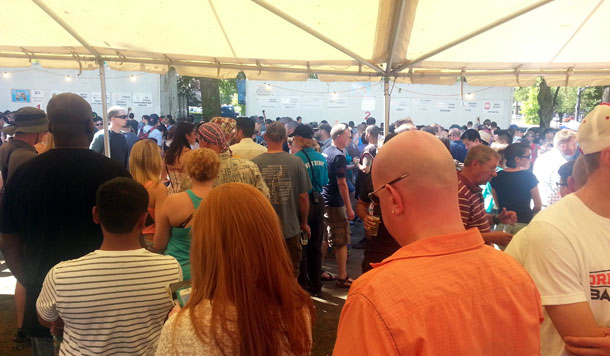
Line for 21st Amendment Hell or High Watermelon Wheat at the Oregon Brewers Festival

Postmodern beer, *that* root beer & The Murky

MONDAY BEER LINKS, MUSING 07.06.15

The Good, the Bad & the Murky — Brew Britannia: One Year On.
Boak & Bailey are taking off the rest of July after posting this epic (11,000 words) look at the British beer world since their wonderful book, “Brew Britannia,” came out last year. If you find sentences like this seductive (I do) you need to set aside some time: “When we can buy a bottle of London murky brewed in Berlin, Barcelona or San Diego, then we’ll know for sure it has become ‘a thing’, as London porter did centuries before.” [Via Boak & Baley’s Beer Blog]

Toward sincere beer.
I wish I’d written this. The first chapter of the book that was going to be called “Indigenous Beer” and now might be called “Brewing Local” will be about place and, ahem, terroir. That means trying to sort out post-industrial, postmodern, and post-Fordist beer. This really smart writing from Joe Stange increases the chance I might make sense. [Via DRAFT]

It was going to be a long night at U Fleku…
Here’s the first chapter of a beer book “that would fuse travel, history and beer” Adrian Tierney-Jones was thinking he’d like to write. The book is on hold for now, and it might take on a radically different form should it spring back to life, so Tierney-Jones writes we should consider this a first draft. In any event, another one for Pocket. [Via Called to the Bar]

The story behind Not Your Father’s Root Beer.
Geez, this alcoholic beverage sure pisses off some people on my Twitter feed. I’ve succeeded so far in paying a minimum of attention, but this story from Don Russell is too interesting to pass on. [Via Joe Sixpack]

Is New York in Danger of Losing Its Most Interesting Beer Boutiques?
If so, why? [Via Grub Street]

The Haight.
Ron Pattinson was in California last month, among other things selling what he calls his “proper” book— “Home Brewer’s Guide to Vintage Beer.” But he has many more to choose from. Reading about adventures in and about The Haight reminded me of some of the travel-oriented ones, of which “Trips (South)” is my favorite. [Via Shut Up About Barclay Perkins]

Seventeen Go To Berlin And Have A Really Good Time.
Road trip. [Via Total Ales]

Small is the new IPA

Earlier today Brewers Association economist Bart Watson tweeted this:

“Small breweries are small. Looking at CA 2014 data: Breweries < 100 bbls = 144. 100 < breweries < 1,000 = 209. Breweries > 1,000 = only 122.”

If you break down the percentages that’s 30% under 100 barrels, 44% between 100 and 1,000, and 26% at 1,000 or more.

What does this mean? I don’t know. I’m not sure how much context taking a look at numbers from way back adds, but since I totaled them up . . .

In 1879 California had 195 brewers, with 24 selling less than 100 barrels, 118 between 100 and 1,000, and 53 more than 1,000. The percentages: 12%, 61%, 27%.

Of course, brewing was pretty new in California, less than 30 years old. New York breweries went much further back and there were more of them than in any other state.

So New York in 1879: 30 breweries under 100 barrels, 116 between 100 and 1,000, 219 above 1,000. That’s 60% of the breweries selling more than 1,000 barrels and almost 100 more than California today. Only 8% of New York breweries made less than 100 barrels, 32% between 100 and 1,000.

Could food trucks make that much difference?

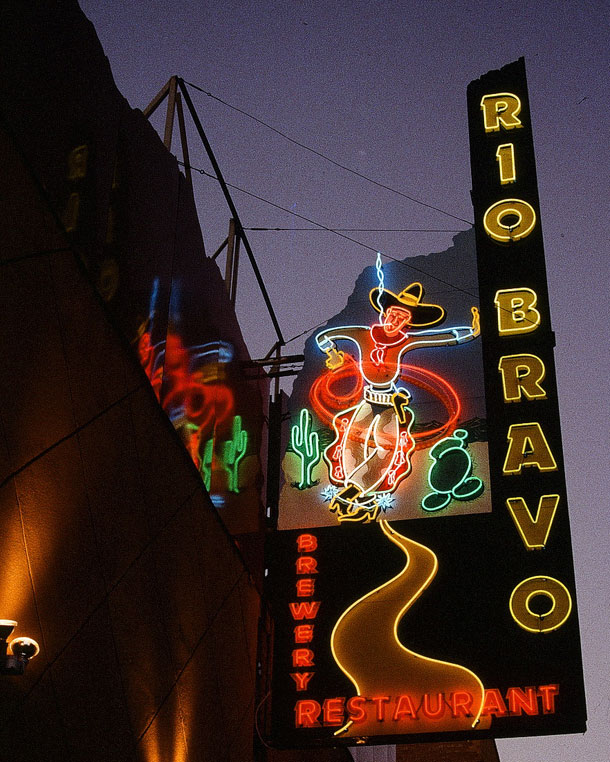
Remember this beer drinking neon cowboy?

This was one of the best brewpub signs ever, but when Rio Bravo Brewing in Albuquerque closed1 in 1997 apparently nobody saved the neon.

Rio Bravo Brewing, Albuquerque, circa 1995

Now a new Rio Bravo Brewing is ready to open, although not in the original spot (appropriately, considering the neon, on old Route 66). And not with the same sign.

*****

1 Alvarado didn’t last a year.

Have beer links, will read

MONDAY BEER LINKS, MUSING 06.29.15

Does It Matter Where Your Beer Is Brewed?
This is one of several stories that followed the announcement that Anheuser-Busch InBev has struck a deal to compensate the drinkers who thought they were getting German-brewed Becks when the beer was in fact brewed in St. Louis. It illustrates how business-oriented people think about beer. The way I view it: One of the attractive things about (well brewed) beer from a smallish, local brewery making unfiltered, unpasteurized beer is that it becomes something else when it leaves home, something else not as good. Put another way, to understand the power of local taste the beer where it’s not local. [Via the Wall Street Journal]

Lagunitas to build 3rd brewery in Azusa, CA.
Last week Lagunitas founder Tony Magee announced on Twitter (he is @LaguntiasT) plans to open a third brewery, this one in southern California. On Thursday he added details and context with this post at BeerAdfocate.com. Among (many) other things he writes: “Some serious-minded beer lovers and some brewers have a legitimate idea that growing in a modest way is the ‘correct’ way. But that is pious thinking if it excludes other approaches to salvation. Small is great and big, if done thoughtfully and without compromise, is beautiful too.” He obviously leans toward big, very big. I’ve cited a quote from Peter Bouckaert of New Belgium Brewing more than once, but here you go again. “Brewing is a compromise. You have to take into account so many factors,” he said, in this case talking about the actual brewing process. “It’s an interaction. You need to see any beer you create as a holistic thing.” But to move beyond the brewhouse and to elaborate on the previous musing, brewery owners decide how big they want their brewery to grow and at some point “without compromise” becomes, let’s say, challenging. [Via Beer Advocate]

In Pursuit of Impartiality.
I don’t agree with everything here — as noted above, I don’t think “drink local” is a crock — but credit to Alistair for giving Budweiser an unbiased tasting. Extra credit for not claiming it tastes of corn. [Via Fuggled]

Bavarian Beer Trail Cycle: Gears and beers.
“It’s a ride on which I’ll need to pace myself, not so much on the bike, but in the breweries.” [Via Stuff]

The Story Behind That Photograph.
Part confession and part plea: There are stock photos out there I swear I’ve been looking at for 30 years. I might have gone too far down the rabbit hole. But please publishers, if it appeared in Michael Jackson’s “World Beer Guide” don’t use it. Now to the point, a lovely story. [Via Boak & Bailey’s Beer Blog]

A visit to Orval brewery.
Ed Wray visits Brasserie Orval, takes lots of photos and collects plenty of information. Much has changed since I wrote “Brew Like A Monk.” That shouldn’t be a shock — one of the points I make over and over is that change if constant, if not dramatic, even at Trappist breweries. It might be the use of a different barley variety or a tweak in the process. At Orval, for instance, they changed the way they add Brettanomyces not long after I wrote BLAM, dosing Brett inline at bottling rather than during the secondary fermentation. These days Orval is dry hopped with French Strisselspalt rather than Styrian Goldings (what I saw when I visited). This must be pretty exciting for French hop farmers, because Strisselspalt acreage has shrunk considerably since Anheuser-Busch began dialing back what it bought in 2008. [Via Ed’s Beer Site]

Duluth blasts St. Paul for billboard’s beer boast.
Who can’t love talking trash in Minnesota? One more reason for me to look forward to visiting Duluth next month for All Pints North. [Via Pioneer Press]

Southern Brewing Co. Takes Local to the Next Level.
Ingredient of the week: beets (in a Kölsch). [Via flagpole, h/T @austinlouisray]

Coriander, soap and science
My friend Yvan De Baets has been known to describe beers brewed with too much coriander (cilantro) as “coriander soup.” This video indicates that maybe he should be saying “coriander soap.”