Or 25.07.16 if you prefer.
Either way, Happy Birthday Daria.
Or 25.07.16 if you prefer.
Either way, Happy Birthday Daria.
There will be no beery links here Monday. A busy Saturday will be followed by two days of birthday (not mine) travel. On Saturday I’ll be taking a stroll along Manchester Avenue with Lew Bryson and Joe Stange. Some walking, more drinking of beer, probably even more talking. I expect that, among other things, we’ll be discussing topics that came up in two posts that would be in the Monday links were there to be Monday links.
1) Imports in the Age of Local. Set aside a little time, because Bryan Roth has more than 3,000 words to say about this at Good Beer Hunting. Both Joe and Lew have written, or co-written, several guidebooks. These are reminders that people travel to drink local. Makes sense to me. For centuries beer has also traveled to meet drinkers. But the business of selling it might have changed.
2) The Dreary Reality Of Those Disclosures. It will easier to follow what Alan McLeod has to say if you subscribe to Boak & Bailey’s newsletter (scroll down and look on the to sign up). This is a topic I might think about too much, over think, and make too complicated. Alan and I discussed this after Boak & Bailey wrote about it in their May newsletter and I included some of the thoughts last week in the keynote speech at the Beer Bloggers Conference in Tampa. The bloggers heard the fourth rewrite of the keynote, and it needed at least four more.
But I’m OK with Julia Herz’s takeaway: “Journalists need to be held to a higher standard.” (And that means holding ourselves to a higher standard.) Self righteous? Probably. Certainly more explanation is needed, and maybe Joe and Lew will help push me past the tipping point that will result in the addition to the mission statement here.
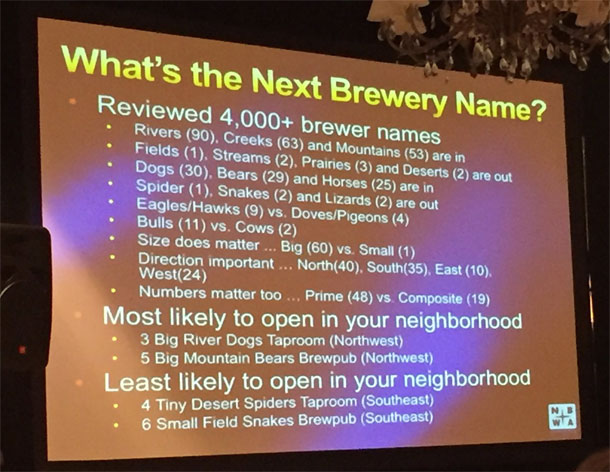
Hopportunity Cost: Craft Brewers Brawl Over Catchy Names as Puns Run Dry.
Maybe, maybe not. But this story does present an opportunity to show this slide Lester Jones, NBWA economist, displayed during his presentation at the Beer Bloggers Conference in Tampa. Photo courtesy Sean Jansen. (Disclosure: As the keynote speaker I had my way to the conference paid.) [Via Wall Street Journal]
How Craft Brewers Advance Science, and Make Better Beer.
The blurb on Twitter that pointed me to this story mentioned hop genome sequencing (which Hopsteiner and others have been working for some time), so I headed there expecting something in the way of new information about that. Didn’t happen. So perhaps it is my disappointment typing, but to write Paul Mathews — who is scary smart — “is to hops what John James Audubon was to birds” is ludicrous. How hard would it have been to discover what E.S. Salmon accomplished a century ago? [Via The New Yorker]
Bits we Underlined In… How To Run a Pub, 1969.
This book “is a product of its time: it is addressed entirely to men, women are a problem to be dealt with, and the language around race might shock some modern readers.” Of course, that it offers such a candid look at its time is what makes it so interesting. [Via Boak & Bailey’s Beer Blog]
‘Heaven’s water’: the launch of Amsterdam’s first rainwater beer.
I feel like I should have known this: “It seems like a disruptive idea, but when we researched it, in the Middle Ages, [Dutch] breweries set up near churches and cathedrals to catch rainwater runoff from their roofs.” [Via The Guardian]
The Foundations of a Great American Brewery: The Early Architecture of Anheuser-Busch.
The first installment in what apparently will be several posts. For additional reading I recommend ordering a copy of Brewery History 155: “Approaches to the history of American brewery architecture.” [Via St. Louis Magazine]
Ich bin ein Berliner (Weisse) – A beery tour of Germany’s capital.
And more suggested additional reading: Joe Stange writes about Berlin in the current issue of DRAFT magazine (in print, no link). [Via Beeson on Beer, h/T Matthew Curtis]
This brewery is using cutting-edge Artificial Intelligence to engineer the perfect beer.
Not intended as a political statement, but were I to come up with a beer brewing algorithm I would not call it ABI. [Via Digital Trends]
Yes, this is my tweet, but several of the responses were delightfully clever (click on the date to see them).
Tampa. Beer Bloggers conference. Write your own caption. #BBC16 pic.twitter.com/PAuGuw6kDP
— Stan Hieronymus (@StanHieronymus) July 8, 2016
An Open Letter to Beer Nerds.
Pick a paragraph, any paragraph. I’ll take this one.
The labels explain how this unique, captivating brew came into existence. Often there’s a “journey” involved, which displays excellent creative skills on the part of the marketing team involved, and no flagrant embellishment or anything. Beer is important and political and life-altering.
[Via McSweeney’s, h/T James Schirmer]
How Big Will Craft Get? Oregon’s Numbers are Suggestive.
There was more sky is falling speculation last week, but also this. [Via Beervana]
Burned Boise beer brewer back on job, wins awards.
“Sometimes, you don’t realize how dangerous your job is, because you do it every day. We work around chemicals and batters, slippery floors, heat. There’s so many different hazards in the brewery and you just take them for granted when you’re around them all the time.” [Via Idaho Statesman]
Beer essentials: The craft beer boom in Japan shows no sign of running dry.
“Ichiri Fujiura, proprietor of Watering Hole and soon to be brewer at Tharsis Ridge Brewing, notes that homebrewing and craft beer are ‘totally unrelated in Japan.’” And this story suggests that is one thing that slow the advance of in craft beer. [Via Japan Times]
MSU’s century-old barley revived to make Michigan beer.
“The whole idea of locally grown barley to make your brew is resonating very well with the microbrew industry.” [Via Lansing State Journal, h/T Jeff Alworth]
So many oral histories, such wonderful women!
It’s really important to collect this history. [Via Oregon Hops & Brewing Archives]
Categories of grisette and grisette strength.
“As usual there are still questions, but hopefully this helps to make the identity of grisette a bit more clear and helps you choose what strength to make your grisette.” [Via Hors Catégorie Brewing]
10 questions to ask about any wine appellation.
Granted, I think in terms of beer and appellations more than most, but there are some parallels here. [Via The Gray Report]
Following acquisition by Lagunitas/Heineken, the Independence Brewing Company of Austin TX will rebrand as the Ironic Brewing Company.
— The Beer Nut (@thebeernut) June 30, 2016
Tom Vanderbilt’s You May Also Like:Taste in an Age of Endless Choice is an absolutely fascinating book, although it likely won’t leave you satisfied if you expect an answer to the question of why we like what we like. But he introduces so many ideas, like this one from an article in The Guardian: “With the internet, we have a kind of city of the mind, a medium that people do not just consume but inhabit, even if it often seems to replicate and extend existing cities (New Yorkers, already physically exposed to so many other people, use Twitter the most). As Bentley has argued, ‘Living and working online, people have perhaps never copied each other so profusely (since it usually costs nothing), so accurately, and so indiscriminately.'”
He gets around to discussing beer late in his book, and that might make its way into something I write. Meanwhile, a non-beer-specific thought from the final chapter, which is made up of a series of messages—a sort of “field guide to liking” in a world of infinite variety.
We like thing more when they can be categorized. Our pattern-macthing brains are primed to categorize the world, and we seem to like things the more they resemble what we think they should. Studies have found that when subjects look at pictures of mixed-race people and are asked to judge their attractiveness, the answer depends on what categories are used; a Chinese-american man may be judged more attractive than men in general but less attractive than Chinese men. Things that are “hard to categorize” are hard to like—until we invent new categories. We like things more when we can categorize them, and categories can help up like things more, even things that aren’t as good as we might like.
You could read this as an argument for more beer styles. Please do not show it to anybody with the power to make that happen.