It starts with a quote from Louis Nizer, the famous trial lawyer and author. He said:
“A man who works with his hands is a laborer; a man who works with his hands and his brain is a craftsman; but a man who works with his hands and his brain and his heart is an artist.”
Don Russell paraphrased Nizer to begin a column about making a case for extreme beer. Along the way he wrote:
Beerwise, the most inspired brewers are not just craftsmen, they are artists.
If there is an avant-garde movement among these brewers, then it is extreme beer.
And later, “Session beers, I’m afraid, are Norman Rockwells.” This led to a flurry of discussion at Seen Through a Glass about *xtr*m* beers and session beers, but only a little about brewers as artists.
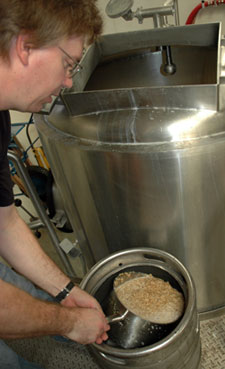 So what about that? And who to ask? How about brewers? I printed out part of Russell’s column and took it to the recent Craft Brewers Conference in Austin. I showed it to a dozen brewers along with another old saying that farmers make wine and engineers make beer.
I asked them to choose one of four words to describe themselves: artist, artisan, engineer or farmer.
Eight chose artisan, four chose artist. Most also said it depends on how you read the definitions.
“Since artisan essentially takes in artist, then artisan is appropriate,” said Garrett Oliver of Brooklyn Brewery.
Matt Van Wyk of Flossmoor Station Brewing, a school teacher before he was a brewery, suggested a fifth choice. “Some brewers are just producing a product for profit,” he said. “I lean toward artisan.”
Steve Parkes, the brewer for Otter Creek and Wolaver’s Organic Ales, picked artist, “By this definition.” Parkes is also the owner and lead instructor of the American Brewers Guild. Does that mean he’s in the business of training artists?
“No, artisans. The artistic component needs to come from them,” he said. “I can’t train that. I can give them the tools, but I can’t teach inspiration.”
Tony Simmons (call him an artisan) of Pagosa Springs Brewing told an interesting story. He was in a class at Siebel Institute with a woman who worked at Miller Brewing. Out of curiosity, not intent, he asked her what it would take for him to get a job brewing at Miller.
“You couldn’t,” she told him. “We hire engineers and train them to brew our way.”
John Graham of Church Key Brewing was part of the conversation. “On tours I tell people it is half heart, half science. You have to follow the rules,” he said. “I’m definitely not an engineer.”
We decided we might have to track down a German brewer to find an engineer. But that’s wouldn’t be Eric Toft, a native of Wyoming who now brews at Private Landbrauerei Schönram in Bavaria.
“I got into this because I thought it was artisinal and connected to agriculture,” he said. “You still need to be an engineer to run a brewery.”
Matt Brynildson of Firestone-Walker Brewing made it clear he envies Toft. “I would call myself an artisan, but I totally wish it could be more farmer,” he said nodding toward Toft. “Or to be as connected as he is.”
Toft regularly visits farms where his hops are grown and others that produce barley for his malt. All are less than 200 kilometers from the brewery. He uses a single barley variety – Barke – without regard to yield or how easy it is to grow (always a consideration for malt companies), paying farmers more if necessary to get what he wants (flavor).
Toft was in Austin helping the Association of German Hop-Growers and the Halltertau Hop-Growers Association. They advertise hops as the “spirit of beer,” but I’ve also seen hops referred to as the heart of beer or the soul of beer. Others call malt the soul of beer.
Does your beer even have a soul? Do you care? The answers could be no, and no. That’s fine. But I suspect if you said yes the fact it is brewed by artists or artisans might be as important as the ingredients used.
 I’m beginning to realize there is a chance I will break down and try Miller Chill. Got to be curious, right? Check out the number of posts at
 We already know this, but brewing innovation doesn’t stop at the U.S. borders. It isn’t limited to Belgium, or even to such new-ish hotbeds as Denmark and Italy.