Monday morning musing: Is mainstream beer back?

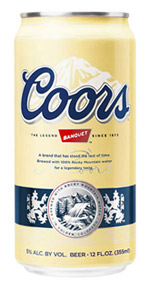
Coors BanquetA few beer related thoughts to help you shake free of any turkey-infused haze remaining after a long weekend:

– The Milwaukee Journal Sentinel examines if a surprising surge in sales of Coors Banquet means full-calorie, mainstream, premium-priced beers can end their 21st century slide (Budweiser sales, for instance, fell 21% from 2002 to 2006).

There’s also the chance that Coors’ modest gains aren’t a barometer of anything. “I guess it shows you that a brand can get so small that it can finally find its base,” said Eric Shepherd, editor of Beer Marketer’s Insights.

– As the story about the effects of higher prices for beer ingredients continues to gain momentum (here and here) the Cascade hop has turned out to be a poster child for the sudden change.

As recently as July the industry was still working through years of oversupply and you could buy a pound of Cascade for $3. Now we’re hearing about prices 1000% higher. That’s the spot market and not what the average brewer will pay in 2008, but it make you realize . . .

Once again, Stone Brewing is a step ahead. The brewer of Arrogant Bastard Ale and other hop-infused beers has been Cascade free since opening in 1996. OK, that doesn’t mean its hops cost any less, but it makes a good story.

Bill Brand begins a story about “extreme beers” with a discussion of price, in this case asking ” Would you pay $30 for a bottle of beer?”

John Alderete is betting that some of us will. Having persuaded a group of investors to back him, he is now fermenting an experimental trio of beers in wine barrels at Devil’s Canyon Brewing in Belmont, pending licensing for his own Mayfield Brewing Co. in Palo Alto.

Mr. Alderete may make terrific beer, and $30 for a 750ml bottle might turn out to be a great price, but one reason that high prices for a few special releases seem reasonable is that the breweries selling them have established a history of excellence.

If we start paying $30 for beer just because of the price tag looks impressive then Alan has a right to complain.
Tumbling UK pub sales not the whole story

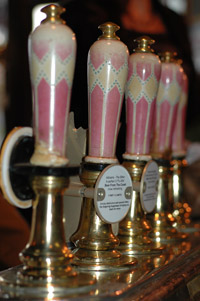
Nag's Head handpumpsMelisa Cole offers a brilliant post today regarding the news that beer sales in UK pubs have slumped to their lowest level since the 1930s.

I’m a bit confused and bemused by this announcement and what it’s trying to achieve; because, to my mind, all this proclamation is going to generate is stories about beer not being popular any more, which – if we’re not careful – could surely just become a self-perpetuating prophesy.

As important, she points to a dichotomy that has a direct parallel in the United States. Independent and local brewers report growth of 7.5% per year at the same time larger breweries bemoan tumbling sales.

Much like in the U.S., where those who call themselves craft breweries enjoy double digit growth although overall beer sales remain flat. Here the smaller breweries have gone out of their way to point to these numbers whenever media business stories mention beer losing market share to wine and spirits.

In fact, the number of breweries in the UK is increasing and more pubs are selling cask-conditioned beer. Overall cask sales languish because the “big four” multinational brewers &#151 who control 56% of the ale market &#151 don’t support cask.

Cole writes:

The major problem I DO have is that, once again, the BBPA’s doom and gloom approach does nothing more than further damage beer’s image by painting it as a product that nobody wants.

What this report seems to say to me, when viewed in light of Pete Brown’s findings, is that, actually, fewer people want mass-produced products and that the big brewers are missing out by under-investing in their cask brands.

Sound familiar?

Further reading: Five reasons beer sales have slumped.

Can a brewery be big and human scale?

An interesting exchange of comments at the Portland Beer Blog regarding the Widmer-Redhook merger. Summarizing the two views:

One side: “The ruin of the American Beer revolution may be paved by over sizing, takeovers and greed.”

The other: (From Vasilios Gletsos of BJ’s Brewery) “I feel this is a short cut to thinking, and promotes a mythical narrative to the history and growth of the beer industry . . .” You really need to read it all.

The U.S. Brewing IndustryThe debate about if size matters (no, not like the e-mails you have sitting in your spam folder) ain’t going away. See Small, the New Big – and beer, a post from 20 months ago that quotes from a debate from 10 years before, one that had already been going on for 10 years.
Phil Markowski addressed the issue last week while talking about the decision by Southampton Bottling to strike an alliance with Pabst Brewing. As a result he will direct brewing of some of his brands at the Lion Brewery. “It’s less romantic, but the perception that you can’t make good beer on a large scale is wrong,” he said.

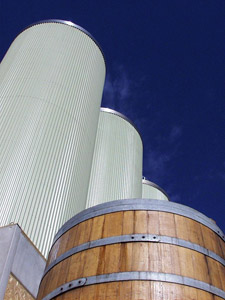
In my head I’m a journalist and I know he is right. Those New Belgium Brewing conditioning tanks pictured above hold 2,100 hectoliters (more than 55,000 gallons each), and New Belgium has grown to be bigger than the Lion. The primary fermentation tanks at Duvel Moortgat in Belgium hold 1,000 hectoliters each. I have Duvel in my beer fridge.

In my heart I’m enough of a beer romantic to make Journalist Stan nervous.

My interest in the role of place in a beer; the how and the why; the ingredients and process . . . is, on the one hand, basic curiosity &#151 and desire to find a story you won’t fall asleep to before I finish. On the other hand, these things represent emotional attachment to an idea of artisanship that many, maybe even me, relate to production size.

If you’re still with me give this, The artisanal movement, and 10 things that define it, a read. Lost Abbey brewmaster Tomme Arthur, whose batches are basically small and smaller, passed it along a while ago and I think it helps to frame this conversation.

Each item on the list might be worth a blog post, but for now I’m claiming the first: A preference for things that are human scale.

Scroll back to the picture above. It’s from 2000, the year New Belgium installed the 2,100 hecto tanks and had its first four 60 hecto wood vats (“foedres”) delivered. Shortly thereafter the brewery acquired six 130 hecto foedres. Now six more are on the way. The tanks mostly yield La Foile, but also a variety of other even-harder-to-find wild beers. As impressive as the brewery’s tank farm will be with the new additions, its wood capacity still won’t equal one of those big tanks on top.

I’d call La Foile production human scale.

The outdoor area where those four foedres sat a few days while they were “swelled” (filled with water) long ago was encompassed by one of many brewery expansions.

New Belgium Brewing has grown into a big place, and a busy place. It wouldn’t be accurate to have described it as a ghost brewery last June on the weekend Widespread Panic was playing at nearby Red Rocks, but it sure was less crowded. It happens every year; Panic comes to Red Rocks and everybody wants off.

Eric Salazar does his best to accommodate them. Salazar and his wife, Lauren, manage the NBB barrel program, but that’s only part of their jobs. She oversees quality control and he works in the brewhouse, including production and scheduling logistics. He didn’t even pretend to complain a few days after the concert when he talked about the juggling involved.

“Maybe there’s going to come a time we can’t do this,” he said, “but I hope not.”

Makes you think that big and human scale don’t have to be exclusive.

Cottage brewing, circa 1912

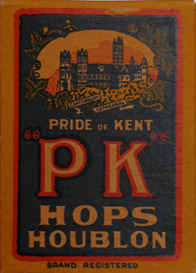
Hops boxThink homebrewing is difficult? Here’s a recipe for Cottage Beer:

“Good wheat bran 1 peck, water 10 gallons, hops 3 handfuls, molasses 2 quarts, yeast 2 tablespoonfuls; boil the bran and the hops in the water until both bran and hops sink to the bottom; then strain through a sieve, and when lukewarm put in the molasses and stir until assimilated; put in a cask and add the yeast; when fermentation ceases bung, and it is ready in 4 days. This is an excellent beer.”

Doesn’t look too hard, although I’m not vouching for the end result. The recipe comes from a book called Lee’s Priceless Recipes, which included “300 secrets from the home, farm, laboratory, workshop and every department of human endeavor.”

The book was published in 1912, and I expect that all the pages in Beverages section were stamped “NOT LEGAL TO MAKE” when Prohibition came into full force in 1919.

Not sure why Corn Coffee would have been illegal, other than it sounds disgusting. Cherry Cordial, Egg Wine and Peruvian Bitters I can understand.

As you can tell by the Cottage Beer recipe, most of these were kitchen-size batches. But the one for Home-Brewed Ale? That takes 8 bushels of malt, 12 pounds of hops and 5 quarts of yeast. It calls for straining the cooled wort through a flannel bag into a fermenting tub.

My point? That ingredients grown and processed specifically to use in beer make better beer. And better ingredients make it better still.