A beer trophy, safe at home

HopsWe’re finishing up a few quick days back at home in New Mexico, dealing with the sort of chores that come up after eight months away, heading out this morning with an eye toward catching Mardi Gras parades in New Orleans before the real craziness begins.

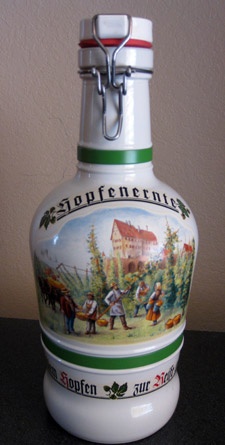
We breathed a sigh of relief when we took some items out of the back of the RV, such as a paper mache plague mask Daria has been taking care of since Venice (yes, it would be perfectly appropriate in NOLA, but it’s not going) and this flip-top bottle. The story:

We’re headed from Nuremberg to Frankfurt on the day before we are to fly home. We’ve decided to revisit Rothenberg, where we spent the first night 15 weeks before. Along the way we pass by Bad Windsheim and decide to drive by the brewery (it’s still pretty early on a Sunday morning).

We see a sign for a “floh markt” and start following the arrows. We’re just window shopping because our bags are full and carrying anything else on would be impossible. Of course we could see something small . . . but it appears there’s nothing at a price we’d want to pay. Not until about the last table we could stop at.

Here’s a lovely flip-top bottle with a hop mural decorating it. I’m confident it will be too expensive to tempt me. I ask. Seven euros. Daria thinks she heard seventy, which seems a little high but almost makes more sense than seven. “Sieben?” I ask. The woman nods. A dilemma. How could I possibly get this home?

The woman apparently thinks I’ve paused as a negotiating tactic. “Sechs,” she says. I guess that closed the deal.

I ended up making room for it in my backpack. What the customs official in Frankfurt had to say when it went through the scanner is another story.


Do you know your beer dinosaur’s ‘born on’ date?

Let’s play connect the dots:

– Why those long trips can kill your wine. Beer is just as vulnerable.

– Anheuser-Busch InBev has decided its beer really has a longer shelf life than previously advertised and is dropping the “born on” date for its smaller brands (which just might be the ones that don’t sell as quickly).

Thanks to Charlie Papazian for pointing out this story. It has generated a firestorm of comments, so set aside a little time and go read them. Just for fun, one of my favorites:

Wait for the announcement that InBev has found a way to “without affecting quality” shorten the brewing process.

– Now stick with me for a paragraph or two. Maureen Ogle often comments on the future of print, meaning both books and newspapers, so maybe this won’t seem like such a leap. Thoughts from Bill Wyman’s Hitsville blog:

But let’s face it, most newspapers sucked in all sorts of ways, and one of the main ways was opting toward blandness and timidity wherever possible, as as not to offend the older folks subscribing to the papers.

The truth was, it didn’t matter what they published. People just subscribed to newspapers! For the ads, because they always had, some even for the news. . . . Now, things are different. Online, you have to publish stuff people want to read, or fashion it to seem that way.

What happens if you replace the word newspaper with big breweries, publish with brew, read with drink and consider craft breweries are as “disruptive” as online publications?

Do you see any dinosaurs in the room?

There’s a lot going on in St. Louis these days — I hope we’re going to be able to spend a few days there next month — that’s interesting to watch even if you don’t want to drink the beer. And I expect you, I and the guys who’ve been drinking Bud at the corner bar for 30 years don’t necessarily see things the same way. (You might be shaking your head at my newspaper analogy, but then that’s where I used to work.)

My view: Big breweries created opportunity for small-batch breweries by only offering incredibly bland beer. Now Inbev brings ruthless cost-cutting to the game. Perhaps the company’s consummate skills in the marketplace will crush the competition, but it looks to me like more opportunity for small-batch breweries. But remembering it takes more than “simply” brewing beer with flavor. It takes the skill to get that flavor clear to our glasses.


Time for craft beer nostalgia

Is this a sign of maturity? At least a bit of what’s new these days just might be old, meaning “retro beers” don’t have a monopoly on nostalgia.

First, Bill Brand reports that New Albion Ale will be back for SF Beer Week. He’s got the details in his pdf newsletter, but check his blog for updates. Basically, Don Barkley — who worked with Jack McAuliffe at New Albion — pulled out an old ledger McAuliffe started and found a recipe.

Barkley brewed the “new” New Albion Ale at Napa Smith, the winery-brewery he recently went to work for after retiring form Mendocino Brewing.

You can see photos of a much younger Barkley in “MICROBREWERS: 1981 – 1996: A Photo History” (this link goes to a promo at YouTube). The self-published book contains hundreds of photographs of microbrewery pioneers along with commentary. It costs $64.95 (details).

What I’m really looking forward to is Jay Sheveck’s “Beer Pioneers,” a documentary he hopes to have ready in 2010. He’s been working on this for more than 10 years, and is still collecting interviews. He posted a teaser at Facebook that’s certainly worth your time. (Please read the text here as well.)

He’s even got footage of the elusive Mr. McAuliffe.


Monday musing: Beer as an object of art

Well I give up all my sculpturing
‘Cause my life had gone all sad
An I went to work down at the factory
It weren’t art … but it weren’t bad
So
They put me on the assembly line
Putting plastic leaves on the plastic palms
Then they shipped then off the Los Angeles
Yeah it weren’t art … but it weren’t wrong
Now some say it’s pathetic
When you give up your aesthetic
For a blue collar job in the factory
But all that exhibiting
Was just too damn inhibiting
For a beer drinking
Regular guy … like me

                    – Terry Allen, Oui

A couple of years ago I asked a few brewers attending the Craft Brewers Conference to choose one of four words to describe themselves: artist, artisan, engineer or farmer.

There’s another part to this. If you think your favorite brewer is an artist does it follow that some beers must be art? A great beer, a wonderful dish or an excellent bottle of wine may be aesthetically pleasing as art, but that’s not the same as being an object of art.

Does it seem like a stretch to call these art?

I got to thinking about Terry Allen’s lyrics because I’m writing a lot about process while working on the wheat beer book. The way I see it there is a rather wide gap between the skill need to put “plastic leaves on plastic palms” and to put consistently good beer in a glass. Just not sure how you describe that skill.

I didn’t ask Bernard Kuhn, brewmaster at Weissbräu Freilassing in southeastern Germany, if he’d call his beer art, but I’m pretty sure the answer would have been no. Kuhn brews three regular weiss beers and one winter special, no flavors of the month, following quite traditional methods (decoction, open fermentation, true bottle conditioning). But what he talks about first is quality.

“You cannot always do the same process,” he said. “You have to brew good beer out of shitty malt. That’s the skill of the brewmaster.”

Is the art in what a brewer actually does in the process or end result, in neither, in both?

Random travel note: Today we’re off to Archer City, Texas, to wander through the multiple buildings of Booked Up, the antiquarian book store operated by author Larry McMurtry. This could be dangerous.


Can craft brewers actually duck hard times?

A canary in a coal mine?

Jeff Alworth has been trying to figure out how the recession is influencing craft beer sales. My gut feeling is that he’s on to something.

Look, I’m not predicting that a bunch of craft breweries are going to go out of business, but stories like this one, “Craft brew sales on the rise as more offbeat beer flavors hit Superbowl coolers,” seem a little too good to be true.

When you look at all the things people aren’t buying these days it would hardly be surprising to see a luxury, affordable or not, like craft beer on the list.

Yes, I’ve seen the reports from many brewers who say they are still in expansion mode, who are having trouble keeping up with orders. Is this, in economist-speak, a leading indicator or a lagging indicator?

Guess we’ll find out soon enough.