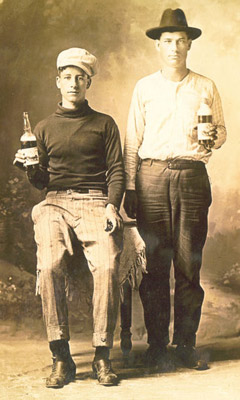
Brewing with corn and potatos

Thank goodness for Google books. Otherwise if you wanted to read The theory and practice of brewing, from malted and unmalted corn, and from potatos it would cost you $602.75 plus shipping.

But you can read this argument for brewing with potatoes, apparently spelled “potatos” in 1829, for the price of your Internet connection. Author John Ham (not that John Hamm) makes an elegant case for the spud.

“This root contains, intermixed with its fibrous part, a juice which is not pleasant to taste, (although a great detergent or substitute for soap) and also a large quantity of fecula, or starchy matter, a great part of it to no degree inferior to the finest arrow-root. It is this fecula alone that constitutes the value of the potato in brewing . . .”

Time to add another category at the Great American Beer Festival?

More on the myth, or not, of handcrafted

Ashton Lewis, a sometimes book author and “wizard” for homebrewers, but more important brewmaster for Springfield Brewing Co. in Missouri, takes the notion that “manual brewing equipment produces beer with more ‘character’ than beer brewed using automation” to task this week.

His post, titled “Progress Is a Funny Thing”, concludes:

So the next time you take a brewery tour at some a brewery with awesome automation, like New Belgium, Boulevard, Sierra Nevada, Harpoon, New Glarus, etc, etc, don’t bag on this great modern technology. Rather look at all the details of brewing that are given more attention because the brewers are not busy raking out spent grains by hand or manually turning valves that, thanks to modern automation, are being controlled to do what the brewer has pre-determined should be done.

The topic of “hands on” always gives me reason to pause. It’s important to be skeptical about change. But what we should be focusing on is ingredients and process, not if a brewer manually opens a valve or uses a computer to control that valve.


Call me irresponsible – I drink ‘craft’ beer

If you are . . .

– 105% more likely than the average person to drive hybrid cars
– 77% more likely to own Apple Mac laptops
– 65% more likely to purchase five pairs or more of sneakers every year
– and 32% more likely to not be registered voters.

Then you are probably a Blue Moon drinker.

I’m not making this up. It’s all in an Advertising Age article headlined “What Your Taste in Beer Says About You,” reporting research by Mindset Media. Of course any story in which the “the concept of beer-as-window-to-the-soul . . . (is based on) psychographics” is required by law to be silly.

What kind of beer do these guys drink?Let’s go straight to the stereotypes: Budweiser drinkers are 42% more likely to drive a truck than the average person and Blue Moon drinkers drive hybrids. Corona drinkers are 38% more likely to own three or more flat-screen TVs and Michelob Ultra drinkers are 34% more likely to buy life insurance.

As you might have already guessed I’m a psychographics skeptic; so much so that I didn’t believe in it even before it was invented. But why let that get in the way of a little fun? Consider this:

[xxxxx] are socially liberal and usually quite willing to go against convention. They really hate moral authorities, and believe children should be exposed to moral dilemmas and allowed to come to their own conclusions. They can also be sarcastic and snide in order to get a point across.

“Blue Moonies” or “craft” beer drinkers?

The former. Real “craft” beer drinkers are lumped together into one category that does not include Blue Moon drinkers.

This group is more likely to spend time thinking about beer rather than work. They are more open-minded than most people, seek out interesting and varied experiences and are intellectually curious. Craft-beer drinkers also skew as having a lower sense of responsibility—they don’t stress about missed deadlines and tend to be happy-go-lucky about life.

Craft-beer lovers are 153% more likely to always buy organic, 52% more likely to be fans of the show “The Office” and 36% more likely to be the ones to choose the movie they are going to see at the theater.

Like looking in a mirror, right?


Weekend beer reading: Why the big bottles?

A few links for your weekend beer reading pleasure:

– Shouldn’t stronger beers be sold in smaller bottles? I understand all the reasons why they aren’t, but Don Russell’s discourse on big beer bottles had me asking myself that question.

– You’ll want to put your thinking cap on before considering the questions Alan has, starting with What Is Actually The Enemy Of Good Beer? Give them some thought and leave him a comment.

– Nice that the Houston Chronicle wrote about Saint Arnold’s new downtown brewery. Nicer still that 51 people took the time to comment.

– When trends collide. Alexander D. Mitchell IV relays the news that a) the Baltimore Sun is retiring the “Kasper on Tap” beer blog because “did not attract a large enough audience to sustain it” and b) the Washington Post has made Greg Kitsock’s beer column a monthly status rather than biweekly feature.

Given the recent apparent success of Baltimore Beer Week and the fact that more newspapers around the country regularly feature beer stories this seems a little curious. In Texas, which has been as hard a place for small-scale breweries to get a foothold as anywhere, 51 readers comment on a story about Saint Arnold. In The D.C. area, an early bastion for better beer, the newspapers can’t figure out how to talk with beer drinkers. This is another reminder that newspapers are in disarray.


Tasting: Double blind and by the numbers

Pardon that the example of how this could work comes from the wine world — making it my second wine originated post in two days — because it’s very beer relevant.

Also, as Ed Carson pointed out with his comment about the rather dense posturing about the brain and wine that there’s a danger of violating New Beer Rules, Nos. 5 and 8, about taking beer too seriously. Fact is you don’t need to know the alcohol content or bitterness units (let alone the level of isoamyl acetate) in a beer to figure out if you like it, or to discuss it with friends.

Part one explains the premise:

There is a better way to review wine. It combines objective assessment with subjective preference in a compelling way, while providing story, context, and accountability. I’m talking scores out of 100, producer and regional story and commentary, double blind tasting, labs for insight and accountability, contextual pop-ups for technical and wine specific information, and beautiful creative commons photography. Pla-dow!

But you know what? No one will ever use such a system. Too risky. High potential for embarrassment. Too costly. Too time consuming. The list is endless.

Basically, double blind means the person (or people) doing the review would taste a beer without knowing anything about it. Not the brewery. Not what country it might be from. Not the style. Just look at the beer, taste the beer, evaluate the beer.

In Part 2 Pinotblogger provides an example of how it works. He starts with his score, the price of a bottle and a summary. Then he writes about the region where the wine was produced and the winery. Next more about his impression from the blind tasting. This is followed by the costly part that likely isn’t going to happen in wine or beer, and might actually be frivolous. That’s sending it to a lab and having it evaluated.

As you can see he got the grape variety wrong and it turned out the particular bottle at quality control issues. I think that makes it more educational.

What beer numbers would I like to see from a lab? The alcohol content and bitterness units for starters. My friend Derek Walsh, who lives in the Netherlands, provided those as well as original gravity, apparent attenuation, color and pH for many beers featured in Brew Like a Monk and Brewing With Wheat (February, Brewers Publications). He calls it a “strip search” and those numbers can tell you a lot.

Still more numbers related to quality control — like the level of dissolved oxygen or the amount of carbon dioxide — would also be interesting. But none of it is going to happen so I better get back to giving you the promised book reviews.

For further reading I suggest checking out the comments at Pinotblogger.