Is this what it takes to run a brewery?

How much does this tell you?

The quote appears on Page 95 of Dethroning the King: The Hostile Takeover of Anheuser-Busch and comes for Charlie Claggett, an advertising guy. That’s the context.

“I think he (August Busch III) genuinely wanted to pass it down to his son, but I think his son wasn’t up to it. August used to say, ‘You’re thinking with your heart and not your head.’ And I think that was the weakness his son had. He just did not have the cutthroat willingness to cut somebody off at the knees if he had to, which is the way you have to run a brewery. Because let’s face it, anybody can brew beer. It’s just a matter of who has the most money and power, and who is willing to do what it takes.”

What a paragraph.

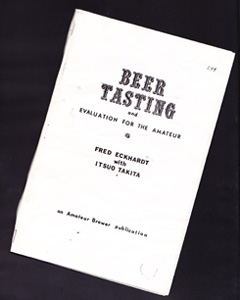
Bottled beers types and categories (1977)

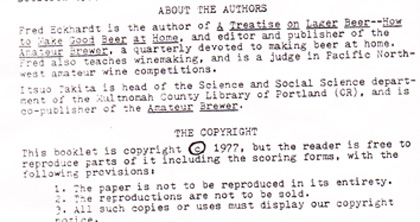
Beer Tasting and Evaluation for the AmateurIn 1977, the same year Michael Jackson wrote The World Guide to Beer, Fred Eckhardt and Itsuo Takita published a somewhat smaller tome.

Beer Tasting and Evaluation for the Amateur wrapped everything up in a modest 16 pages. As you can see, it was printed at a local copy shop. In the preface they wrote their goal was to “get the ball rolling.” The bulk — if such a word is appropriate in something this size — focused on flavor, evaluating that flavor and providing a score (based on a 20-point scale, somewhat different than the one that appeared in Eckhardt’s Essentials of Beer Style in 1989) for each beer.

Quite honestly, I had forgotten I had this. It toppled off the shelf when I reached for Essentials to see how many styles Eckhardt had cataloged in 1989 (38, in fact).

Because the pamphlet also included a list of “bottled beers types and categories” that some might call beer styles, and because styles are certainly the topic of the week, with hopes I’m not violating the copyright . . .
I. PALE OR LIGHT COLORED BEERS
A. Low Alcohol Beers.
B. US-type Pale Beer.
C. Malt Liquors.
D. European Continental type lagers.
E. English type ales.
F. European top fermented beers, except class R.
G. Amateur pale malt extract beers.
H. Amateur pale beers, 50% or more grain malts.

II. BROWN OR DARK BEERS
I. U.S. type dark beer.
J. Continental European type dark beers.
K. Strong Ale – celebration ales or beers (over 6% alcohol by weight).
L. Brown Beer.
M. Porter.
N. Stout.
O. Amateur dark malt extract beers.
P. Amateur dark beers, 50% or more grain malts.

III. OTHER BEERS.
J. Still malt beverages.
R. Lactic Acid Beers.
S. Miscellaneous hopped beers.
T. Original rice beers.
U. Other beers not included in the above.

The list totaled three classes, 21 types (4 of them amateur) and 85 categories (examples to follow).

The number of categories in a type varied, as did the detail about each. English type ales (E.) was pretty typical.

E. English type ales. English hop bouquet (Bullion, Fuggle, Golding). Color light straw to dark amber. Pale ale isn’t.

1. English best bitter. Intense, impressive or pronounced ale character, 4.6% /w; 4.8-7.2% /v alcohol. Bass Pale Ale. Whitbread Pale Ale.

2. English Mild Ale. Pronounced, noticeable or mild “ale” character. 3-4% /w; 3.6-4.8% /v alcohol. Rainier Ale.

3. U.S. stock ale. Intense, impressive or pronounced hop and “ale” character, alcohol over 5% /w; 6% /v. Rainier Ale.

4. U.S. mild ale, pronounced, noticeable or mild hop and ale character, 3-4% /w; 3.6-4.8% /v. Color straw to amber. Ballantines Ale.

The authors write, “There are undoubtedly errors in placement of description. We would appreciate correction, and additions.” But it was an interesting first version, saying much about the state of beer in the United States at the time (600 brands available, including 110 imports).
Headache ahead: Considering beer styles

Do you have a vested interest in whether a beer is a porter or a stout?

Do I?

Two words, but for me a two-part question.

* First, I drink beer. And I have an affection for imperial stouts. So if a beer is called “imperial porter” should I trifle with it?

You answered no? Flying Dog Gonzo Imperial Porter won the gold medal in the imperial stout competition at the 2008 World Beer Cup. So much for style guidelines holding a beer back. Just to be sure it still suits me I had a dram of the barrel-aged version just this past weekend. Flat out great.

That doesn’t mean that if I walk into a brewpub pub and happen to be in a dark-and-roasty mood I won’t look at the chalkboard listing beers and wonder just what the brewer intended when he chose to brew those “styles.” My solution is simple. I ask for a sample of each. Something you can do in a brewpub, but can’t at the beer store when confronted by a six-pack you haven’t seen before.

* Second, I write about beer. It is hard for me to avoid the concept of style, as mindbending as the discussions may be. But do I need to weigh in on the topic every time a spirited discussion breaks out on beerblogland? It seems I do this time.

“Does beer style matter? Does it mean anything?” was the topic at the British Guild of Beer Writers’ annual seminar this week. I suggest starting with Mark Dredge’s summation and questions that popped into his head (that’s where I stole the line at the top from), then the comments that followed.

Lots of fun reading resulted from that gathering — Pete Brown, Parts I and II, and Velkly Al for starters. And serious questions from Adrian-Tierney Jones.

More to come, I suspect, but I’m leaving it to others. Instead I suggest tomorrow we climb into the wayback machine and read what somebody other than Micheal Jackson was writing about styles in 1977 (the same year Jackson first published his World Guide to Beer). That should be fun.

Meanwhile, to the question Mr. Pencil & Spoon posed: “Beer Style: Does is it Matter?” In I moment I will signal WordPress it is time to publish these words. Then I will head to what here in the southwest constitutes a beer cellar (a chest freezer with a temperature controller). I will retrieve a beer, not a style. OK, the style might be “strong.”

I think the answer to the question is, “Not tonight.”

These monks are growing hops

A brewery is under construction.

The first hops crop is in.

An update on Monks’ Ale.

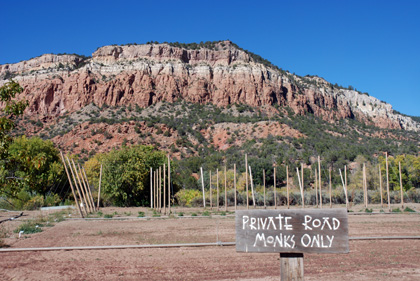
Just make sure your muffler is in good repair before tackling the last 13 miles of road on the way to the Monastery of Christ in the Desert northwest of Abiquiu, New Mexico.