Are weird beers part of the ‘attention economy’?

Today at Grantland, Michael Kruse examines how those wild and wacky uniforms have helped turn the University of Oregon into a national college football power.

. . . the head of a think tank and a visiting scholar at Berkeley’s Center for Research on Social Change gave a wonky talk at a conference in Cambridge, Mass. “We are headed,” Michael H. Goldhaber said, “into what I call the attention economy.”

Economics is the study of the allocation of resources that are scarce. These days, more and more, information isn’t scarce. Stuff isn’t scarce. What’s scarce is attention. The companies that win in an attention economy are those that win the eyeballs of people who have too much to look at. Too many ads. Too many screens in too many places. Too many games on too many channels on too many days of the week.

“This new economy,” Goldhaber said in Cambridge in January 1997, “is based on endless originality.

“If you have enough attention,” he added, “you can get anything you want.”

The uniforms got the attention of talented high school football players from across the nation. That’s where the story begins and ends, but there are other things to consider along the way. These are relative to beers that are different; weird, wacky, extreme if you like, but maybe only as different a pumpkin beers.

At times this might be a little unsettling.

“If attention is now at the center of the economy rather than stuff, then so is style,” UCLA professor Richard Lanham wrote in The Economics of Attention: Style and Substance in the Age of Information. “It moves from the periphery to the center. Style and substance trade places.

“Push style to the extreme,” Lanham wrote, “and it becomes substance.”

I can’t decide if this sounds like an endorsement for extreme beer or an Onion headline.
Putting the Dutch in Dutch Porter

I’m not sure if “A Practical Treatise on Brewing, and on Storing of Beer; Deduced from Forty Years Experience” by William Black, published in London in 1835 will make the bibliography for “For the Love of Hops,” so I am passing along this little story now.

It comes from a short chapter called, “The Flavour of London Porter.”

No single house can imitate the different flavours of all the great London establishments; but the flavour of any particular house can be easily acquired. By the way, talking of flavours, I must take the liberty of relating an anecdote which is said to have occurred during the last century.

A Dutch house was at that time in the practice of getting whole gyles of porter brewed on purpose for them by one of the great houses of London. On one occasion one of their clerks was in London at the time of brewing, and went to see the process. He unfortunately, poor fellow! tumbled into a copper of boiling worts, and before he could be got out again was actually boiled to death. The gyle of beer was sent to Holland, and turned out to be very good.

The next batch sent, however, did not turn out so well, and the Dutch house complained of it, saying it had not the same flavour as the preceding gyle. The answer returned by the London house was, that they had no means of giving them precisely the same flavour, unless they would send them over another Dutchman. So much for flavour.

How can Dutch Porter not be a recognized style?

It’s official: America now IPA country

Sales of IPA (known as India Pale Ale in some parts, but quite often simply called I-P-A) in the United States surpassed those of Pale Ale for the first time this year, according Symphony IRI.

The data is primarily for packaged goods sold in supermarkets, convenience stores and big box stores but there’s no reason to believe it would be different if you tossed in, say, beer sold on draft in pubs and bars. Officially, “seasonal” is the No. 1 craft beer style, but that’s another discussion.

In his “Craft Brewing & Mid-Year Category Sales Review” Dan Wandel of Symphony IRI told Brewers Association members that IPA sales increased 39 percent in the first half of the year, continuing an ongoing trend that moved it past Pale Ale. He also said that IRI now tracks 253 IPA brands, up 76 in the last six months.

As well as reporting the basic facts (craft beer dollar sales increased 14.3 percent in the first six months, but sales of Blue Moon and Shock Top beers are growing even faster) Waddell took a look at what else beer drinkers buy when they go shopping for their favorite brands.

When craft beers are in a shopping basket there’s a good chance that imported wine will be. Products such as natural cheese, fresh cut salad, yogurt, orange juice and canned tomatoes also index highly. When other beer is in the basket there’s a much higher chance cigarettes, processed cheese slices and frozen pizza will be.

And we wonder how stereotypes get formed.

Edelstoff: A beer fit for a hop queen

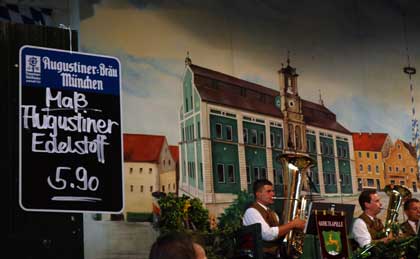
Did I mention the Edelstoff from Augustiner was from the wood, and a lot cheaper than beer at Oktoberfest in Munich?

Veronika Springer, Hallertau Hop Queen

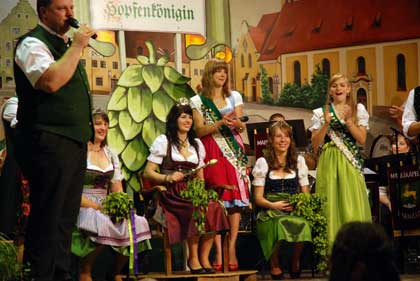
Last week Veronika Springer was crowned Hallertau Hop Queen (Hopfenkönigin) for 2011-2012. I didn’t vote for her, but she received 62 percent (1,478) of the votes. The Wolnzach Volkfest tent was rocking, packed with hop farmers and friends washing down traditional festival food with liters of Augustiner.

Veronika Springer, Hallertau Hop Queen

The new queen is well qualified, having grown up on a hop farm and currently working at NATECO2, an extraction plant where hops are the biggest part of the business. She didn’t get my support, or that of several of the brewmasters I was seated with, because she seems to be skeptical about the future of “flavor”1 hops.

Change is afoot in Germany and these are brewers who want to be part of it. That doesn’t mean they are about to abandon tradition, but it does mean the range of flavors from Halltertau hops will soon be broader.2 The crew at the Hop Research Center at Hüll is not interested in copying American hop flavors, but I was there maybe three minutes before I thought, “These guys are not going to be left behind.”

1 With the line between what were once known as “bittering” and “aroma” hops already blurred — and the term “dual purpose” just not cutting it — I’m not sure how the idea of “flavor hops” will fit in, but I heard those words in the UK, Germany and Czech Republic. These could also be called “impact hops.” To the continental palate Cascade is a “flavor” hop; while you’ve got to throw something like Citra or Simcoe at an hop-experienced American for impact. Sound confusing? At least you don’t have to sort it out for a book.

2 These hops are also going to show up in beers brewed in America. I can’t wait.

And the band played on