The conversation over beer doesn’t have to be about beer

The fifth edition of The Cask Report is out today. As author Pete Brown explains, “It’s primarily aimed at publicans who may (or may not) be interested in stocking cask ale, but some of it may be of interest to others who write about beer, or are interested in it.”

He also provides a quick summary in his blog:

  • Cask ale drinkers are more than twice as likely to go to the pub regularly as drinkers who don’t drink cask ale
  • The number of cask ale drinkers has fallen overall – but the number of young people drinking it (18-24) has risen for the second year running
  • This represents a broader recruitment trend – of all people who say they drink cask ale, 10% of them started drinking in the last year. 37% started drinking it in the last ten years. Cask ale drinkers are leaving the market at one end, but they are entering it at the other – a clear sign of the revival of interest in cask ale
  • 2500 more pubs are stocking cask ale this year
  • Cask ale’s share of on-trade beer has increased to 15% – getting on for one in six pints served in the pub
  • He’s got more bullet points, including that “for most drinkers, the dynamic in the market is about ‘familiar’ versus ‘unfamiliar’ beers.” An important lesson for those selling beer; maybe even those writing about beer. But prefaced with a observation worth remembering: “Only the beer industry and beer geeks debate the merits of micros versus big regional brewers.”

    Seems to me you could substitute other topics that are non-issues for most beer drinkers. Like the differences between “microbrews,” craft and faux craft. Or between porter and stout. Of course, I’m hardly one to talk (or write). This blog is for people fully engaged with beer, and not unlike conversations I might have over beer. But is something to remember when my family lets me go out in public.
    Brace yourself for Pretty in Pink beers

    Second Shift Hibiscus Wit

    Just how much longer until Hibiscus Wit is declared an official World Beer Style?

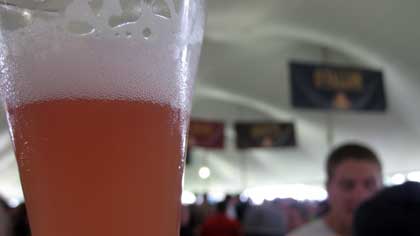
    MateVeza Morpho Herbal Ale is the latest yerba mate beer from MateVeza and pours a distinct shade of pink. I’m wondering if Hamburger Mary’s in Chicago will bring its Hibiscus Wit to the Great American Beer Festival next week. There are several others breweries that use a measure of hibiscus in the recipe, although it’s hard to imagine any of their beers during out pinker than 2nd Shift Hibiscus Wit (pictured above as it was poured at the St. Louis Brewers Heritage Festival in June).

    Hibiscus adds a nice herbal note to a wit beer, at least when its used well. But it’s the color that could make hibiscus beers the next Blue Moon White Pink.

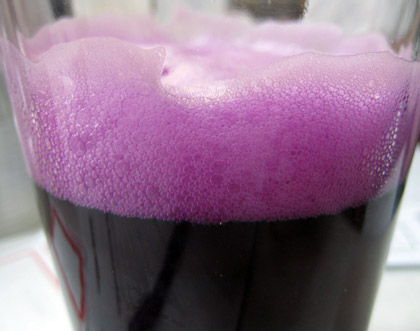
    And of course I’ll be hoping this paves the way for purple beers.

    Prickly Pear Wit - New Mexico State Fair

    Which beer is not like the others? (Reprised)

    This was so much fun at the beginning of the year I’m not sure why it took this long to do it again.

    The goal is to identify the outlier and explain why it doesn’t belong on the list. There may be more than one answer, although I happen to have a specific one in mind.

    a) Dogfish Head 60 Minute IPA
    b) Schlafly Oatmeal Stout
    c) Il Vicino Slow Down Brown
    d) Geary’s London Porter
    e) Arcadia Scotch Ale

    In case you’ve forgotten: Round one ~ Round two ~ Round three.

    The next big market for small breweries?

    Beer made with mango cider, from local grains, with jaggery (sugar) and local berries . . .

    “It’s very easy to sell the idea of a good beer,” he says. “Our clientele is typically aged 25 to 35. They are young, working professionals, typically from single- or double-income families with no kids.”

    But he says they are not drinking to get drunk.

    “It is an identity,” says Mr Talekar. “Saying I drink single malt, vodka or better beer is a way of showing I have evolved, because of the nature of the product I am consuming.”

    From another story about the 600 or so American breweries planning to open in the next couple of years? Nope, this one is from India (the jaggery should have given it away).

    Bars and restaurants are also stocking a growing variety of beer brands to attract an average of 4.3 million young adults coming of drinking age each year. But here’s the most striking number: “Some 600 to 700 million Indians are below the age of 30… that’s three times the size of Europe.”

    The world’s largest brewering companies already knew this, of course. For a bit of perspective, Indian breweries made an estimated 15.6 million hectoliters in 2010, about a quarter of what Japan brews and 3 percent of China’s production.