09.23.19, BEER & FERMENTATION LINKS
1) Ken Burns’ Soft-Focus Look at Country Music.
2) Ken Burns’ New Documentary Is in Love With Country’s Myths, Not Its Music
These two reviews do not reflect how well Country Music has been received. The series is very entertaining and mostly loved. As a consequence, it acts an advertisement for country music, and I’ve already read stories about how one result will be still more tourism in Nashville. That’s fine, but Stephen Thomas Erlewine and Carl Wilson point to what was not included, and how the series could have been better.
Last month, Jeff Alworth wrote about the importance of storytelling to breweries. This includes recruiting others, writers or customers are both welcome, to tell the stories. But the tales the breweries would like repeated pretty much word for word may not be the ones folks such as Erlewine or Wilson end up reporting. That’s why it is called reporting.
When I gave the keynote at the Beer Bloggers Conference (now called Beer Now) a few years ago I opened it by playing a clip from James McMurtry’s “Life in Aught-Three.” It begins, “Not that I advocate drinking or nothing. It’s just my job you see. I used to think I was an artist. Come to find out I’m a beer salesman.”
Just a few things I thought about as I assembled links this week.
3) Making sense of rival tribes.
Mike Veseth writes about Wagnerians and Martians and conflicting ideas of wine in America. Wagner believed that wine should be an affordable part of ordinary life and a constant companion at mealtime. The Martian view is that “…anything less than superlative was unworthy, that no price could be too high, and that the enjoyment of wine required rigorous preparation.”
The price question is a constant in beer circles (and pops up pretty much every day). But it is one that brewers must continue to consider if they are serious about inclusivity.
There was plenty of good reading and interesting news last week, so I will leave it to you without comment. Other than suggesting you don’t go directly No. 12, skipping the rest, because the headline is so seductive.
4) Do Electric Sheep Dream of Pilsner? — Halfway Crooks Beer in Atlanta, GA.
5) Riding the Rails: NY Hudson Valley Breweries Near the Metro North Train Line.
6) The Adventures of Nelson and Goldy — Employees of the Month — Pellicle.
7) Under the influence – the empowerment of female beer influencers.
8) The Future of Cask Ale.
9) Why Traditional Cask Ale is Making a Comeback.
10) Craft and local – with Jordi Sánchez Puig of Lupulina.
11) Dixie Brewery rebirth update.
12) Two Amish men escape police after being pulled over for drinking and driving their horse and buggy.
WINE
13) On music and wine.
There are many sections of this article where is would be easy to hit search (wine) and replace (beer). For instance, this, “WineBeer is a multi-sensory experience. We smell it. We taste it. We see it shimmer in the glass, and we feel it wash across our palates. The only sense we don’t use when evaluating wine is hearing.” Oops. Bad choice, because Fred Eckhardt taught us to listen to our beer.
So try this, “Comparing winebeer to music also helps us grasp the importance of complexity beyond flavor. Of course, a great wine will taste of many things from fruit to flowers, soil to spice. But, what keeps us engaged is the order in which these layers of flavors present themselves and how they transform on the tongue.” That works.
FROM TWITTER
MORE LINKS
ReadBeer, every day.
Daily newsletter: Inside Beer.
Alan McLeod, most Thursdays.
Good Beer Hunting’s Read Look Drink, most Fridays.
Boak & Bailey, most Saturdays.

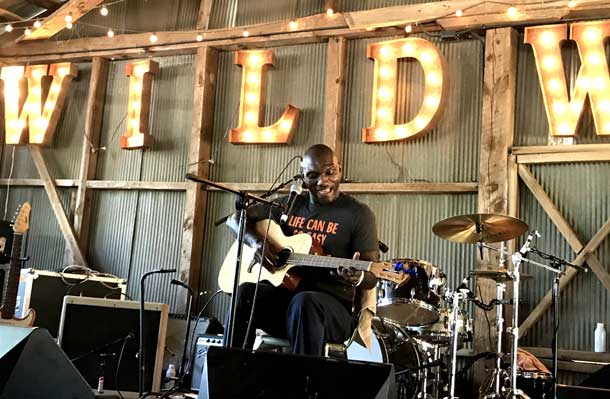 We spent Friday through Sunday listening to live music at a delightful festival south of Athens (Georgia). It was terrific. Cedric Burnside, pictured above, was particularly excellent. Here are links to some excellent beer reading.