Because somebody’s pouring a beer made with pineapple weed

Trees, turning leaves“All truly great thoughts are conceived by walking.”

– Friedrich Nietzsche

I choose the Beers Made By Walking Festival. There may be 12 or 18 or some silly number of events happening in Denver the day before the Great American Beer Festival, and I guarantee you the What The Funk? Invitational will be more crowded. Probably others as well. But when I saw BMBW had moved to Wednesday evening, I redid my travel plans to get to Denver on Wednesday.

The two hours I had to spend at last year’s festival were my favorite two hours of the long weekend. This year I can hang around for the whole event, beginning at 4:30 and lasting until 8 p.m.

Eric Steen started BMBW in 2011 and since then he and others have led brewers and other interested parties on hikes in many different regions. The premise is simple. They ask brewers to go on nature hikes and brew a beer inspired by the trails. Often the result is what Steen calls a “placed-based beer.” Often the beers include ingredients found along the trail. Sometimes not, but what was clear last year is there’s a connection between the brewers and the beers, one that can be contagious.

The result makes for some great eavesdropping, a chance to collect stories without asking questions. Just listening.

The festival starts 4:30 p.m. at the outside space of Our Mutual Friend Brewing Co., about a mile and a half north of the Colorado Convention Center.

Beers Made By Walking Beer List

Bonfire Brewing – Sagebrush Juniper Saison – An ode to the high desert with inspiration from Bellyache Ridge in Eagle, CO.

Boulder Beer – Honey Hips Brown Ale – Honey brown ale brewed with pine nuts, toasted sunflower seeds, wildflower honey, and rose hips added. Inspired by an urban hike through Boulder with Gone Feral.

Breckenridge Brewery – Gooseberry Gose – Inspired by a stroll down Main Street Breckenridge, the tartness from the gooseberries adds complexity to this salty and already sour beer style.

Crazy Mountain Brewing – Naughty Pine – Inspired by a hike at West Lake Creek Road in Edwards, this pale ale includes 25 pounds of pine needles in place of finishing hops and was aged in Breckenridge Bourbon barrels.

Crooked Stave Artisan Beer Project – TBA

Dry Dock Brewing – Hampden Corner Lavender Saison – A crisp saison with lavender harvested right by the brewery.

Elevation Beer Co – Wild Raspberry and Mint Porter – A porter brewed with both wild raspberries and wild mint harvested near Boss Lake.

FATE Brewing – WILD Flower Honey Wheat – The same great honey-wheat beer we brought to BMBW two years ago, inspired by a hike in Boulder’s Chautauqua Park. It has been aged with Brettanomyces in oak for two years.

Fiction Beer Co. – Brett Saison with Rose Hips – A dry, crisp, and refreshing saison brewed with 5 pounds of rose hips at the end of the boil and Brettanomyces.

Fieldhouse Brewing – Squawbush Saison – Made with berries from the indigenous squawbush, they provide a strawberry lemonade-like flavor and sourness to the already tart saison.

Fonta Flora Brewery – TBA

Fonta Flora (In Collaboration with Jester King) – TBA

Former Future Brewing – Sour Red Rye – Inspired by a stroll in the hills of North Carolina, this base beer was aged on blackberries, raspberries, and honey.

Horse & Dragon Brewing – Perambulation Ale II – An American Amber Ale brewed with dandelion root and leaf as well as yarrow flower.

Great Divide Brewing – Rosabelle – Inspired by a walk in Matthews/Winters Park near Red Rocks with the Museum of Nature and Science, this beer is a sour blend aged on plums.

New Belgium Brewing (In Collaboration with Bird Song, Free Range, Heist, and NoDa) – Yours & Mine – A Belgian Golden brewed with beet sugar (a beet sugar plant once occupied NBB’s grounds), lavender from NBB’s property, Colorado sunflowers, and Scuppernong grapes (the state fruit of North Carolina)

Odd 13 Brewing – Gooseberry Saison – Inspired by a walk in Cañon City on a hot July day, gooseberries were added to a sour Saison aged in Chardonnay barrels and then dry-hopped.

Odell Brewing – TBA

Our Mutual Friend Brewing – A wine-barrel fermented Belgian Pale Ale with Colorado wildflower honey and all Colorado wort.

Perennial Artisan Ales (In Collaboration with Scratch) – Carya Ovata – Wee Heavy brewed with toasted hickory bark, collected and toasted at Scratch’s hometown of Ava in a brick oven and brewed at Perennial. Carya Ovata is the Latin name for the Shagbark Hickory.

Riff Raff Brewing – Spruce Juice – Colonial style ale brewed with the new growth from Spruce trees, inspired by trails in the surrounding San Juan Mountains.

Riff Raff Brewing – Juniper Sage – A light bodied, refreshing ale brewed with locally harvested juniper and sage, inspired by a trip along the New Mexico border near Navajo Lake.

Scratch Brewing – Pink Granite Glade Stein Beer – A Stein Beer brewed with pink granite rocks which were heated in white oak embers, added to boil the wort once white hot and then bittered with shortleaf pine, cedar, coreopsis blossoms, wild quinine, and a small addition of hops. Inspired by a hike at the Castor River Shut-ins in the Saint Francois Mountains

Spangalang Brewery – Cucumber Gose inspired by a Denver Urban Garden and The Real Dill.

Stone Brewing – Coffee Milk Stout with Chocolate Mint Inspired by chocolate mint growing locally on Stone Farms.

Strange Craft Beer- TBA

Trinity Brewing – Menacing Chokecherry – Crafted in the spirit of wild harvest. Featuring a feral Brettanomyces strain, aged on rhubarb and wild Colorado chokecherries.

Trinity Brewing – Menacing Huckleberry – A beer only made possible when these berries are ready for harvest, this beer is also aged on rhubarb with a wild brettanomyces yeast strain.

TRVE Brewing – TBA

Wicked Weed Brewing – Terra Locale: Brettaberry – A tart farmhouse ale inspired by freshly baked berry pie. Featuring a half-pound per gallon of strawberries, blueberries, and blackberries, the acidity of the berries with the rustic funk of our house culture are rounded by the flaky crust finish of Haw Creek Honey, Riverbend Pilsner and wheat malts. From our summer memories to yours, cheers.

Wicked Weed Brewing – Terra Locale: Horti-Glory – A tart, farmhouse ale brewed with Riverbend Malt and fermented with our house culture of Bettanomyces. The addition of seasonal elderflowers, hyssop, and honeysuckle transform the rustic house culture into a lovely floral brett saison.

Wild Woods Brewery (In Collaboration with Very Nice Brewing Company) – Pale Ale with Pineapple Weed and Rose Hips. Inspired by the friendship and proximity of these two breweries, this beer opens up with big floral and citrus notes.

Wit’s End Brewing – Irish Red with Heather and Peated Malt. Inspired by an international walk on the Cliffs of Moher, this Irish Red includes a healthy addition of the perennial shrub and special malt.

Session #100: What makes a beer historically accurate?

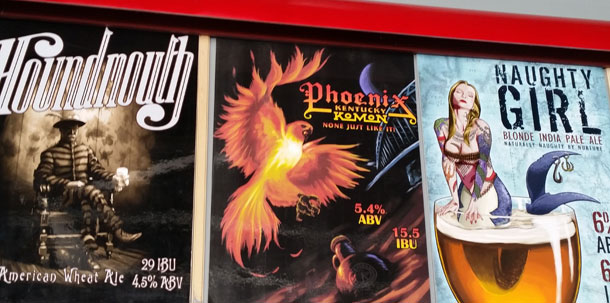
Phoneix Kentucky Komon

Reuben Gray hosts the 100th gathering of The Session and asks blogs to write about “Resurrecting Lost Beer Styles.” Visit his site for links to other contributions.

The SessionWhen David Pierce set out to brew the first commercial batch of Kentucky Common in, well nobody knows how many, years “it was still back when we all thought it (had been) a sour beer.” That was 1994 and Pierce was brewmaster at Bluegrass Brewing Co. in Louisville.
We’ve since learned the idea that the process used to brew Kentucky Common in the early years of the twentieth century included a sour mash is just plain wrong. But, going on the best information anybody had to offer, Pierce began with a 100 percent sour mash, mashing in hot one night and arriving to a horrific smell at the brewery the next day. It was not an easy beer to sell. Roger Baylor at Rich O’s Public House in New Albany, across the Ohio River from Louisville, did his best to support a beer he thought was historically important. He promoted it as “beer formaggio.”

Pierce made the beer periodically in the following years before he left BBC to work for Baylor at New Albanian Brewing. He refined the process, souring only part of the mash, creating a beer than wasn’t as pungent. He thought the fifth, and last, batch was probably the best. “We couldn’t give it a way,” he said. Then somebody suggested they call it a Belgian sour brown ale. The last seven barrels (14 kegs) sold out in a week.

In the years since, meticulous research by Leah Dienes, Dibbs Harting, and Conrad Selle established that if Kentucky Common occasionally turned out sour in the marketplace in the years before Prohibition it wasn’t on purpose, and it certainly wasn’t made using a sour mash. That is reflected in the recently released BJCP Style Guidelines. Kentucky Common is in Category 27, Historical Beers, and the guidelines even specify “Enter soured versions in American Wild Ale.” That works fine for judging in a homebrew competition, particularly in a historic context, but what about modern day commercial beers? Kentucky Common now has a 20-year history in which a sour mash is used in the brewing process.

Granted the modern history is limited. However, if you are looking for a “Kentucky Common” brewed in Kentucky and sold outside of Kentucky it is going to be Against the Grain’s Kamen Knuddeln, which is a blend of a young sour-mashed beer and a barrel-aged stout. Jerry Gnagy gets a lactobacillus starter from Four Roses Bourbon for the sour mash. It makes perfect sense that had Kentucky Common been brewed continuously for a hundred-and-some years that it might evolved or at least different versions would have emerged. Using lacto from a nearby distillery? Makes sense. Include a portion of beer aged in bourbon barrels? Also indigenous.

Last month, as part of the Derby City Brewfest it hosted, Bluegrass Brewing invited participating breweries to make a Kentucky Common. Eight Commons ended on offer, some sour, some not. Because we were in Kentucky the following week I got a chance drink several of them. I certainly could have wasted a larger chunk of an afternoon than I did drinking New Albanian’s Phoenix Kentucky Komon and chatting with Baylor (who has currently stepped away from the business while he runs for mayor of New Albany). It is not an easy beer to make, and the brewery does it just once a year on its smaller four-barrel system — yes, four barrels a year; like I wrote, a pretty limited modern history. “It’s one of my roughest mashes of the year,” brewer Ben Minton said, in this case because of the percentage of corn and temperamental false bottom in the mash tun. “It comes out a little different every time.”

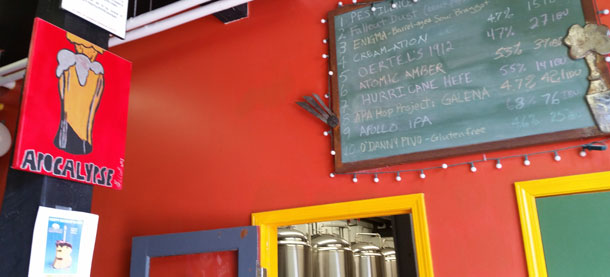
Apocalypse Brewing, Louisville

Two historic (in other words, not sour) versions I had at Apocalypse Brewing were equally delightful. Dienes had her Oertel’s 1912, which is based on the records in Oertel’s brewing logs and the only example of the style in the BJCP guidelines, on tap. Harting brought his homebrewed version. It is the only beer he struggles to keep on tap. “Oh dad, can I take a common home?” Harting said, quoting one of his children. “I’m sure it was a fabulous bucket (growler) beer,” he added.

This works for me. Kentucky Common of the past. Kentucky Common of the present. Kentucky Common of the future. There doesn’t have to be just one.

In NOLA, ‘city beer’ brewed with magic

Some times I have so much fun doing research I feel a bit guilty. Unless I can convince myself that magic is somehow indigenous there’s little chance New Orleans “city beer” is going to make it into “Indigenous Beer: American Grown.” So I’ll just share this passage from “Germans of Louisiana” now:

Before the 1850s a beverage called “city beer” was consumed by the common man in the saloons and restaurants of New Orleans. This concoction was made according to a secret formula from fermented molasses and vermouth1 but contained no preservatives. Consequently it would spoil during transportation and had to be drunk soon after it was brewed. Beer drinkers added syrup to mitigate the herbal taste and were known to suffer violent hangovers if they over indulged. It was the custom for the oldest boy in German families to fetch a bucket of beer at the end of the day to be drunk with dinner.

In 1845 the first city brewery appeared in New Orleans, on Philip and Royal streets, owned by Wirth and Fischer. A local German newspaper described the product of this Stadtsbreuei (city brewery) as made of magic and big barrels of sugarcane syrup mixed with Mississippi River water. Despite the popularity of city beer in the German community, the brewing business was hampered by the necessity of drinking the beer on the day it was brewed.

You read that right: magic is listed as one of the ingredients

*****

1 In another book (“The German People of New Orleans 1650-1900”) says city beer was “a molasses brew and wormwood.”

Session #95: Have I got book ideas for you

The SessionThree-time Session host Alan McLeod — the first three-time host — has offered a question for the 95th round that is delightfully easy for me to answer.

What is the book you would want to write about good beer?

I’m already at work on a book focused on indigenous beers of North America, past and present. Expect it from Brewers Publications in September of 2016.

There are plenty of other books I think somebody should write, so three quick suggestions:

– More indigenous. It’s a big world.

– More national or regional books like Martyn Cornell’s “Beer: The Story of the Pint: The History of Britain’s Most Popular Drink.” Memo to publishers:it is out of print and used copies are going for $40. Seems to indicate a level of reader interest.

– The last few days Jeff Alworth and McLeod have posted some year-in-review stats for Beervana and A Good Beer Blog respectively. A quick look here reveals that the best read post here is from almost seven years ago (gee, Stan, what have who written recently?): “Words to describe the beer you are tasting” (14,754 views). And I am pretty sure they are coming to read what I cribbed from the Merchant du Vin newsletter. No 2014 post attracted one third the attention (the top ones were all hop related). Does this demonstrate the need for an entire book? I’m pretty sure somebody clever could wrap a very interesting book around this topic, or use it to write something I would find totally silly and useless. Strangely intriguing.

Of course I’d like to see these books in print in English. That’s the language I read. But it should be obvious much of the research requires understanding other languages, making sense of things when Google Translate struggles.

If you decide to tackle one of these projects you are welcome for the ideas. You know you’ve got one customer. If you are looking other inspiration, then poke around the comments section at A Good Beer Blog. I fully expect to see something there I wish I’d thought of first. (Confession, I have a “Steal this idea” folder on Evernote.) But I’ve already got a book to write.

Place-based beer, a global roundup

MONDAY BEER LINKS, MUSING 11.24.14

Place-based beer, a world-wide local movement and Place-based beers and 13-year-old Special Brew. The first link is to the transcript of a talk about “beer and terroir from an international perspective” Martyn Cornell gave in Denmark, and the second is about what he found while he was there. They are both about beer from a place, beer terroir, indigenous beers. Like I wasn’t going to make these the top links for the week. I sure as heck want to try some of this “Hay Ale.”

Mark Hø Øl (“Hay Ale”) from the Herslev bryghus. Made with hay from the field at the back of the brewery: hay goes in after the wort is boiled, and fermentation using yeasts and other micro-organisms in the hay is allowed to take place for two days. The ale is then boiled again, and a “combinational yeast” added – and more hay. The result is a sharp, pale, flat beer with a taste of what I can only call “fruity feet” – but in a good way.

[Via Zythophile]

Now on tap: Beer brewed with zebra mussels and milfoil right from Lake Minnetonka. I can’t start linking to every story about beer made with local ingredients, but this is a perfect companion for the two from Cornell.
[Via StarTribune]

How Craft Beer Fails Its Female Fan Base. Listen up, people, this is important.
[Via First We Feast]

The Belly of the Beast: A Trip to Anheuser’s Research Pilot Brewery and The Man Who Dumps More Beer Than Most Brewers Produce. Two different, but not entirely different takes, on a press trip to the Anheuser-Busch pilot brewery in St. Louis. Notice the additional attention lifestyle publications are giving beer? A few years ago, when Paste magazine was something you looked for in print because online there wasn’t much, they briefly hired Stephen Beaumont for a series of authorative articles. Then they didn’t, presumably because their audience wasn’t ready. Now it must be, because there have been seven new beer-related stories in little more than a week. My favorite is the carefully researched history of craft (and crafty) beer by Daniel Hartis.
[Via Paste and Men’s Journal]

Beer Advocate and the United States of Beer: The Complete Series! Bryan Roth consolidates links to series of posts thick with numbers, but with words that help make sense of them. I think he’s wrong about the Dakotas.
[Via This Is Why I’m Drunk]

Free State & Boulevard Newspaper Clipping from 1989. A newspaper article, old school style (a pdf rather than a link). It’s pretty obvious Boulevard Brewing founder John McDonald never expected this brewery to grow to the size it has (and will). He says, “We feel like we have to establish a local market. We don’t do that we don’t have any business shipping beer outside the city.”
[Via KC Beer Blog]

How Climate Change Will End Wine As We Know It. How the wine industry is — and isn’t — reacting says a lot about the future of agriculture. And beer is an agricultural product.
[Via BuzzFeed]

The 2014 Xmas Photo Contest Is On!!! The deadline to enter is Dec. 12. The rules might be the same as last year.
[Via a Good Beer Blog]