Question 1: What do these hops have in common?
Cascade
Citra
East Kent Goldings
Galaxy
Hallertau Mittelfrüh
Kohatu
Marynka
Nelson Sauvin
Saaz
Strisselspalt
Styrian Goldings
Wai-Iti
Question 2: What seems strange about the picture?
Question 1: What do these hops have in common?
Cascade
Citra
East Kent Goldings
Galaxy
Hallertau Mittelfrüh
Kohatu
Marynka
Nelson Sauvin
Saaz
Strisselspalt
Styrian Goldings
Wai-Iti
Question 2: What seems strange about the picture?
Did every local television station get the same marching orders this past weekend? Super Bowl: Go find a beer story.
In Cleveland it was about Mickie Reinhart, who has come up with seven flavors of “hops drops,” liquid additives intended to be used in light lagers. The varieties include chocolate and coffee, as opposed to ones, say “tangerine” or “lychee fruit,” that have drinkers and brewers talking about new “flavor” hops.
Reinhart’s not trying to fool anybody that the drops will turn cheap beer into something it’s not. “These are really good for thin, watery tasting beer,” she said.
Anyway, a few Monday morning links, all from England, nothing about Super Bowl commercials.
* Will Hawkes profiles Eddie Gadds of Gadds’ brewery, who sounds like a poet describing his favorite hop, which happens to be his local hop, East Kent Golding: “When you smell them, you know there is a class about them. They’re not particularly pungent, mores the pity – they’re pretty bloody shy. It’s very difficult to find really good ones and it’s even harder to get the flavour out of them. But if you can do it, it’s great.”
* Simon Johnson has assembled his Craft Beer Manifesto in one spot, after first “releasing” it one Tweet at a time. Use only barley that’s been warmed by the breath of kindly owls. Brilliant.
* Zak Avery poses a question for the ages: “What is a brewer?”
Mark Dredge at Pencil and Spoon raises the question of using hop extracts and oils in the brewing process.
Part of me think it’s a bit strange to use extract but the other part doesn’t mind if it’s done to be able to give the best flavour or bitterness possible – extract seems to give a cleaner type of bitterness than flowers or pellets. It’s no different to adding chilli extract instead of chopping up fresh peppers – you just get a different type of flavour which you will struggle to match with fresh ingredients.
Go comment there, if only to say you are on board with the idea or that you think it totally sucks. An answer somewhere between is of course acceptable. I’m curious to see what people think.
I must resist adding a single word, because it would lead to 3,000 before I knew where the day went.
‘Tis the season for predictions. The Future of Beer, or at least for 2012. The rise of gluten free beer, discovering gruit, more hoppy beers, fewer hoppy beers, old school beers, new fangled beers.
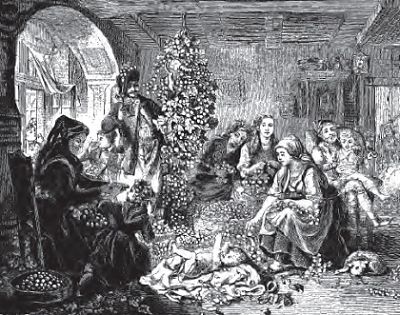
There are more where those came from. They can’t all be right in 2012, but they could be in the long run. Because that’s the way beer works. Consider this from Hop Culture in the United States, published in 1883. The subtitle, Practical Treatise on Hop Growing in Washington Territory, pretty much summarizes the contents. (The pastoral image at the top, showing a family comfortably picking hops, is taken from the book.) The back of the book includes a variety of statistics and contributions from elsewhere. The sources aren’t always obvious, but this was surely written by somebody in England.
Influence of fashion on the use of hops
“The brewing industry is not exempt from the influence of fashion. A careful survey of the types and descriptions of beers in vogue at different times, will show that fashion has had something to do with our trade. Without going back to the olden days, when our Saxon forefathers imbibed freely of ale and mentheglin made from barley and honey, without any admixture of flavoring herbs, we may refer to the period when the introduction of hops into this country gave quite a different character to the national beverage; instead of the sweet and mawkish ale, a true beer, flavored with aromatics essence of the hop, came into fashion.
“This took place in the sixteenth century, since when, hopped beers have been more or less in fashion. Towards the end of the eighteenth century, there was a great rage of black beers, and so great was it that our metropolitan brewers found their trade rapidly increased by the production of this article; porter was consumed in enormous quantities, and it seemed at the one time as if light-colored beers would become things of the past. We know now that fashion for porter and stout is in the decline. Large breweries, at one time engaged solely in the production of these specialties, have altogether discontinued the brewing of black beers.
“Toward the end of the last century and at the beginning of this, the taste of the public inclined to very strong ales. The old-fashioned stingoes and strong stock ales were consumed in large quantities and with thorough relish at this period, probably because the habits of life which then prevailed, caused the physiques of the people to be stronger than the present times. In those days, beer was brewed regardless of cost in many a household, and the modern private trade brewer had scarcely started into existence. Gradually the taste for lighter and cheaper beers grew, until the year 1851, when the great Exhibition marked an era in brewing, as it had done in other industries. The splendid productions of Messrs. Bass and Allsopp, then attracted much attention, and from that time the taste for high-hopped beers has gone on increasing until lately, when there has been an evident tendency to fall back again upon milder and less bitter beers.
“During the last two or three years, brewers have experienced a demand for beers of very low gravity, and containing less of flavor of the hops than was fashion on some twenty years since, and of course it is their bounded duty to comply with the dictate of fashion in this respect. We will not further refer to the threatened introduction of lager beer into this country, than to say fashion takes strange freaks, and it will be well for brewers to be prepared for all eventualities.”
Their bounded duty to comply with the dictate of fashion.
This arrived in the mail Saturday, a pleasant reminder this is the season for happy surprises.
But also that I have a book to finish.
So I’m swearing off Appellation Beer until some time in January. I might post a few comments and photos on Twitter, because there are fun events (like this and this) on the horizon. But I won’t be publishing my annual best of the year lists. You’re on your own.