The week that was: Lagunitas and sharks not jumped

MONDAY BEER LINKS, MUSING 09.14.15

It was a very noisy week, on Twitter and via my rss feed. Noise that wasn’t about things that interest me at this moment and that was so loud you couldn’t hear the other stuff. But it seems it was an Important Week, so here are a bunch of links you may or may not think belong together — followed by some “sit back and enjoy a great beer” ones.

Craft beer brewers just got downgraded to ‘sell’
[Via MarketWatch]
Lagunitas’ Magee speaks on Heineken deal and craft beer’s ‘next phase
[Via Chicago Tribune]
That Lagunitas-Heineken deal.
[Via Steve Heimoff]
Shakeup at craft beer giant Stone Brewing.
[Via Fortune]
‘Craft beer’ crumbling.
[Via I might have a glass of beer]
Signposting Craft.
[Via Hard Knot Dave]
Welcome to Starbeers.
[Via Fuggled]
The Curse of Craft strikes again.
[Via Ed’s Beer Site]
Craft Beer Sales Are At An All-Time High (Part I)
Craft Beer Sales Are At An All Time High-and why this could be scary.
[Both via The Hop Tripper]
We need to dial it back a notch.
[Via All About Beer]
And in Every Town.
[Via St. John’s Wort]

OK, a lot of words, and I am leaving most of the heavy lifting to you. My thoughts are mostly related to the last three links. Many of the “things that concern (Mitch Steele) about the future” are related to brewing and selling beer on a larger scale. Nothing wrong with that, and certainly keeping with the theme in Jason Notte’s story (first link). You can decide how it meshes with this from Greg Koch (fourth link): “There are two ways of operating a business – commodity or artisan. We operate as an artisan. We make decisions based on our passions. … Anybody that thinks commodity can operate as an artesan is ignoring the basic facts about how businesses operate.”

But as regular readers know, I cannot buy into the notion that breweries must always be growing. There is another way. Jeff Alworth’s commentary for All About Beer includes many amen sentences, words to drink by, and most importantly this: “Going forward, I’m planning to focus less on the specific products and breweries of the commercial sphere—they will come and go, inevitably—and more on the act of sharing a beer with someone I enjoy.”

And I certainly agree with this:

But beer companies? They are organs of commerce, however wonderful the brewers and publicans they employ may be. We feel good about beer, so we place that good feeling on the institution of private businesses. And in many cases, that feeling is well-placed. Breweries are collections of humans, after all. When they make good beer and create a wonderful space to enjoy it, they rightly earn our loyalty. But they’re also businesses, and sometimes their owners decide to sell to different owners—and then we have to make new judgments all over again.

But not with this:

Magee’s announcement is a spectacular Trump-like masterpiece of overstatement, and for me it was the moment Craft jumped the shark into over-seriousness.

No, Lagunitas is not a proxy for “craft.” No brewery is. And most drinkers don’t give a hoot what Tony Magee has to say. (Pausing for a moment of introspection: a lot more care than wonder about what I am thinking, so perhaps I should quit typing now).

Daria and I spent much of a week ago Saturday afternoon on the deck at Piney River Brewing, which is located on a farm 26 miles south of Plato, Missouri, a town that will remain the official “population center” of the United States until the 2020 census. Inside, the superintendent of a nearby school system was playing guitar and singing. Outside, volunteers were selling hot dogs and brats (Piney River does not serve food) to raise money for the Houston Education Foundation. Beer was the part of some conversations, not included in others. I don’t expect much changed this week. More concerned discussion about the St. Louis Cardinals’ recent slump, some comparing of notes about the kids’ new teachers, idle talk about the sudden and welcome arrival of cooler weather.

To be clear, Piney River also is not a proxy for “craft.” And it is a business. The brewery recently expanded, adding capacity that would allow it to produce 10,000 barrels a year. Founders Brian and Jolene Durham want to brew beer “in and about the Ozarks for the Ozarks.” When they first opened the tasting room one day a week (now it is open three) they expected a few friends would show up. Turns out they must have more friends than they realized, Brian said. It’s places like this that capture my attention these days, and beers that reflect where they are brewed, the where not necessarily being the brewery itself.

So there’s a reason that what Jordan St. John wrote (the final link) seems so brilliant to me.

. . . there’s the craft model. It’s not specific to craft beer. It’s a 19th century manufacturing model. It’s generational, driven possibly by the lifespan of the founder and the interest of his partners or progeny and it’s on a vastly more human scale. The smaller production level means that the owner is answerable to a community. The wealth that it generates will end up flowing back through the community in which it operates.

I’ll try to include the spirit of that thought in “Brewing Local.”

Meanwhile, those other links I promised . . .

Researcher recreates Viking beer.
The story this week I most want to read more about. [Via Knut Albert’s Beer Blog]

Young wine writers: don’t be too smart.
“Generally, in life, I reckon that less smart people are often happier. If you are too smart, I suspect that you’d find popular culture so inane as to be depressing, you’d be frustrated by the general low level of most journalism, and you’d spend a lot of the time quite bored. And as a writer you’d find that anything you wrote would only really appeal to small segment of the population.” [Via jamie goode’s wine blog]

Behind the new Abbey: How we changed the malts.
There have been several stories recently about breweries retooling their IPA recipes (for instance, this one from Bryan Roth). Tweaking recipes is hardly new — recall Ed mentioning Rochefort had begun using Aramis hops. But talking about it seems to be. I’m looking forward to this week’s discussion about choosing a new yeast. New Belgium co-founder Jeff Lebesch talked about that yeast candidly in “Brew Like a Monk.” He cultured from a Chimay bottle. “What I learned later is that Chimay could get kind of wild, so who knows how reflective what I got out of that bottle was of Chimay? I was doing all my culturing from bottles then, keeping them on plates in the house. Somewhere in the early 1990s I did a major cleanup of our yeast. It really changed the character of the beer.” [Via New Belgium Brewing]

Hype for hops helps farmers break into beer business.
This story overlooks most of the obstacles those who would grow hops outside of the Northwest face. Those challenges were at the top of my mind last week because I writing a story about it for New Brewer magazine. Perhaps that’s why when I saw the news of the Lagunitas-Heineken deal I thought immediately about the implications for hops, and in terms of real estate (because brewing is always about time and space). If Lagunitas is going to be selling two million more barrels per year, for instance, that means they could need more than three million more pounds of hops per year. That’s about 1,500 more acres of hops. Growing 1,500 more acres of corn in Iowa is not a big deal. But 1,500 more acres of hops just about anywhere, that’s a chunk. [Via CBS News]
What’s a hop picker look like?

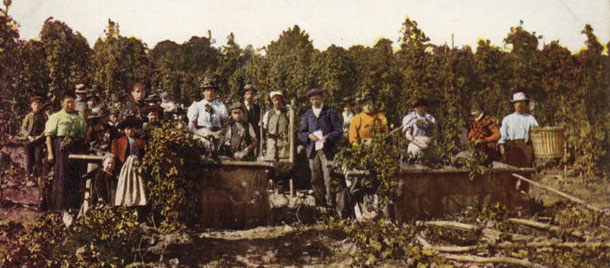
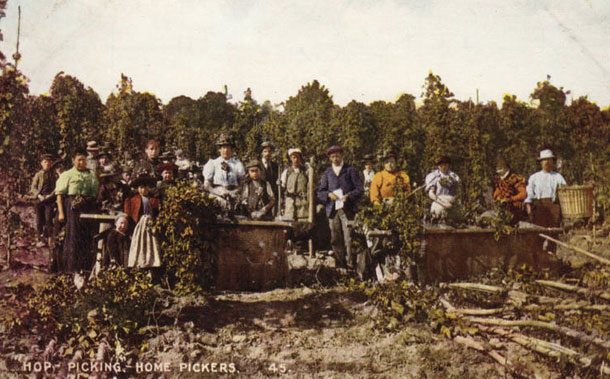
Let’s start with two bits of nostalgia. Here’s a postcard from 1912 depicting a hop-picking crew in Washington’s Yakima Valley.

Hop pickers, Washington state, 1912

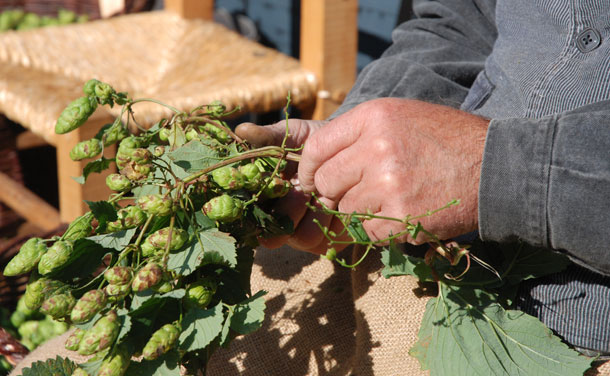
And here’s a photo from 2008 at Hoppefeesten, the beer and hop festival held every three years in Poperinge, Belgium. An area resident illustrates how hops used to be picked.

Hop picking, Poperinge, Belgium

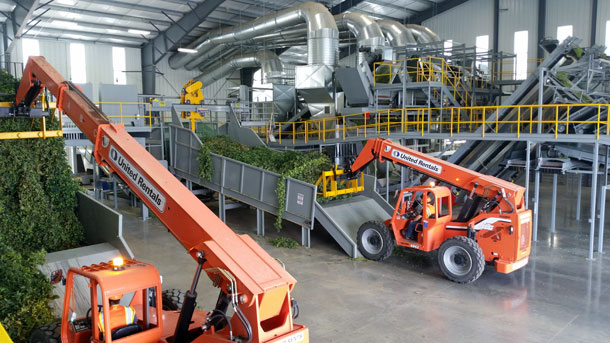
And here’s a photo taken last week at Perrault Farms in the Yakima Valley, which this year began using two new Dauenhauer hop picking machines, set up basically in tandem. I guess I should have shot a panoramic photo to depict the size of the operation. It is stunning.

Perrault Farms, Washington, new hop pickers

When Alberic Perrault began growing hops in 1928 it took 100 people 30 days to harvest his 13 acres — or almost 8 workers per acre. These days in the Yakima Valley instead of workers per acre production is measured in terms of acres per worker. The average is about 20 acres per worker, and most of those acres yield considerably more pounds of hops.

Hops 2015: No bumper crop this year

Hop pickers, hop harvest

The good news is that this headline is pretty stupid: “IPA Lovers Beware: Beer Prices Could Skyrocket Next Year Thanks to Drought.”

The not so good news is that this one is more accurate: “Trouble Brewing: Drought-Hit Hops Crop Concerns Craft Beer Brewers.” And the story that goes with it is well reported and more complete.

That hop prices must go up if growing breweries are going to continue to use the varieties of hops they are in the manner they are is not news (see this explanation from last January). However, lack of water in the state of Washington, an unsually hot late spring/early summer in the American northwest, and a not-so-great growing season in Europe are about to remind us that beer is an agricultural product.

Earlier this week, Otmar Weingarten of the German Hop Growers Association told the those attending International Hop Growers Congress in Bavaria that production in Germany’s main hop growing regions would likely fall 12 to 22 percent short of earlier predictions. And Ann George, executive director of the Hop Growers of America, said that US alpha varieties yield would be down up to 5 percent and aroma varieties off 10 to 15 percent. There’s bound to be variation from region to region and variety to variety. For instance, best guess is that Centennial yields, also disappointing in 2014, could be 20 percent short of expectations.

That is bad news for brewers without contracts who were hoping for a bumper crop (so they could buy the excess). And it means you’ll see more stories about hop shortages as harvest begins next month and rolls into fall. But this is not the hop shortage of 2007 and 2008, one that was a big enough deal to merit an entry in “The Oxford Companion to Beer.” Then a combination of events led to an alpha shortage that became obvious after the 2006 harvest. In 2005, the “spot” price, one that brewers without contracts for some or all of the hops they needed would pay, was $1.95 to $2.80 per kg alpha. A pound of Cascade cost $1.65 to $1.75. By the end of the 2007 harvest the shortage was so extreme that most un-contracted hops sold for $198 to $220 per kg alpha and some ticked as high as $992. The price of a pound of Cascade climbed to $30.

Right now there remains an alpha surplus. I should probably write a primer about what this means, but just the basics for now. Most of the world’s largest breweries use hop extract to brew their beers and treat alpha as a commodity. They don’t use a lot for any individual beer, but they use a lot of hops. They like paying low prices, but as we saw in 2007 when they need to they have the money to spend whatever they must. So if alpha gets out of balance, and particularly given the structural change that has taken place, then all bets are off.

The future of hops – a graphic prediction

The Barth Report, hops 2015

There went my Friday morning. No time to read hundreds thousands of tweets hypothesizing about the implications of the Duvel Moortgat/Firestone Walker deal. The Barth Report for 2014-2015 is available to download, and to print, because the best way to make sense of all the information included about hops it is to underline the key passages using different color pens.

Some of the news isn’t as newsy in the past. These days, the US June acreage report gets quickly publicized and dissected and the Barth-Haas Group, the world’s largest hop broker, issues a similar world update even before its annual report is out. But this is the one published since the nineteenth century, with reports going back to 1909 available online. Each year it collects statistics about the businesses of brewing and hops everywhere, and over time that provides important context.

Meanwhile, the cover (pictured above) says something about right now. “A Firework of Hop Varieties” occupies the space at the end of the report reserved to look at current issues (for instance, organic hop farming in the 2010-2011 report). Depending how deeply you have already descended into the hops rabbit hole this could look very 2012 to you, but for many in the beer world it is still uncharted territory:

“From a state of insignificance in regard to taste and appreciated mostly for their bitterness, hops have worked their way to the gustatory core of most craft beer recipes. Today, brewers exchange opinions on the sensory impressions of a wide range of hop varieties in a depth and with emotions which until recently only wine connoisseurs were known. Demand for new hop varieties is showing no sign of abating and is inspiring hop breeders all over the world. Regardless of the time-consuming process of traditional hop breeding (8 – 10 years until a new variety is ready for the market), in the past five years, many new hop varieties have been brought to market at shorter intervals. A common feature of virtually all the new varieties is that they are able to offer particularly sought-after fruity notes.”

Hopstate NY: 2015, not 1879

Imagine Iowa without corn, or Illinois without soybeans.

That’s what it would have been like in the 1870s to think of New York without hops. By 1879 New York grew 80 percent of American hops. Four years later, The Western Brewer provided an industry overview: “It will be seen that in 1850 hops were raised in 33 States and Territories; in 1860, in 37; in 1870 in 36; in 1880 but 18. … It remains to be seen whether California, Oregon, and Washington Territory will increase their production; or, in a few years, drop off as so many others have done. It is probable that New York will always remain the banner hop state.”

Instead, within 10 years the Pacific Coast produced more hops than New York, and by the time Prohibition began New York farmers grew less than 4 percent of the national crop. This happened for multiple reasons: lower yields in New York than on he West Coast, hop disease issues, higher labor costs, and small inefficient operations.

Hop Growers of America estimates New York farmers strung 250 acres of hops in 2015, two-thirds more than in 2014. That’s considerably less than the 39,072 acres in 1879, when 10,000 New York farmers harvested 21.6 million pounds, but the pace of expansion has picked up. The first commercial field to operate since 1954 was planted in 1999, but 11 years later farmers harvested only 15 acres.

“We have a real mix of people,” said Steve Miller, hired by the Cornell Cooperative Extension in 2011 as the state’s first hop specialist. “There are only a couple of growers who’ve had hops in for more than 10 years in the state. The vast majority of growers have only had them in for a year or two.”

Last year, Miller estimated there are now about 75 farmers there with two to five acres of hops, and most have the potential to expand. Yields on farms with mature plants have topped 1,500 pounds per acre. In 1879 the average was 554. “It’s based on people becoming growers, not hobbyists,” Miller said. “People who have knowledge and equipment and barns.”

The state of New ,supports this revival in a variety of ways, including funding Miller’s research. So has Brewery Ommegang outside of Cooperstown. From the time Ommegang opened in 1996 its press releases mentioned it is located in the former center of U.S. hop growing. This always seemed a bit curious, because at the time nobody in New York was growing hops and you wouldn’t describe any of Ommegang’s beers as hop focused. Although the brewery recently released its first IPA and brews a range of hop forward pale ales, hops still aren’t what you think of first when somebody says Ommegang.

Ommegang posted the photo above last month, showing the small hop yard at the brewery. It is growing test varieties for the Cornell Extension program and will trial them in beers. The brewery also bought one and a half tons of New York hops last year. A good portion of those went into Hopstate NY, a pale ale released only in New York state a couple of weeks ago. It is brewed with Cascade, Nugget and Chinook hops, so it is brimming with citrus aroma and flavor, its resin character lingering beyond the finish.

No melon or blueberry or other exotic New New World aromas or flavors, but something different than New York hops offered in 1879.

A bit of disclosure: We don’t live in New York. I was able to taste the beer because the brewery sent me some. I certainly would buy it if I lived in New York. I won’t claim that at first sip, or third for fourth, that I thought, “Oh, this tastes of New York” (or the rolling hills around Coopertown, of which I am quite fond). But I could see it becoming a familar taste. One of place.

Last month when I was in California I had a lengthy — rambling, you might say — conversation with Brian Hunt at Monnlight Brewing about what makes a beer relevant. I’m going to be a while sorting that out, but I’m pretty sure than Hopstate NY is an example of relevant.