This is a stereo viewer card, a 19th century invention. Each card held two almost identical images that, when viewed through a stereoscope, created a realistic 3D scene. When viewed through the stereoscope’s lenses, each eye sees a slightly different perspective, and the brain merges these perspectives into a cohesive scene.
In this case, the scene is from a farm near Bamberg, Germany. Those are hop bines in the background.
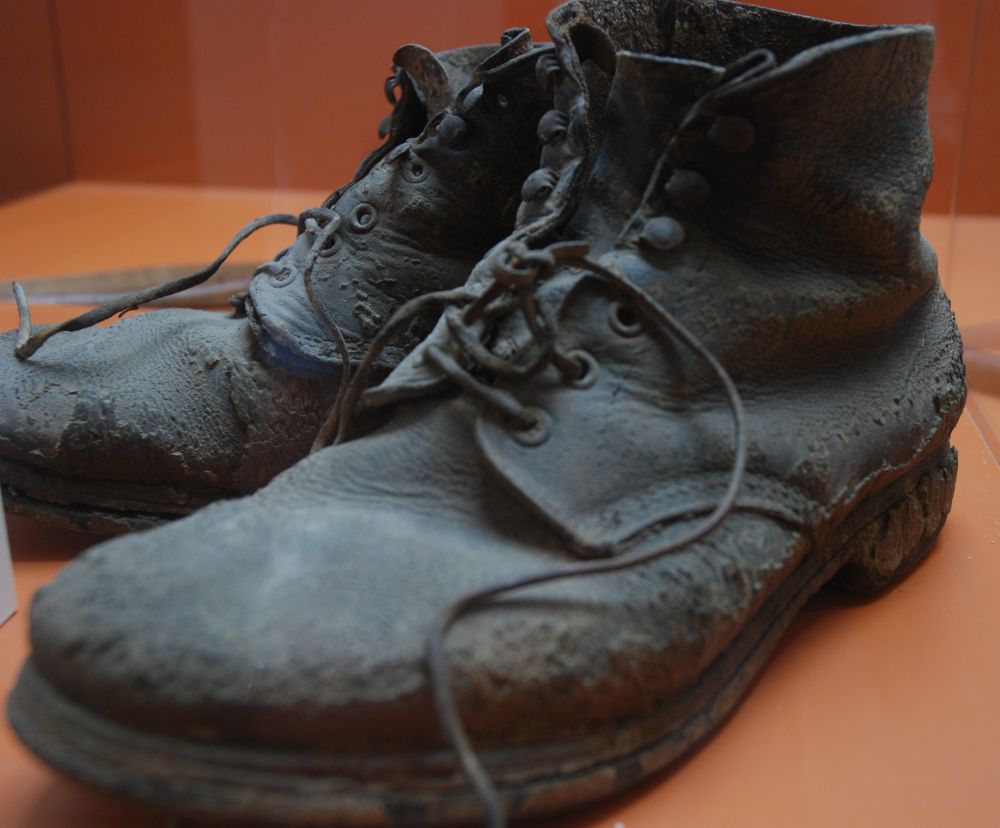
Spotted in Deutsches Hopfenmuseum in Wolnzach, Germany. The shoes were worn by a worker processing hops. When a bag was filled, a worked would jump into it, stomping down the hops to make sure the bag was full. When I dug this out, I wondered if these could have been called Hopfenstopgen boots. That’s because in Hop Queries Vol. 4, No. 6, I wrote about dry hopping in Germany in the 19th century. That was called Hopfenstopfen, which can be translated at hop plug.
Simon Moosleitner, a subscriber in Germany, suggested there is more to think about, writing:
“I would give it a slightly different translation. You’re definitely right with translating Stopfen as plug or bung. However, in this case the word Stopfen is a nominalization of the verb to stopfen (you may notice the difference in capitalization, in German nouns are always written with a capital letter).
“The verb stopfen has a slightly different meaning. It is used when repairing clothes or to be more precise darning socks. But more importantly it’s the same word (potentially even etymologically) as to stuff. Whether you want to say one stuffs a pillow with feathers or food into oneself, the word stopfen can always be applied. Hopfenstopfen is therefore the act of stuffing beer with hops, which I guess is an even more fitting term now with all the hazy beers around.”
Hop harvest has begun in Oregon (where I’ll be in two weeks). This is roadkill from a previous harvest.
Perhaps I will try to make “fun with numbers” a semi-regular Friday feature. We’ll see.
When I received an email last week declaring “Oregon Retakes No. 2 Spot for U.S. Hop Crop” I was en route to Argentina, so wasn’t inclined to do some necessary math. Several sites have since posted the information.
It is a fact that Oregon farmers strung 5,421 acres for harvest and Idaho 5,109. But . . .
Last year, average yield per acre was 1,732 in Oregon and 2,273 in Idaho. If yields are identical this year (they won’t be) then Oregon farmers will harvest 9,389,172 pounds of hops and Idaho farmers 11,612,757. In my mind, more pounds of hops trumps more acres.
This is not to say that the difference in yield will be as large this year. Idaho farmers will harvest far fewer acres of Helios this year (the USDA has withheld the numbers to avoid disclosing data for individual operations) and last year the average yield for Helios was 3,092.
Expect ad update in December, when the USDA posts final results of harvest.
– Last week, Jeff Alworth endeavored to shame 10 beer myths. He chose “noble hops” as one of them. I certainly prefer the term landrace hops and I agree that marketers amplified “noble” to sell their hops. However, the origins go back to the 19th century. I’ve written more extensively about this in print, but here is a short version of the story.
What bothered me more was the discussion of cohumulone. Arguments about co-eightch, as is known among both friends and foes, have centered on if hops with higher levels impart a harsher bitterness. Research at Oregon State University pretty much debunks that. And as far as “IPA hops” go, an average lot of Simcoe will have a lower level of COH than an average lot of Saaz.
A big difference between landrace varieties and modern bred varieties is the alpha to beta ratio. One reason that Coors stepped up to support Cascade hops more than 50 years ago was that Cascade had a ratio of about one to one, more like the landrace varieties large brewers were using at the time. It turned out that Cascade had other qualities (like plenty of geraniol) that didn’t quite fit in their beers. It’s not necessarily the a-to-b that makes the difference, but it serves as a marker for auxiliary bitter compounds.
– Father Martin has a new hat. We are traveling, so access to my photo archives is limited. Otherwise I would also post a photo of Father Martin wearing the Benedictine Brewery “dad hat” he was wearing the last time time I saw him almost two years ago. If you visit the brewery “our story” page and scroll dad hat you’ll see him with the old hat, which was black in its youth and gray in later years.
The story is about a 50-year partnership between the abbey at Mount Angel, Oregon, and Coleman Agriculture. Previously, the monks tended to hops grown on the land that Coleman Agriculture now leases. The beer to celebrate their partnership is brewed with Simcoe hops, grown in a field across from the the brewery tasting room.
Jeff Alworth yesterday used to news that the Brewers Association added seven new beer styles to the Beer Style Guidelines in advance of the Great American Beer Festival to rage about how there are too many beer styles.
This is one another of those discussions I feel like I’ve been part of more than enough times already, so just two thoughts.
I am happy that there is a defined category for West Coast Pilsner. Highland Park Brewery has won three GABF medals for the beer they call Timbo Pils at their website and describe as a West Coast Pilsner. Timbo has won as an American-Style Pale Ale, an India Pale Lager and in the India Pale Lager or Malt Liquor category.
The first GABF competition in 1987 included a dozen categories: Ales, Alts, Cream Ales, American Lagers, American Light Lagers, Bock/Doppelbocks, Continental Amber Lagers, Continental Pilsners, Porters, Stouts, Vienna Style Lagers, Wheat Beers. Where would you have entered Timbo Pils?
Vera Charles*Second, I’ll write more about the hop named Vera in Hop Queries this month. Meanwhile, the announcement that the 2025 competition will include a special category featuring beers brewed with Vera (formerly known as W1108-333 or HRC-003) caused me to imagine a festival that will never happen.
The fest would include beers named only after the hop “providing the leading role” in their aroma and flavor. In the GABF Vera competition, brewers will declare the underlying style. Not at this festival. Festival attendees could ask about other ingredients in the beer, about supporting hops, about the yeast, fermentation temperatures, lagering time, IBUs, whatever they wanted. Except style.
There could even be a competition. Similar to Juicy/Hazy IPA at GABF, the most entered hop category would be Citra.
*************************
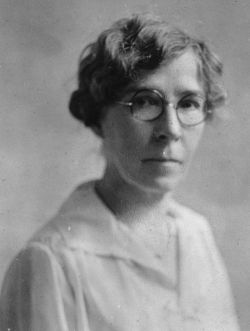
* Vera Katherine Charles (1877–1954) was an American mycologist. She was one of the first women to be appointed to professional positions within the U.S. Department of Agriculture. Charles coauthored several articles on mushrooms while working for the USDA.