Pilsner Urquell: 5 weeks does not equal 3 months

After touring the Pilsner Urquell brewery last November I promised that when I got a chance I’d take a look at Michael Jackson’s video report from 1989 (the Beer Hunter series) to compare what he saw then with what Pilsner Urquell says is how long they’ve “always” lagered beer.
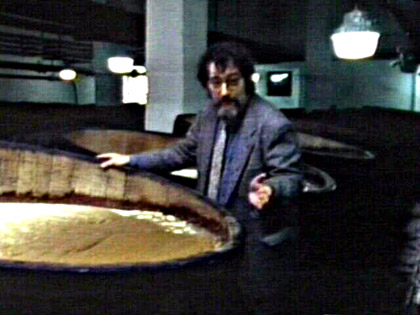
Michael Jackson at Pilsner Urquell

I tell you, that’s one great half hour of video. Discovery really needs to reissue the three hours of video in DVD form (before our VCR dies). Incredible details about the wooden vessels the brewery was using, the coopering, the whole process. I love watching Jackson wander through the caves, and the Hitchcockian moment where a giant barrel appears to be stalking him. You get thirsty seeing him march around open wooden fermenters, then he climbs a ladder to loom over one and explain that this is one of the things that make Pilsner Urquell different, presumably better. He says that others in the industry have told the brewery it is crazy not to modernize but that its leaders swear they won’t abandon open fermentation. Sigh.

But back to the question at hand. These days Pilsner Urquell lagers its beers five weeks, claiming this is the same amount of time as when Josef Groll first brewed the beer in 1842. On the other hand, the Beer Hunter report in 1989? “Three months,” which on my calendar is one quarter of a year (13 weeks).
‘I Am A Craft Brewer’ video

Greg Koch has posted the video he used yesterday to introduce his keynote speech at the Craft Brewers Conference in Boston entitled “Be Remarkable: Collaboration Ethics Camaraderie Passion.”


Click on the play button to watch or head on over to the “I Am A Craft Brewer” area at Vimeo, where he promises “a program is in development to include even more of America’s amazing craft brewers.”


Beer pairing of the week

Short enough to Twitter, but in Big Bend National Park off the grid means not only no electricity or Internet via wi-fi but also no cell phone service. So a day late . . .

Great triple pairing – a hike in Big Bend National Park, Saint Arnold Summer Pils and Jimmie Dale Gilmore’s voice cutting through the desert air.

Feeling restored and invigorated.


Mama, it’s hot outside; pour me a . . .

Maybe the rest of the world will forsake pale lagers, but that’s hard to imagine in Texas. We’re only a few days into April and it’s already getting plenty hot. When we headed to Threadgill’s yesterday for a bunch of vegetables I could only imagine ordering one beer — Live Oak Pilz on tap.

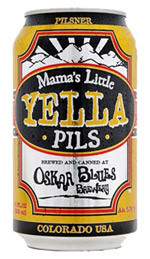
Mama's Little Yella PilsBut today, assuming the clouds I’m looking at right now go away, when we spend a few hours boating it won’t be with Pilz in hand. Live Oak doesn’t package its beer.

(Yes, responsible boaters don’t drink and drive, but we’ll only be passengers.)

So should I go with beer from a bottle, Saint Arnold’s Fancy Lawnmower, or from a can, the new Mama’s Little Yella Pils from Oskar Blues in Colorado? Sorry, Mama, when there’s a good local alternative the rules of our trip make it easy to pick the beer brewed nearby.

I tell you what, though, I’m wondering why Oskar Blues didn’t hit on this idea before. Hot weather, and cold pilsner in a can makes for one fine match. (In fact, the answer it pretty simply. Since first packaging Dale’s Pale Ale at the end of 2002 the brewery has struggled to keep up with production.) Although, like the brewery’s other beers, Mama’s Little Yella Pils packs a lot more aroma and flavor when you drink it from a glass rather than straight from the can.

Both Live Oak Pilz and Mama have the pleasant grainy/grassy qualities I associate with a pale lager from the Czech Republic. And the all-malt flavors that, let’s be honest, many drinkers think interfere with drinkability. Not you, right?

Not the same as sitting in Domažlice and drinking Pivovar Kout na Šumav? 10°. But in a boat. From a can. This is progress.


Will pale lagers dominate forever? Ron says ‘no’

Ron Pattinson writes today about perspective and change. He makes two really important points back-to-back.

The horizon of personal experience influences our view of both the past and the future. We extrapolate the present back into the past. I used to think Bitter and Mild, as I experienced them in the 1970’s, had been around for centuries. It’s a fault repeated in many books about beer. Even brewers have little concept of what went on before they started brewing themselves.

And before you even pause to consider that he gives us more to think about.

The future we expect to be a continuation of the present, with just the odd tweak. Who could have imagined in 1900 that Porter would have disappeared within 50 years? Or in the 1940’s that Mild would have disappeared from swathes of Britain by 1980? Will pale lager continue its domination for another 100 years? History tells us no. Its decline will be unexpected and surprisingly swift.

It is hard to imagine isn’t it? Harder still to think about what might take its place.