Hold it, which Blind Pig beer was one of the first Double IPAs?

Cheers to Martyn Cornell for calling out a list of the most influential” beers that was both embarrassingly America-centric and lacking in historic perspective and replacing it with his own “The REAL 20 most influential beers of all time.”

Given that I’ve sworn off railing against lists I thought I might sit back and enjoy, but reading through more than 100 comments I’m surprised that the inclusion of Russian River Blind Pig IPA has not been questioned. Look, I love Blind Pig. It is one of my favorite beers on earth. Drink it it next to a Double IPA, even one as good as Pliny the Elder, and the phrase “less is more” makes perfect sense. But there seems to be some confusion about chickens and eggs (or, in this case, IPAs and DIPAs) at Blind Pig Brewing.

Let’s start with the entry at First We Feast (where the silliness began):

RUSSIAN RIVER BLIND PIG IPA
From: Santa Rosa, CA
Style: IPA
ABV: 6.1%
Website: russianriverbrewing.com

Joshua M. Bernstein says: “Beer geeks rightfully praise Vinnie Cilurzo’s Pliny the Elder, the double IPA against which all others are judged. Thing is, the path for Pliny was blazed by Blind Pig, an IPA brewed to compensate for a flawed brewery [the beer was originally brewed by Cilurzo at Blind Pig before he brought it to Russian River]. Blind Pig’s equipment was so antiquated, off flavors were all too common. To compensate, he added heaps of hops, setting a bitter template that brewers worldwide now follow.”

Then consider how it ends up in Cornell’s “REAL 20.”

Sierra Nevada Pale Ale I’m prepared to consider, as the pioneer of “hop forward” American pale ales, and the same consideration may be due to Blind Pig IPA, the first “double” IPA.
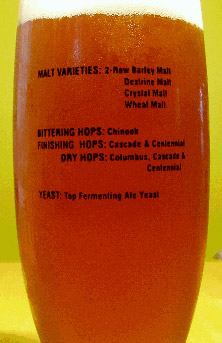
Blind Pig Double IPAAnd now revisit the story that Cilurzo has told many times about over his first “double IPA.” He brewed a beer he called Inaugural Ale in June 1994, the very first batch he made at Blind Pig Brewing1 in Temecula, California. Indeed, he said, “Our equipment was pretty antique and crude, so I wanted to start out with something that was big and, frankly, could cover up any off flavors.”

The beer contained between 6.5 and 7% alcohol by volume and Cilurzo calculated it had 100 International Bitterness Units (the actual number would have been much lower). It was aged on oak chips for nine months and served on the brewery’s first anniversary. He had special glasses made for the occasion, with the ingredients printed on the side. He described it as a “double IPA.”

“After that, we made it a tradition to make DIPAs for our anniversary. At our second anniversary, the beer was 120 (calculated) BUs. This was almost undrinkable at the time of bottling, but there was a small market for it,” Cilurzo says. “We had a tasting room at our brewery. Customers would bring their Blind Pig growlers back for refills, etc. The last drop of Second Anniversary Ale, out of the brewery’s last keg, filled (Stone Brewing Co. co-founder) Greg Koch’s growler.”

Quite obviously, this was a very influential beer, was one of the first Double IPAs,2 and is the parent of Russian River Pliny the Elder.3

But Blind Pig IPA was a different beer — brewed after Inaugural Ale, first simply called India Pale Ale, with 6% ABV and 75 calculated IBU (Cascade and Columbus), and later They Passed This Way IPA. It was an excellent beer from the get-go, but it did not blaze the path for Pliny or other Double IPAs.

*****

1 “Vinnie Cilurzo left Blind Pig to brew at Russian River Brewing in northern California, owned at the time by Korbel (the sparkling wine producer). When Korbel decided to get out of the brewing business, Natalia and Vinnie Cilurzo bought the brand name and opened a brewpub in Santa Rosa, later a production brewery. Cilurzo continues to brew Russian River IPA, but revived Blind Pig IPA after moving to Santa Rosa.

2 Mitch Steele revisits the discussion about who brewed the first commercial IPA in “IPA: Brewing Techniques, Recipes and the Evolution of India Pale Ale.” Recommended.

3 Pliny the Elder is 8% ABV and is made with several hop varieties not even available when Cilurzo first brewed Inaugural Ale.

One more reason to love August Schell Brewing

August Schell T-Shirt at Zion National Park

This photo comes with a disclaimer (what doesn’t these days?) but that doesn’t change the basics. Me, wearing an August Schell Brewing T-shirt, at Zion National Park.

Schell, of course, is the brewery name on everybody’s lips after Jace Marti’s great post on the company’s Facebook (it drew 150 comments) that provided significant perspective to the “Craft vs. Crafty” kerfuffle.

Schell brews excellent beer, but drinking it will always be better because we visited the brewery in New Ulm. Definitely a “beer from a place” experience. I own the T-shirt (which is looking a little weary these days) because it was a prize given out during judging for the Upper Mississippi Mash-Out in January of 2008. When you signed in to judge that entered your name in a drawing. If it showed up on a list after a round of judging you could pick out a prize. Mine came up rather late, so I was plenty happy to see the T-shirt still there.

A few months later we were at Zion in southern Utah — the final shakedown cruise before our grand adventure. I was waiting for Daria and Sierra to return from a side adventure when I heard somebody behind me say, “I have to take a picture of that.” I realized I was “that.” She didn’t care that the T-shirt was from one of America’s oldest breweries, just about the message, “It’s always happy hour somewhere.”

After Daria and Sierra and returned we headed out I told them about what just happened. Daria made me go back and sit down. The result was the photo you see. Thus the disclaimer.

A Westvleteren XII pack not bought

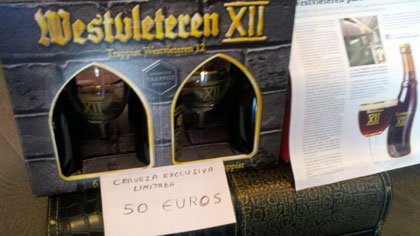
Westvleteren XII in Spain

The point is not whether six bottles of Westvleteren XII and a couple of glasses is worth $85. That’s $5 more than it costs for a National Parks annual pass.1 Pretty easy to tell which of those is a better buy.

The point is not whether it is the World’s Best Beer.2

It’s not that a story on NPR (if you are shaking your head at this point, wondering what I’m rambling on about, that’s a good place to start) has drawn more than 100 comments.

Of course, I can’t perfectly describe the point. If there is one, I do think context is involved. When you get the right bottle, it’s an amazing beer. At that moment, particularly if you are seated in the In de Verde cafe beside the monastery, it is hard to imagine a beer being better.

It’s that good in West Flanders because of the context. It can be elsewhere as well. Although Patrick Emerson provides perspective of value from the point of view of an economist, he also puts it in very human terms: “So is Westvleteren 12 worth $85 for six? Well that is for you to decide, for some it will not be and for others it will. This will be a function of how much enjoyment you’ll get from drinking it, how much you cherish the opportunity to try it and your ability to pay for it (among other things).”

And when you are in Toledo, Spain, there may be no context. That’s where the picture at the top was taken in August (I think I posted it on Twitter). The package was €50 (about $63 at the time).

It might still be sitting there.

*****

1 Unless you are 62 years old. Then it costs $10 for a pass that lasts as long as you do.

2 There is no such thing.

The tribute beer we need in 2013

My, time flies, and faster the older you get. Back in 1997, my wife, Daria Labinsky, and I wrote a story that appeared in All About Beer magazine in the early days of 1998. It was called “The Class of ’88” and examined several brewpubs that opened ten years before and their influence.

Now Deschutes Brewery, one of those featured in 1998, has announced it will collaborate with four other breweries that opened in 1988 to create commemorative beers to celebrate their shared 25th anniversary.

So it’s been 15 years since we wrote that story about places that were 10 years old. (That’s what I mean about time.) It may be a little dated, but I added it to the archives here. And not only because it provides an excuse to repeat a great quote from the late Greg Noonan:

“When the homebrewers stop entering the profession, and the backyard breweries are squeezed out, then it will become stagnant. You gotta keep getting the guys who say, ‘Cool, I can sell the beer I make. I can do it.’ ”

You may not know you miss Greg Noonan, but you do.

Anyway, the skinny for the Deschutes press release:

Brewery Partners: North Coast Brewing Company (Ft. Bragg, CA) & Rogue Ales (Newport, OR)
Beer Style: Barley Wine
Planned Release Date: March 2013

Story: In the same year these breweries were born, renowned beer connoisseur Fred Eckhardt published The Essentials of Beer Style which included a barley wine style guideline which will provide the basis for this collaboration. All three versions of the barley wines that will result from this unique collaboration will be packaged in 22-ounce and 750 ml bottles, plus draft.

Brewery Partner: Great Lakes Brewing Company (Cleveland, OH)
Beer Style: Smoked Imperial Porter
Planned Release Date: May 2013

Story: Building on a history of great porters – Great Lakes Brewing Company’s Edmund Fitzgerald and Deschutes Brewery’s Black Butte Porter – this Smoked Imperial Porter promises to be exceptional. Both beer versions will be available for a limited time in 22-ounce bottles and draft.

Brewery Partner: Goose Island Beer Company (Chicago, IL)
Beer Style: Belgian-Style Strong Golden Ale
Planned Release Date: Q4 2013

Story: Brewers and owners are still working out the details on this beer, which they plan to brew with Riesling juice and Pinot Noir grapes. It will be aged in barrels that previously held Muscat wine in them for 10 years. Again, each brewery will produce its own version of the brew in bottles and draft.

I’ll buy those beers.

But — attn. anybody at Wynkoop Brewing (Marty Jones, Andy Brown, and even Colorado governor John Hickenlooper) or Vermont Pub & Brewery (and that could include you, John Kimmich or Peter Egleston) — the commemorative 25th anniversary beer I want to drink in 2013 is the one that Russell Schehrer and Greg Noonan could have, should have, would have brewed together.

Another way to think about aroma, hops and beer

DRAFT magazine hoppy beer evaluation

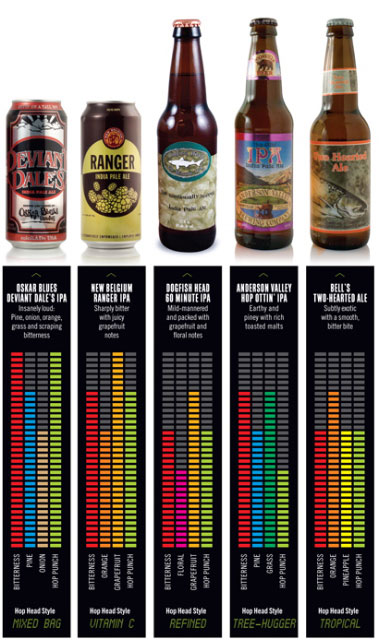
Does this illustration courtesy of DRAFT magazine1 make you think about beer aroma and flavor any differently? Particularly hops? The point is not whether you find grapefruit more prominent in New Belgium’s Ranger IPA or Dogfish Head 60 Minute IPA or if you agree that Anderson Valley Hop Ottin’ IPA has more bitterness than Bell’s Two-Hearted Ale but less hop punch.

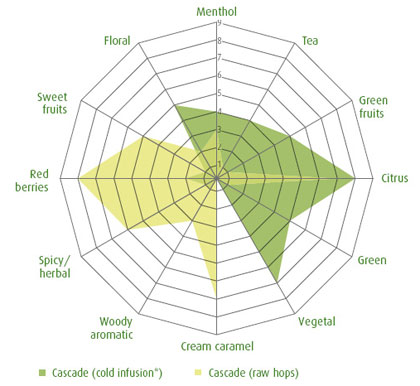
I like it because the colored meters make it easy to think in terms of volume (synonym: impact) as well as the way the aroma components fit together. This is different than spider graphs (here are a couple more examples beyond the one that follows), so brilliant that I take back everything nasty I said when DRAFT used the antiquated tongue map as an illustration in its early issues.

Cascade hop, Barth Haas Hop Aroma Compendium

This spider chart appears in The Hop Aroma Compendium compiled by Joh. Barth & Sohn. The tan portion indicates how two beer sommeliers and a perfumist perceived the aroma of raw Cascade hops, while the green shows how that changed in a cold infusion (similar to dry hopping).

These work best if you are willing to accept, perhaps even embrace, a certain amount of ambiguity. Members of tasting panels at breweries are trained to identify X or Y as this or that aroma or flavor. That’s so their brewers can make beer with a certain level of consistency. (See New Beer Rule #4.) Drinking, and enjoying, beer can be altogether different, and it might be best not to get too specific when trying to pick out particular aromas or flavors. In How to Love Wine author Eric Asimov devotes an entire chapter to “The Tyranny of the Tasting Note.” It’s a topic he’s addressed before, and tends to get wine writers pretty riled up. He makes excellent points, but also some I’m not sure I agree with. Probably something better examined in a separate post (maybe even the next one). But a key takeaway is that when somebody starts describing “aromas of apricot, jam, guava, and jackfruit” that there’s little chance another drinker will get then that tasting note is not only useless, but discouraging.

These visual representations are much friendlier. Both managing editor Jessica Daynor and beer editor Chris Staten provided details via email about the illustration in DRAFT.

“. . . there’s no formal data behind the sensory ratings — just our ratings of each flavor element from 1 to 5 (that number was multiplied by 6 in design, which is how we got the final artwork you see in print),” Daynor wrote. “We feel that part of our job as editors is to present beer to readers in as many digestible ways as possible, and particularly for people new to beer, sometimes, it’s more practical to make sense of flavor elements visually, which is what we did here. It’s so easy to make generalized statements about IPAs: ‘They’re really bitter;’ ‘They’re hoppy;’ etc., but what does that actually mean? And if that’s the case, then aren’t all IPAs the same? With that piece, we’re trying to show that even among the most common IPAs on shelves, there are many flavor nuances that make each beer unique.”

Staten added: “I’ve always been intrigued with the path beer drinkers take when they’re first exploring the world of hops. Often, I run into newer drinkers who say they love IPAs but can’t figure out why particular IPAs rub them the wrong way — lot’s of the time it’s because they aren’t focusing enough on the flavor profile to discover likes and dislikes. The piece was just a casual way to let these particular readers know that there’s a wide range of hop flavors, and a wide range of flavor combinations/perceived bitterness/etc. from IPA to IPA.”

A casual way. I like that.

*****

1 The November/December issue (“Top 25 Beers of the Year” cover).