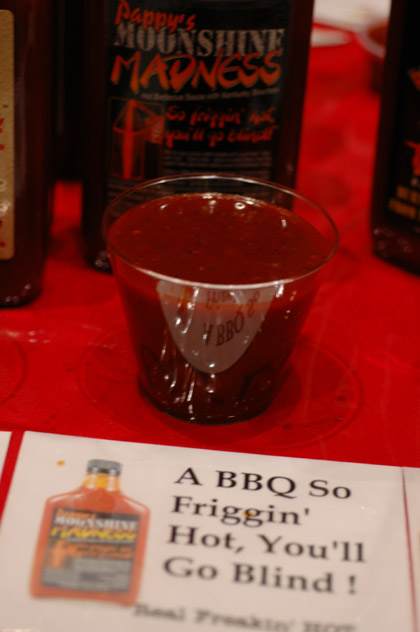
100 IBU beers got nothing on these guys

Hot hot chile sauce

Shocktop WheatYep, one of the reasons we moved to New Mexico was because we love the hot food.
For us the annual Fiery Foods Festival in Albuquerque, which wrapped up today, is as exciting as the Oregon Brewers Festival.

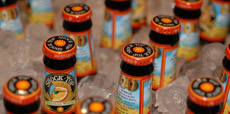
I did come across a beer story today, which I’ll post Tuesday, beyond the obvious — that the specialty beers Anheuser-Busch is distributing, such as its own Shock Top Belgian Top (pictured), Redhook and Widmer, Hoegaarden and Leffe Blond, are the ones the distributor is bringing for drinkers to sample and to buy. Much higher profile than a few years ago.

But there’s also a chile pepper/hops analogy that’s been obvious since our first visit to Fiery Foods in 1994.

You’ve got a set of vendors selling insane products. Sunday that would be sauces so hot they’d burn away several layers of taste buds, leaving you in pain and unable to taste anything for days. At a beer festival that would be beers with crazy amount of hops.

You’ve got another set who totally avoid excess, and can be seen wagging their fingers.

Then there are the folks who talk about flavor and heat. Or flavor and bitterness. Bless ’em.

So soon, Stone beers and hot sauces. In the same bottle. Be here.

Scallop Stout: What’s next? Monkfish?

Out of hops? Try scallops.

British brewer Shepherd Neame has used them to make Scallop Stout.

“There’s a hint of smokiness and a slight taste of the sea but no fishiness. I can find no scientific reason for why it works, but it does,” brewer Stewart Main said. The newspaper report states the 3.7% abv beer “is made using traditional methods but with a handful of scallops thrown in for an hour.”

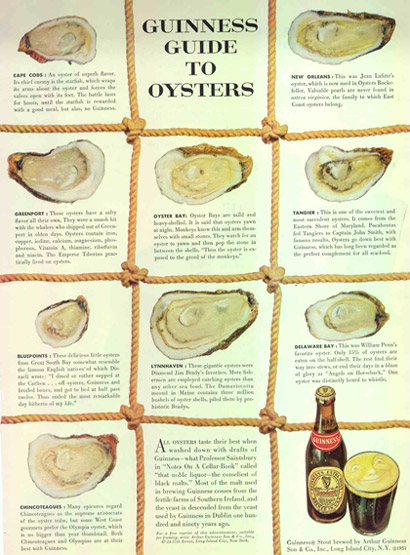
Bivalves and stouts aren’t exactly strangers. Not only have Guinness and other producers long advertised serving oysters with stout but once in a while brewers even tossed them into kettle.

Guinness oysters ad

It can get confusing. For instance, Marston’s Oyster Stout contains no oysters.

Writing about oyster stouts several years ago, Michael Jackson made it clear (“Heaven sent – downing oysters by the pint“) there is a balance to be struck, be it stouts with oysters included or in finding the right stout to go with oysters.

A stout must lean to the dry side if it’s to accompany oysters. Despite its fullness of body, Guinness’s Dublin-brewed, strong (7.5 per cent) and quaintly named Foreign Extra Stout does the trick. especially if it is lightly chilled. The regular bottled or canned stuff is arguably too sweet and the jury is out on the draught version.

Murphy’s and Beamish are barely dry enough, but there is a case for the peppery, spicy Cain’s Superior Stout, from Liverpool. I have long loved the toasty, faintly anise-like porter from Harvey’s of Lewes, East Sussex.

Not sure what he would have written about Scallop Stout.

However, What to Drink with What You Eat includes a story from Brooklyn Brewery brewmaster Garrett Oliver:
“One of the funnest dinners I have ever done was with the Westchester association of country club chefs. I paired seared diver sea scallops with brown butter sauce with a Taddy Porter from Samuel Smith, which is a dark beer with a buttery, residual sugar and caramel taste to it, and a slightly chocolatey aroma.

“They were surprised to see a light dish with a dark beer. We deconstructed the scallop, which is sweet, with a caramel sear, and the butter in the brown butter sauce. With the beer, I am delivering a round, soft buttery flavor with caramel.

“You have carbonation that scrubs the palate and removes fat and oil. This audience of chefs was shocked, and said it was one of the best food and beverage combinations they ever had.”

‘Fried beer’ and hedge fund beer picks

Super Bowl Sunday could be called “National Beer Day,” according to one press release, because an estimated $12 million will be spent on beer for consumption before and during the game day.

Much of the discussion centers around Budweiser and Bud Light, since Anheuser-Busch is the Super Bowl’s biggest advertiser. And Miller has co-opted some of the attention with a second Dalmatian commercial. More of the same? Mostly, but look around and you never know what you’ll find.

Saint Arnold Brewing in Texas posted recipes “just in time for the big game.” Last week the brewery held its first “One Pot Showdown,” cooking contest that requires each recipe to include Saint Arnold beer as an ingredient and to be cooked in a single pot in the Saint Arnold parking lot. The event raised $1,800 for Meals on Wheels. Fried Beer (click on the link for the lengthy recipe), made with Winter Stout, finished first. Amberized Green Chili was second.

TheStreet.com has “Microbrewed Beer Picks for the Big Game” – a good list if you’re having hedge fund managers over to watch the game.

– Among the “proposition” bets you can place is which will be the first beer commerical at halftime.

And then there’s YouTube.

– Miller has already started showing its second Dalmatian commercial, featured in the Wall Street Journal with A-B’s reaction.

– The Associated Press put together a sneak preview of the A-B ads:

– Of course, you knew we could count on the Marin Institute to demand an end to advertising and marketing beer during the Super Bowl. They might have found it more effective to come up with a spoof like this one:

Sadly, this sort fun doesn’t do any of us beer drinkers much good. Don’t think it’s just an attack on Bud.

New Beer Rule #7: Beer is not the new wine

Beer For LunchLast night we ate leftover smoked meat and drank Southern Tier Choklat. One, then the other. No pairing involved. Sometimes you just want a beer, maybe even a strong one.

Choklat, an 11% abv imperial stout infused with dark Belgian chocolate, qualifies on both counts. It’s one of the beers I’ll be writing around 85 words about in the next All About Beer magazine Beer Talk.

You’ll notice these days that more often than not Beer Talk panelists suggest a food pairing for the beer they are describing. I tend to be the slacker. I know that Charles Finkel, who tastes the same beers as I, will have terrific suggestions and I try to use the small space alloted to squeeze in something different.

I’m keener than most about the notion beer belongs at the table, but these days the movement hardly seems to need my help. For instance, the Brewers Association yesterday revealed new details about “SAVOR: An American Craft Beer & Food Experience,” including something called educational salons. These are presentations by “savvy cross drinkers.”

I guarantee you that the words “Beer is the new wine” will be bandied about.

What does that mean? I really don’t know. The phrase doesn’t seem to serve beer or wine well. Wine is the new wine. Beer is the new beer. (And the old beer, which is equally important.)

Beer “styles” have always evolved, with various riffs sometimes turning evolution into revolution. This is nothing new. In the 1930s it was the monks at Westmalle refining the “tripel” style. These days it might be two brothers in a former hardware store in Warren, Mich., inventing something new or an ex-English major in San Diego blending mead, strong ale and sour beer to create Veritas (Latin for truth).

Truth is it’s still beer.

NEW BEER RULE #7: Beer is still beer.

Leading beer trends for 2008: No. 4a*

Beer CollegeWere I inclined to make predictions (not likely) about the Top 10 Beer Trends of 2008 then one would somehow have to include the words “education” and “certification.”

For education, I’d start with Jan. 31 and Feb. 1 in Chicago for the Siebel Institute of Technology’s course on Professional Beer Tasting & Styles. More about that in a moment, because the syllabus gets a little long.

Certification I: Ray Daniels posts that the online exam for the first level of Cicerone certification should available soon.

Certification II: The Master Brewers Association of America quarterly newsletter reports the board of governors “approved a new MBAA-sponsored education program targeted at individuals
in the wholesale and retail beer trades.”

The program’s goal is to improve the image of beer and broaden its appeal by better maintaining its freshness throughout the distribution chain and by increasing the knowledge of beer styles and proper serving techniques for those who distribute and serve beer. The Publication Committee is charged with producing a new reference book that will provide the relevant and necessary information to educate applicants to be certified under the program. Individuals applying for certification must demonstrate a comprehensive knowledge of beer by passing a rigorous exam based on the contents of the reference book.

Back to the course at Siebel, Randy Mosher (author of “Radical Brewing” and the upcoming “BeerSense: Understanding the Pleasures of the World’s Best Drink”) put it together. The presentations include:

Section 1 – Introduction
* What is Beer?
* Beer in Context: Lifestyle & Diet, Culture, Seasons
* A Little Beer History: Beginnings, Medieval to Modern, The American Beer Story, Craft Beer Revolution

Section 2 – Sensory
* Techniques for Sensory Evaluation:Practical Tips for Evaluating Beer, Sources of Flavor & Aroma
* The Taste of Beer: Beer Aroma & the Flavor Wheel
* The Formal Tasting: Types of Tastings, Competitive Judging, Evaluation Forms
* Informal Tastings: Settings & Methods, Tasting Glasses

Section 3 – Beer by the Numbers
* Gravity / Strength of “wort”, Alcohol, Color, Bitterness,
* A Question of Balance

Section 4 – Common Defects of Beer
* Including tasting of beers spiked with off-flavors: Raw materials, Brewhouse, Fermentation/maturation: Yeast, Packaging,
* Mishandling, Beer Infection: Age, draft system problems, Light

Section 5 – The Process of Brewing (and why you should care)
* Beer Ingredient Analysis: Malt, Other Grains & Fermentables, Hops, Water, Yeast, Other ingredients
* The Brewing Process: Malting, Mashing, Boiling, Chilling, Fermenting, Maturation, Filtration, Storage/Shipping

Section 6 – What Is a style?
* An introduction to the definitions of beer styles, followed by more detailed presentations of the major beer styles. The styles presentations feature a combination of lectures, PowerPoint slides and numerous tastings, giving a thorough overview of the character of the majority of beer styles including:

Section 7 – Ales of the United Kingdom
Section 8 – Lager
Section 9 – European Ales
Section 10 – Belgium & France
Section 11 – New American Classics

Section 12 – Serving & Storing Beer

Section 13 – Beer & Food
* Pairing Approaches: Classic Combinations, Some Surprising Pairs, Beer & Cheese, Beer with Desserts
* Beer Cuisine, Beer & Food Tastings & Dinners