Truth is sometimes I turn these lists into a post so I have the links saved for more careful reading later.
Curling strategy. This chart will make wagering easier the deeper into a match you watch.

Truth is sometimes I turn these lists into a post so I have the links saved for more careful reading later.
Curling strategy. This chart will make wagering easier the deeper into a match you watch.
Sometimes we are our own context, meaning what you bring to a glass of beer influences what you take from it.
Rick Lyke writes about a 7-year-old bottle of Schlenkerla Urbock, his daily drink Monday, that opened with a big smoked ham nose. A fellow taster from Wisconsin taster said it was like smoked sturgeon.
Drinkers in Bamberg, Germany, where Schlenkerla beers are brewed, most associate them with meat, but in Wisconsin — home to Friday evening fish fries — smoke and fish makes perfect sense. The same in Alaska.
That wasn’t something Geoff and Marcy Larson of Alaskan Brewing necessarily considered when they first brewed Alaskan Smoked Porter more than 20 years ago. In fact, Geoff Larson didn’t react very well the first time a drinker told him his beer tasted like salmon. In fact he had smoked the malt that went into the beer at a fish smokery, but he had cleaned the facility obsessively in advance, fearing how fish oil might affect the beer.
“I took it inappropriately and defensively,” Larson said. Months after, talking to the late Greg Noonan — who had made his own smoked porter at Vermont Pub & Brewery — he began to understand just how powerful memories of smoke are.
“Greg talked about first using hickory and customers would ask if he put hickory smoked ham in the beer,” Larson said. “Then he used maple and they asked, ‘Hey, did you start throwing sausage in your beer?'”
It wasn’t salmon that drinkers noticed but the alder wood both the malt and fish were smoked over. In Southeast Alaska smoke from alder wood conjures up memories of campfires and smoked salmon. In the northeast maple smoke reminds consumers of Jimmy Dean Sausage.
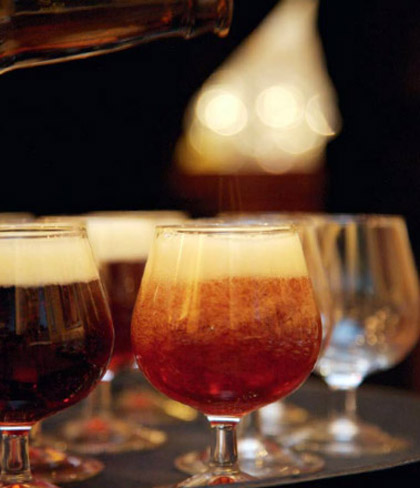
Let’s start out with what’s wrong with The beerbistro Cookbook
Before moving on to what’s right about the book I must offer a longer than usual disclaimer. Co-author Stephen Beaumont is a long-time friend of our family (I even know his secret hotmail address). He links to this site and has written nice things about Brew Like a Monk. Likewise I occasionally link to his.
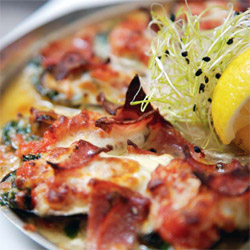 During our family’s lengthy travels we happened to be in Toronto the day after Daria’s birthday. She decided, with absolutely no coaching, she’d like to celebrate at beerbistro. Because our timing was terrible we had picked a time that Stephen, who helped start the restaurant as well as co-authoring the cookbook, was in New Orleans. However he did alert co-author Brian Morin, the chef and driving forcing behind the bistro, we’d be in town.
After we’d ordered our first beers (I started with the local King Pilsner, at Stephen’s emailed suggestion) Brian surprised us by showing up at the table to chat. We talked about beer, about cooking with beer, about the local food markets and his shopping trip earlier in the day, and similar topics. Sierra, our daughter, was totally taken with Brian. She was doubly taken by the Cheese and Lager Fondue. She is triply taken with the cookbook. So although Stephen and I are good enough friends I’d be comfortable enough criticizing the book I know better than to cross a starry-eyed 12-year-old.
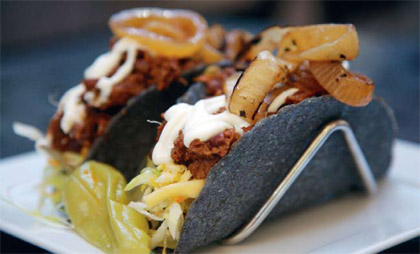
Which takes us to the first good thing about the book. These are recipes Sierra and I can make, written to include ingredients you can find. Brian is big on local and fresh but also sensible. After one more bit of food porn a few more positives:
– Your friends will enjoy the primer. You may not need to read about beer’s history, beer styles, how to pour a beer or even beer at the able again. But these remain foreign concepts on much of our continent. Also be advised you don’t want to glaze over what seems familiar. The beer and cheese primer toward the end is exceptional.
– Beer in the kitchen. It starts with a philosophy about all ingredients, one of which happens to be beer.
– Beer Styles à la beerbistro. Twelve basic categories “recommended as an accompaniment to the recipes or, in many cases, as a descriptor of the beer called for in the recipe.” Thus the styles become quenching, sociable and soothing. Or spicy: “Well-rounded ales with a natural spiciness, either from fermentation or spice addition or both. Look for Belgian or Belgian-style strong blonde ales, such as La Find du Monde and Westmalle Trpel, and complex North American spiced ales, such as Dogfish Head Midas Touch and AleSmith Grand Cru.”
– The recipes. Including more with mussels than even a Belgian could imagine.
– The recipe for Rochefort 8, chocolate, and chocolate chip ice cream. Best dessert I had in 14 months on the road. I’m not one inclined to do anything with Rochefort 8 other than put it in a glass and drink it, but there’s no pain in parting with three bottles to make six cups of this ice cream.
Sierra gets the last word, and she actually has a question that amounts to a bit of criticism: Where’s the fondue recipe? But she can forgive that omission. Leaving out the recipe for beerbistro’s Belgian-Style Frites . . . that would be unforgivable.
A few things you might have missed last week:
– The held the Iron City Brewing auction Friday and yesterday in Pittsburgh.
– Granted Equity For Punks might be important to the future of BrewDog, has led to considerable discussion about the value of the company, and certainly reminds us that no matter how much fun brewers appears to be having they are involved in serious business.
But Pete Brown points out that there’s investing and there’s something else:
But that’s not the point. I doubt Brew Dog will sell all 10,000 shares, but the people who are buying are buying something more than a 0.0009% stake in the most exciting brewery in the UK. The people buying are people who don’t normally buy shares. They’re buying this share because they want to align themselves with something interesting and iconoclastic, to be part of an adventure. Think of it less as a share, more like a T-shirt or badge saying “I’m one of these cool, interesting people who’s part of this cool, interesting thing.”
BrewDog has priced those shares at £230, which right now equates to $375.
– If you are watching the second NFL game of a doubleheader today (or about any other televised sporting event that ends as afternoon turns into evening east of the Mississippi) you might hear the announcers say to stayed tuned for something upcoming immediately (or maybe local news will be thrown in) “except on the West Coast.” In fact, that’s “except on the West Coast and in the Mountain Time Zone.” But because, according to Google answers, little more than 5% of the voting population lives in the Mountain Time Zone we remain pretty invisible. That’s OK; we don’t want anybody else living here.
Still, it made me smile to get the press release from Odell Brewing about a new beer called Mountain Standard. It’s made with Cascade and Chinook hops grown on Colorado’s Western Slope.
“We’ve experimented with locally grown hops for smaller batches brewed on our pilot system, but haven’t been able to find enough hops to extend the beer beyond our tap room,” Brendan McGivney, head of production, said for the press release. “This year we sourced 400 pounds of hops from the Rising Sun Farms in Paonia, Colorado. We plan to brew one batch every year with each harvest.”
Bottled in 750 ml cork and cage finish bottles, Mountain Standard joins Bourbon Barrel Stout and India Barleywine as part of a new line of single serve offerings. The beer will retail for $14.99 to $15.99 per bottle, and is available in the brewery’s eight state distributor region (90% of which lies in the Mountain Time Zone).
On Nov. 2, the day after daylight savings time officially ends, Odell Brewing will celebrate the return of Mountain Standard Time with an un-corking celebration at the brewery’s tap room in Fort Collins.
– “10 worst dining trends of the last decade,” from the Chicago Tribune. Pretty pictures.
 Don’t forget that Beer 47 hosts The Session on Friday. The topic is “Beer Desserts.”
David Jensen writes “What beer desserts have you tried and liked? Disliked? What beer styles work well with dessert and which ones do not? Do you have any beer dessert recipes that you enjoyed and would like to share?”
All you have to do to participate is write a post and leave a comment so he knows you’re out there.
I’m likely going to miss this month’s gathering, but I promise to be thinking about the chocolate calzone from Vino’s in Little Rock, Arkansas.