The Session #51: Simple pleasures

The SessionBefore the clock strikes twelve here in the Mountain Time Zone on Session Friday just a few thoughts vaguely related to our assignment for Session #51, hosted by Jay Brooks and called “The Great Online Beer & Cheese-Off.”

I apologize for not exactly staying on track. If you read Jay’s post or Bryan Koselar’s you’ll see this was a great social and perhaps educational opportunity. But this was not a party week around here, nor was there time to round up friends or beers.

Sierra and I enjoyed a simple “cheese night,” very nice but not the same with mom a thousand miles away. (We’re packing like crazy, discarding, condensing, etc., and should be in St. Louis for the Heritage Festival.) But without my favorite beer drinking companion a simple beer night became simpler still.

The kid and I shared Maytag Blue Cheese (from Jay’s list), Manchego aged 12 months and cave-aged Gruyere. I wasn’t about to open a bunch of beers I wouldn’t finish.

I don’t remember how “cheese night” became a regular but always anticipated event in our house. Certainly not because we can hoof on down to the store and buy something made locally. Great cheese at Whole Foods, yes. From anywhere nearby, no.
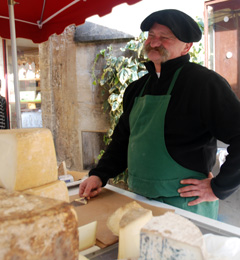
Cheese mongerPerhaps that is why during our Grand Adventure we scooped up Wisconsin cheese in Wisconsin, Vermont cheese in Vermont, French cheese in France. Why we sought out places where cheese is made (quick bit of advice, not every road leading to a Vermont cheese facility is fun driving, and the worst case scenario is you might find he road out blocked by sheep and the gate you came in through locked). Watching cheese made is not as exciting, or as personal, as seeing somebody make beer, or potato chips for that matter. More on a level of Moose Munch or Jelly Bellys (sorry, but we find it hard to pass on any factory tour that includes ingestible samples at the finish).

Then you meet the guy above at a Saturday market in the French countryside. He slices off really thin slices (just a taste) and he tells you Americans hate this. “You like it? You’ll hate this.” And you like it as well. And pretty soon you’ve spent 37 euros on not very much cheese. You give him a 100 euro bill. He says he’ll have to get change for the neighboring booth. He returns with 13 euros. You tell him you gave him a 100 euro bill. He apologizes and you leave happy, because you’ve only spent something like $40 a pound for cheese at an open-air market.

That’s not a complaint. The cheese was great. And it was great during a picnic lunch with wine. Let’s be honest, wine would have served the cheese Sierra and I enjoyed tonight just fine. But that wasn’t the assignment, was it?

I had Boulevard’s Smokestack Tank 7 with “meal” portion, eating mostly Gruyere and Manchego. It was tougher to pick what to have for dessert, to stand up to the Maytag Blue. I thought about an Imperial Stout, a Double IPA (if locally brewed Marble were in 12-ounce bottles instead of 22s that likely would have been the choice) and then decided on a 2004 Sierra Nevada Bigfoot Barleywine.

Tank 7 is a beer with some heft, 8 percent alcohol and plenty of hops (flavor, bitterness, citrus and juicy). The Gruyere and Manchego are cheeses with finesse, but with age their flavors grow more intense. Their earthiness and that in the Tank 7 play well together, peppery notes stronger when the beer and cheese are joined in the mouth than they are in the saison by itself.

Tank 7 doesn’t seem quite as confident matched with the Maytag, but underlying fruity notes and a touch of sweetness don’t give up against the richness of the blue cheese or the tangy notes that imply vinaigrette must be nearby.

I chose Bigfoot to stand up to the Maytag, and its deep, rich maltiness (accented with oxidized sherry notes) certainly did. But it wasn’t so big it overwhelmed the Gruyere. In this case the saltiness of the cheese enhanced the malt sweetness, and in turn made the hop bitterness more satisfying. And the Manchego was a total surprise. Too many cheeses made with sheep’s milk smell like a hot county fair 4-H barns in the Midwest in August. That’s not a earthy aroma; that’s sweaty wool and sheep shit. Manchego is earthy.

Tonight, after this long week, I was mostly interested in drinking the Bigfoot, so a tiny bit of each cheese was plenty for dessert. Then two-thirds of the way through the beer I got to thinking about the Manchego. I headed back to the fridge for another piece. I let it sit on my tongue and took a sip of Bigfoot. I inhaled and the aroma took the direct route to my brain only aroma knows.

Alaskan rain forest. Wet. That’s a good dirt smell. Thank you, cheese. Thank you, beer.
Don’t forget the cheese; Session #51 Friday

The SessionA quick reminder that Session #51 is Friday, and Jay Brooks is hosting what he calls “The Great Online Beer & Cheese-Off.”

Get some cheese — perhaps Maytag Blue, Widmer 1-Year Aged Cheddar and Cypress Grove Humboldt Fog, remembering nobody has ever been kicked out of the Session for showing up with the wrong cheese — and some beer. Have a few friends over, or not. Taste. Takes notes, also optional. Post your thoughts on May 6. Read what everybody else tasted, paired and thought. Get some more cheese. Repeat the rest of the steps.

Those interested can participate in a second round two weeks later. Jay explains: “Whoever wants to participate, pick up some of the other beers that were suggested, and try them with the same three cheeses and do a follow up blog post on Friday, May 20 — let’s call it Session #51.5 — to explore more fully pairing cheese and beer.”

Brewing naked, ‘trading up’ and a ‘super boil’

Ancient recipe for beer

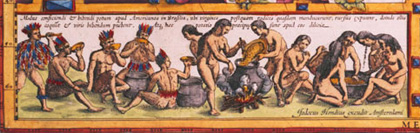
This is a “map cartouche of one of the Western Hemisphere’s earliest recorded recipes (for a form of beer).” It was taken from from America, a map by Jodocus Hondius (Amsterdam, 1606). Seems like a poster that would sell well in homebrew shops.

You’ll find it here, along with dozens of other images from the Clements Library at the University of Michigan, and more about the growing American culinary history collection at the library.

* Trading up to beer (and then to wine). A working paper from the American Association of Wine Economists exams the evolution of beer consumption between countries and over time. Parts are easier to understand if you have an Economics to English dictionary at your side.

Although the focus is on economics, the authors look at all the factors that determine what makes a “beer drinking nation.” In doing so, they track how consumption in those nations has changed dramatically in the past 50 years and ask why. Their findings, in economic speak:

Our first important result is that we do indeed find an inverted-U shaped relation between income and per capita beer consumption in all pooled OLS ánd fixed effects specifications. From the pooled OLS regressions (Table 3), we find that countries with higher levels of income initially consume more beer. Yet, the second order coefficient on income is negative, indicating that from a certain income level onwards, higher incomes lead to lower per capita beer consumption. The first and second order effects for income are strongly significant and the coefficients are quite robust across the different specifications.

The fixed effects regression results confirm this (Table 4), so the non-linear relationship for income holds not only between countries, but also within individual countries over time. As a country becomes richer, beer consumption rises, but when incomes continue to grow, beer consumption starts to decline at some income level. We calculated the turning point, i.e. the point where beer consumption starts declining with growing incomes, to be approximately 22,000 US dollars per capita.

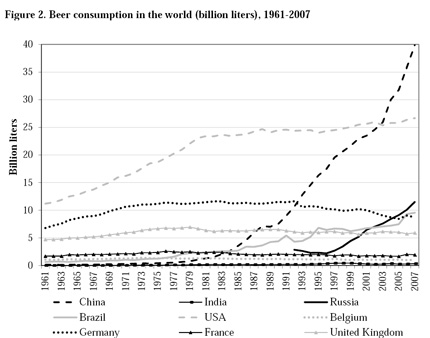
So you get a graph that looks like this, with beer sales soaring in emerging economies — quite obviously China, but also Russia, Brazil and India.

World beer consumption 1961-2007

What the wine economists want to know is “what’s next?” As consumers grow richer will they spend more money on wine (and less on beer)? The Chinese effect has already boosted prices of high-end French wines. Most predict something similar with wines across all prices categories, although that might be 20 years off.

What the study doesn’t consider at all is “beer different,” as in not a commodity, the beers drinkers are “trading up” to on a regular basis, in just about any country where they can find them.

* ‘Extreme’ boiling. Port Brewing/Lost Abbey has begun a “behind the scenes” video series, the first featuring how it makes Hot Rocks Lager. This is an Old World beer, certainly not “extreme.” But the process is a little out of the ordinary, and might just be what it looks like to make beer in Hell. Tomme Arthur calls it a “super boil,” and it is. Pay close attention beginning about 1:40 into the video.


Greg Koch = Jerry Lee Lewis or Lindsay Lohan?

Midweek catching up (from various blogs and press releases):

  • Stone Brewing beers arrived in Missouri this week and you’d think there was a royal wedding about. Stone co-founder Greg Koch was signing bottles and such yesterday in Kansas City and makes a similar splash in St. Louis tomorrow.

    Leading to this fabulous sentence from the KC Beer Blog: “If you’re not aware of Greg Koch, you will be. He’s the Jerry Lee Lewis to Sam Calagione’s Pat Boone, or for a more current reference, he’s Lindsay Lohan to Calagione’s Raven Symone.”

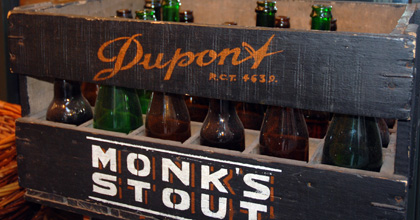
  • Vanberg and Dewulf will begin importing a beer called Monk’s Stout from Brasserie Dupont later this year. It seems Dupont also brewed this beer in the 1950s. Which explains why we came across this case in the window of a Brussels beer shop in 2008:

    DuPont Monk's Stout

  • Alan’s question of the week: Why Is Britain Creating Beer Blogging Celebrities? As he writes, and we’ve witnessed here, discussions about beer writing often may help cure insomnia. But give it a look anyway.
  • The publican as writer. Where does such a being fit in? I have printed copies of the newsletter Roger Baylor used to assemble squirreled away somewhere, from the days when beer writing intended to satisfy your soul came via postal carrier instead of an rss feed. He notes he’s founder of Rich O’s Public House at the top of his blog, The Potable Curmudgeon, but now he also runs a brewery.

    So that’s the background. And here’s a bit of what he had to write in “Avery joins flight from Indiana; Publican yawns.”

    You could hear the sounds of furtive sourcing as shelves emptied of valuable brands. The wails of lamentation kept me awake at night as craft beer fans weaned on the tender mercies of Beer Advocate and Rate Beer vented their despair.

    They should have been asking: Should one’s go-to beer come from another time zone?

    And: Your forefathers had it far tougher, whiner.

    Me? I shrugged, yawned and filled a growler of fresh local beer.

    There’s more, of course, because he has to guide his story to its closing lines: “Just remember: I used to walk ten miles in waist-deep snow just to score a six-pack of Sierra. Your troubles are miniscule by comparison.”

  • Was I snoozing when this was was announced? Stone Brewing has a page where you can report “out of code” beer, that is beer that isn’t as fresh a Stone’s brewers would like it to be when you drink it. Most of the regular beers should be consumed within 90 days.
  • Session #51 (& #51.5) announced: Beer and Cheese-Off

    The SessionJay Brooks has announced the topic for Session #51, and volunteered to host Session #51.5 as well. He calls it “The Great Online Beer & Cheese-Off” and it takes a little explaining. Like somewhere north of 1,300 words.

    So the short version. Get some cheese — perhaps Maytag Blue, Widmer 1-Year Aged Cheddar and Cypress Grove Humboldt Fog, remembering nobody has ever been kicked out of the Session for showing up with the wrong cheese — and some beer. Have a few friends over, or not. Taste. Takes notes, also optional. Post your thoughts on May 6. Read what everybody else tasted, paired and thought. Get some more cheese. Repeat the rest of the steps.

    Refer to Jay’s instructions for more suggestions. As he writes, “Even with making this next Session as difficult as possible, I’m hoping the fun factor of trying these cheeses with a lot of beer will make for a lively and interesting Session, with a lot of participation.”

    Cheese night

    Yes, the instructions are a little long, but this is do-able. We managed to celebrate more than one “cheese night” in the RV during our Grand Adventure. We’re still talking about the Madison Blue.