Hops, eggs, Goose Island, and organic

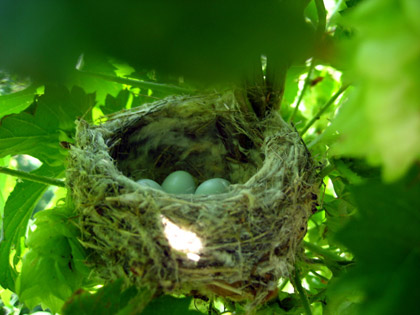
Bird's nest in hops

Sierra and I made a home school field trip yesterday to check out a small operation a few hours to the north, virtually on the banks of the Rio Grande, where a couple of guys are growing all manner of organic foods at 5,800 feet.

Included are many varieties of hops, most of them apparently native to New Mexico. That’s a story I’ll be digging into, but that’s another day.

This was a fascinating lesson in biodiversity. For instance, all kinds of flycatchers and birds use the hopyard trellis (built with wood reclaimed from a mountain fire) as a hunting platform for insects.

Thus the picture at the top. Birds have built a nest in some of the thicker hop bines (in this case Cascades). It made me think of a recipe Goose Island brewmaster Greg Hall provided more than 10 years ago when we were compiling the Brewpub Cookbook for Time Life Books.

Hall suggests burying the eggs used in the recipe in a container of Cascade hops for three to dive days. Because eggs are porous, he said, they will breathe the piney aromas and it will perfume the eggs.

Let’s hope the eggs in this picture hatch. Then maybe some day a resident of the Embudo area will have a bird fly close and think: “I’m not sure why, but I seem to crave a hoppy pale ale.”
Gastro-what? A gas-what-pub?

Beer waiterLast week I casually used the term “gastropub” pub in referring to a series of stories about beer and cheese in the Boston Globe and didn’t give it further thought.
Today Stonch writes about the Time Out search for London’s best gastropub, and this time I paused.

The word merits an entry in Webster’s New Millennium Dictionary of English. It usually appears in a context that implies it is a good thing. Yet I still wonder if it is a great word for those who want to boost the image of beer and promote the idea that fine beer is a fine match for fine dining.

According to Wikepedia:

A gastropub is a British term for a public house (“pub”) which specializes in high-quality food a step above the more basic “pub grub.” The name is derived from gastronomy and was coined in 1991 when David Eyre and Mike Belben opened a pub called The Eagle in Clerkenwell, London. They placed an emphasis on the quality of food served, though The Eagle was not the first pub to offer good food. Gastropubs usually have an atmosphere which is relaxed and a focus on offering a particular cuisine prepared as well as it is in the best restaurants. Staying true to the format requires a menu that complements the assortment of beers and wines the gastropub offers.

I appreciate the link to gastronomy. I understand that gastric (as in distress) and gastro- are different. It even appears the British wine-types have bought into the term.

But say the word out loud.

To a 10-year-old. Who’s enjoyed good food in more brewpubs than the average American. And watch her scrunch up her nose.

Beer visits the American Cheese Society

Cheese, beer and cheese, and more cheese today in the Boston Globe.

The paper reports on the 24th annual American Cheese Society conference in Burlington, Vt. You may have to register to read the stories, and the main story doesn’t seem to be online, but here goes:

Some say beer beats wine in this pairs competition. Ann Cortissoz reports on a presentation by Brooklyn Brewery brewmaster Garrett Oliver. Matt Jennings, co-owner of Farmstead cheese shop and La Laiterie gastropub in Providence, says: “It (beer and cheese) is the only way to go. It’s a much more natural fit.”

I also learned that a “Cheese Wars” clip from The American Brew – one of the outtakes I think, I don’t have the DVD with me – is on YouTube:

What’s on cheesemakers’ minds. A quick looks at issues like values, mentorship and growth. What other up-and-coming artisan product might that be relevant to?

“So much is done by touch, feel, and sight,” said Rachel Cohen, a distributor for Cowgril Creamery in California. “You can’t get it from a book.”

How about extreme cheese?

CheeseWhat do you pair with extreme* beer?

Exteme cheese. A hot item in Britain.

“We don’t try to make a he-man’s cheese that is the most vicious, sharp and violent. What we want to do is to give whatever potential is in the cheese the chance to express itself to its limit,” said the man who makes it.

I’m pretty sure this is different than the Kraft Easy Mac Snack Pack, Extreme Cheese you can buy at Amazon.

* Apply whatever definition you want to “extreme” – we’ll argue about it later.

Bringing your own to the restaurant

Ever think of taking your own beer to a fancy restaurant?

I don’t mean homebrew, but a special beer you want to have with a special meal. Wine lovers often have the option, usually paying a corkage fee. After all, the restaurant is giving up a two-to-three times mark up on the bottle of wine you’d otherwise order.

Bill Brand surveyed a few upscale Northern California restaurants – starting with the very upscale French Laundry in Yountville.

French Laundry wine director Paul Roberts said the restaurant has a number of regular guests who brew their own beers and bring them to drink with dinner. The corkage fee for beer is $10, compared to $50 for wine.

“One of our VIPs who comes regularly here and to Per Se (chef Thomas Keller’s New York restaurant) usually brings beer,” Roberts said. “Their son has been home brewing for years, so every time he comes in, he brings one of his beers.”

Other restaurants indicated they’d never had customers ask, but many said that they’d be happy to accommodate customers who want to bring their own beer. They even indicated there’d be no corkage fee.

Of course if many customers start taking them up on that expect a charge to follow.