Here’s the beer list at Cafe De II Prinsen in Amsterdam.
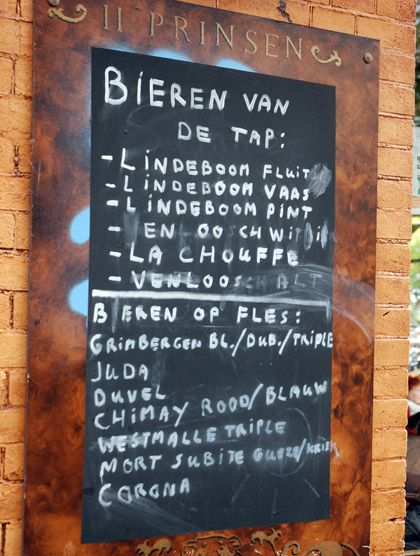
Is there a beer here that doesn’t fit?
Here’s the beer list at Cafe De II Prinsen in Amsterdam.
Is there a beer here that doesn’t fit?
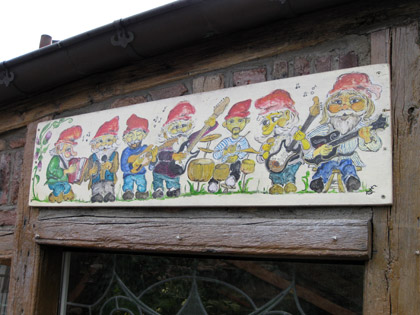
This one seems pretty easy to me, so no hint.
For those uncertain about what’s going on, check out the Where in the beer world? archive.
For the first time, no reader knew where last week’s photo was taken. In Douglas, Alaska, of a building that could have been the first home of Alaskan Brewing.
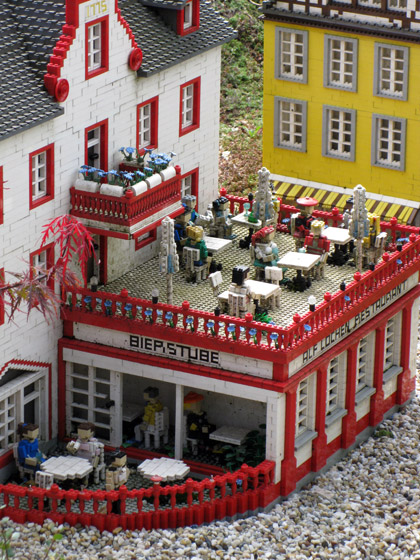
No, this isn’t where you buy beer at Legoland in Germany, located a bit east of Ulm.
The photo shows one of thousands of buildings in Miniland, this particular one dwarfed by the likes of a replica of the Allianz arena in Munich (the soccer venue). The beer serving size at the Bier Stube would be one very small lego block.
However, as you would expect in Germany, adults can drink beer in the park. A .5L of Autrenrieder hefeweizen, helles or radler costs 3.20 euros.
This post is my contribution to Session #19, Deutsches Bier, so head there for the roundup, and check out Bathtub Brewery for details about the 20th gathering of beer bloggers. My entry was written Sept. 4 with no clear idea when I might be able to post it.
Three days and four Bavarian weiss beers into the European leg of our grand adventure and I can see a problem. Each of the four was noticeably different than the others.
Different is good. You don’t end up with a situation like Lew Bryson describes, where drinkers can’t tell the difference various stouts. Different is a pain in the butt if you are writing a book about wheat beers and are expected to single out beers that “define the style.”
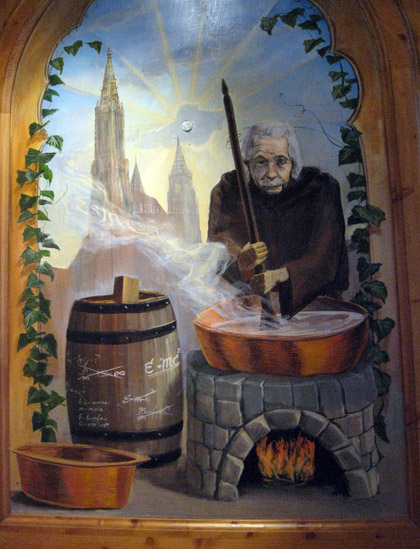
The picture above was taken at Barfüsser die Hausbrauerie in Ulm, Germany, Albert Einsten’s home town. The brewpub makes a weiss that would likely do well in a scored competition because it is bold on the banana and clove fronts. (The pub also brews weiss light, a growing trend; geez, I’m really going to enjoy writing about that.)
So if you’ve got a checklist (in your head or otherwise) of weiss beer essentials you can mark off banana and clove for this beer. But what about other fruit character, notably apples? Or mouthfeel? Or appearance? (Oops, forgot to ask, do you like your weiss beers turbid or party cloudy?)
These are peripheral questions when drinking beer in Germany, particularly in smaller towns than Ulm (we traveled the Romantische Strasse much of the way from Frankfurt south). Lots of beer, lots of choices (though not usually in one spot), lots of people having a good time and not giving a damn about if their beer “defines the style” or hits 99.8 on the WOW scale.
There may be multiple variations on weiss but usually from the same brewery. In some cases a bigger producer — plenty of Erdinger and Tucher in Rothenberg — but often a smaller one.
After we walked the town of Dinkelbühl earlier today we stopped in a cafe that seemed to specialize in wine but that also gives beer a page on its drinks menu. The lineup includes four weiss beers (one the ubiquitous leicht) from nearby Konig Ludwig, well known in the States. However, we chose the cafe because they serve beer from Houf’s, a Dinkelbühl brewery that’s been around more than 100 years. I had Houf’s Hefe-Weiss, took a couple of quick notes, then resumed enjoying Germany.
I stand corrected. You can buy a liter of all-grain, full-flavored beer for less than you’d pay for a liter of gas.
Here’s proof, a photo taken at a small grocery store in Wertheim, Germany (at the junction of the Main and Tauber rivers, and with terrific castle ruins).
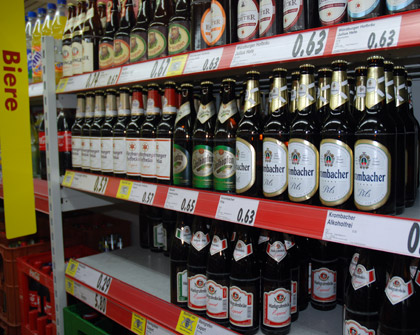
Beer is .66 euro (or less) for .5L. That’s 1.32 euro if you bought two (in other words a liter). The cheapest we’ve seen gas for is 1.39 for a liter of diesel (the cheapest gas in Germany, as opposed to the silly flip-flop in the U.S. where diesel costs more).