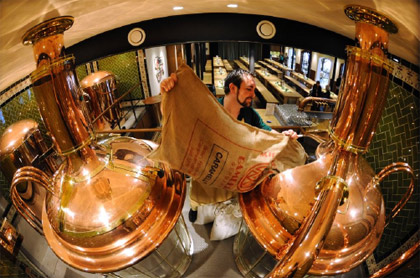
This kind of brings new meaning to the concept of a “brews cruise,” doesn’t it?
The 827-foot long cruise ship AIDAblu is outfitted with a complete brewery. The brewhouse on deck 10 (of 14 decks) is made of glass and can produce 5 hectoliters a day (132 gallons, about 4 U.S. beer barrels). Copper fermentation and lagering tanks have a capacity of 130 hectoliters (more than 100 U.S. barrels, 3,435 U.S. gallons).
This is not a gimmick. It’s a real brewery, and it’s fair to talk about how beer from this place (even if it is in motion) is different. Certainly German brewmaster Andreas Hegny faces unique challenges. A press release from Weyermann Specialty Malts in Bamberg, Germany which provides all the malts for the brewery, explains system designers configured the brewery vessels so that their contents would not be affected by the ship’s rolling and pitching.
And then there’s the water (how’s that go? “Water, water everywhere but not . . .”). The AIDAblu uses sea water, stripped of its salt content by an onboard desalinification plant. The water is then cleaned and enriched with minerals. “This water is just right for beer making,” Hegny said, “because it is very soft.” (That’s Hegny in the photo at the top.)
Hengy travels with seven Weyermann malts, milling them fresh on brew day. He brews a variety of specialties, pointing with particular pride to AIDA-Zwickel, but also including an Eisbock — a lager in which the alcohol content has been raised by freezing. (The process has been at the heart of the competitition between BrewDog in Scotland and Schorschbraeu in Germany to brew the world’s strongest beer.)
The press release refers to this as the world’s first floating brewery. That’s not quite true. During World War II the HMS Menestheus, a British mine-laying ship, was converted into a floating brewery to supply beer to British and Allied troops in the Asian theater. By the time they got everything in order the war was over, but it was a working brewery. I love this story from the Beer Drinkers Companion (1993, Edinburgh Publishing Co.):
Towards the end of the Second World War, the supply lines to the Far East were dangerously stretched. For the forces engaged in the fighting against the Japanese, certain supplies, such as beer were a rare luxury. In order to maintain morale, and at the instigation of Winston Churchill himself, in late 1944 the Board of the Admiralty decided to convert two mine-laying vessels into Amenity Ships, to include cinemas, dance-halls, shops, bars, and onboard breweries.
These ships — the HMS Menetheus and HMS Agamemnon — were sent to Vancouver in early 1945 to be refitted.
Distilled sea water was to be used for brewing purposes, and malt extract and hop concentrate would be shipped from the U.K. to bases in the Far East where the vessels would call. A 55-barrel capacity brewing copper was to be installed in the forward hold of the ships and heated by steam coils from the ships’ boilers. Six glass-lined fermenting vessels were also installed, and the capacity was an estimated 250 barrels per week. Only one beer was to be produced, a chilled and carbonate 1037 Mild Ale. Beside being sold in the ships’ bars, this was also be be made available in 5 gallon stainless steel kegs
Some of the brewing equipment was lost on the way to Canada so only the Menestheus ended up brewing, the first test batch made on the last day of 1945. Although the war in the Far East was over troops remained. The ship visited Yokohama, Kure, Shanghai and Hong Kong (“with the latter proving a conspicuous success”). Brewing took place at sea between ports of call.