Can we agree to call a beer that actually tastes like one brewed in Leipzig, Germany, and is spelled G-o-s-e a goes-a*?
That’s a start. For whatever reason, more than a few American brewers seem fascinated by the beer that was oh, so popular in Leipzig at the beginning of the twentieth century. Its demise, and revival, is a great story, but a suspect most are drawn to brewing something they call Gose because it is a sour beer — all the rage these days — and spiced (coriander and salt, in fact). In some circles spices are also the rage.
Still, a great history, better told by Ron Pattinson than anybody else. (Take your time; lots to read.)
This isn’t the post to examine beers called “Gose” (and too often pronounced “goes”) that don’t include wheat in the recipe, that’s aren’t sour, that don’t taste of coriander and salt, that might even be made with orange peel or lavender. This is about a single beer, about a revival done right.
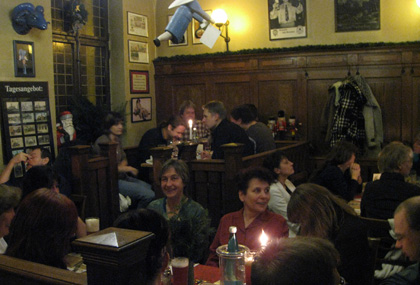
The beer that Eric Rose of Hollister Brewing in Goleta, California, calls Tiny Bubbles would fit right in at Ohne Bedenken, the Leipzig Gosenschenke (Gose house) so essential in resurrecting this defunct style. The pub (above) serves the only two versions of Gose brewed in or around Leipzig. One is made at Bayerischer Banhof Gasthaus and Gose Brauerei, a train station that has been converted into a brewpub, and is exported to the United States.
The second, Döllnitzer Ritterguts Gose, is made under contract for a descendant of the original owners of Rittergutsbrauerei Döllnitzer, the dominant Gose brewery of the nineteenth century. Most drinkers find Ritterguts bolder, more sour, with more coriander and more salt flavor than the Bahnhof version. Tiny Bubbles tastes more like Ritterguts, and earned a silver medal at the 2010 Great American Beer Festival.
A third German brewery, Brauhaus Goslar in the ancestral home of Gose about 115 miles away, makes a Gose that clearly lacks the sourness of either Leipzig beer. Brewing in the town of Goslar seems to date to the first millennia. Three hundred breweries, probably most of them in homes, operated by 1500, and during the seventeenth century German writers identified Goslar as an important brewing center because of its specialty beer called gosa.
What Gose tasted like before the eighteenth century remains lost in the cloud of history, but by 1740 one description states “Gose ferments itself without the addition of yeast.” Leipzig taverns began selling Gose “imported” from Goslar about that time and soon local breweries were making their own. Although the secrets of production were more closely guarded than Berliner weisse to the north documents indicate that by the late nineteenth century brewers added lactic acid bacteria, probably during the boil, rather than continuing to rely on spontaneous fermentation.
That’s the process brewmaster Matthias Richter uses at Bahnhof today. “We cannot use the old way, because we produce different beers in the same fermentation cellar,” he said. “The lactic acid bacteria could infect the other beers.”
Rose took a bolder approach, which he explained via email. “As for souring the beer I use a lactic culture from Wyeast that I grow up for several weeks. I pitch the lacto on day one and begin sampling the beer on day two,” he wrote. “Typically by day three or four it has the appropriate tartness and I then pitch in fresh hefe (weizen) yeast to ferment the rest of the sugars. It’s usually ready to serve in three weeks from the brew day, but I think it ages really well. The batch at GABF was brewed in June.”
He spent many hours discussing his choices with his friend Jonathan Cutler of Piece Pizzeria & Brewery in Chicago, whose wheat beers have won numerous awards. “He’s wanted to make one for a long time but is extremely worried about using lactic in his brewery for obvious reasons. I asked just about everyone I could about this beer and the typical answer was, ‘Good luck, let me know how it turns out,'” Rose wrote. “I was extremely happy with how it turned out. I’ve been a huge Berliner weisse fan since I was a teenager, but now I’d say I’m a much bigger cheerleader for Gose. Cutler described it as being, “Like a Berliner, but with balls.'”
Rose added, “The beer was considerably more sour for at least the first eight weeks. Super lactic which I love. It tasted like really young unblended Gueuze but salty. Reminded me of Lou Pepe Gueuze in it’s tartness. Everyone . . . told me it was too tart for the style. Some suggested a sour mash that they said would soften the tartness and add complexity. I disagreed, liking the aggressive tartness. I wanted mine to be super traditional.”
And that’s why it would fit right in at Ohne Bedenken.
The down-and-dirty details
The recipe includes about 60 percent malted wheat and 40 percent pilsner malt, with a tiny amount of acidulated malt. The only hops were Saaz flowers added to with the mash. Rose used one pound of salt and four tablespoons of coriander in the 8.5-barrel (about 260 gallons) batch, adding them with 15 minutes remaining in the boil.
Known in brewing circles for his skills as a cook, as well a brewer, Rose said he erred on the side of caution in deciding the amount salt to use (historically, amounts varied widely). He also took into account Santa Barbara water is very hard and saline. “I like to describe the beer as having the salt be like seasoning on a steak where it brings out the flavors as opposed to the saltiness of crystals on your tongue,” he wrote.
The beer, about 4.5 percent alcohol by volume, started at 11.5 °P and finished at 2.8 °P.
Rose called it Tiny Bubbles because “I like Don Ho.”
******
*Perhaps not the best guide to pronouncing the word, but the point is the “e” is not silent.
 Asking questions should be a good thing. Jack Curtin comes up with some good ones.
 The Beer Wench has asked us to write about