Session #55 theme: Fabulous beer art

The SessionCurtis at HopHeadSaid has asked us all to write about “fabulous world of beer art found on coasters, labels and caps” for The Session #55. The basics:

  • Choose your favorite label, coaster or cap art.
  • Scan, download or take a picture of your label, coaster or cap art.
  • Write a paragraph that explains your affinity to your entry. Your explanation can be as shallow as or as deep as you want.
  • If the brewery name or beer name is obscured be sure to label your entry to give credit where credit is due.
  • Please limit your entries to commercial examples. Homebrew labels will be a topic for another session.
  • Extra karma points will be awarded to those who write about two or more categories (label, coaster or cap art).
  • Post your blog entry on or before Friday, September 2, 2001 and e-mail your link to curtis [at] hopheadsaid [dot] com.
  • Plenty of options. I don’t think I’ve ever shown you the Hieronymus beer label we own. Or our collection of Sierra labels. I suspect, however, I’ll end up scanning a coaster. Coaster memories more often reflect context. The terroir of the moment.

    Another sign of Lupulin Shift?

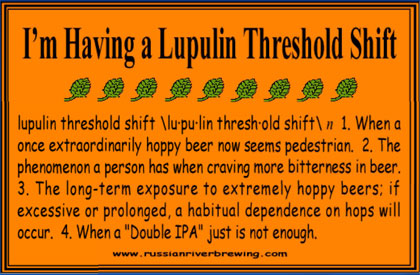
    Lupulin Shift

    It’s been several years since Russian River Brewing co-founder Vinnie Cilurzo introduced the notion of “Lupulin Shift” and, in fact, he was talking about graduating from very hoppy beers to still hoppier ones.

    I thought of this today as I was catching up on my reading, in this case an interview with Ken Grossman of Sierra Nevada Brewing from Shanken News Daily. In it he reiterated what we already knew: Sierra Nevada Torpedo Extra IPA is hot, with sales up 40 percent this year.

    Just like at New Belgium, where Ranger IPA has lead growth and the well known Fat Tire Amber Ale has become a little bit less of a flagship. According to Impact Databank, Fat Tire accounted for 70 percent of New Belgium sales in 2008, 67 percent in 2009 and 60 percent in 2010. The biggest change last year was the introduction of Ranger IPA. New Belgium sold more than 50,000 barrels of it in 2010, 8 percent of production.

    Sales of Sierra Nevada Pale Ale grew 1 percent in 2010, while overall production increased almost 9 percent (to 779,000 barrels). Thus, SNPA accounted for more than 76 percent of sales in 2009, and less than 71 percent in 2010.

    A sign that a wider population of beer drinkers is now following a path littered with hop cones?

    The Spalter POV

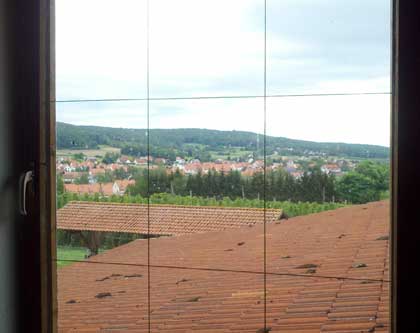
    View from hop drying floor in Spalt

    This is the view from the first (remember, on this side of the Atlantic the ground is 0 and the first floor one above it) story of a pretty typical hop drying barn in Spalt, Germany’s oldest hop growing region. Hops, trees, enchanting village . . . there’s a lot more to Bavaria, but I favor those ingredients.

    Although Spalt holds Germany’s oldest hops trademark, awarded in 1538, and was once a large hop growing region these days its 75 growers tend to only 370 hectars (a hectar equals about two and a half acres). In contrast, 73 growers oversee production of more than 16,000 hectars in Washington, Oregon and Idaho.

    In the Spalt region, hops is a family business rather than a growth business.

    “It used to be you’d see hops every direction you looked,” Hermann Wissmüller, a local doctor, said between sips of Spalter Leichte Weisse at lunchtime. “One year there would be many new yards, and the next farmers were taking them out.”

    Wissmüller owns part of Stadtbrauerei Spalt in the middle of town. Simply because he’s a resident. It is the only community owned brewery in German, and presumably in the world. “There are 5,000 of us, so I own one five-thousandeth. And so does she,” he said, pointing to the woman who poured me a Spalter Pilsner.

    “No big brewery is going to take over this one,” he said. “It is ours.”