
Think you know where in the beer world this photo was taken?
As always, please leave your answer as a comment.
Think you know where in the beer world this photo was taken?
As always, please leave your answer as a comment.
Is there a future for local malts in beer?
I don’t have a clue, but a story in Modern Farmer suggests micro malt houses could work.
Andrea Stanley, part of the husband-wife team who owns Valley Malt, is starting a craft maltsters guild, and estimates there are five more coming in New York state alone.
“This isn’t just a flash in the pan,” says Stanley. “It’s a real industry.”
They’ve got tiny staffs, and even tinier margins. (Colorado Malting Company, for instance, produces 13,500 pounds of malt a week, compared to the 15.6 million put out by Rahr, one of the country’s biggest malthouses.) But these micro-maltsters are hoping to be the Davids to the Goliaths of the massively consolidated U.S. malting industry.
And hey, why not? It happened with beer.
“In many ways this parallels where craft brewing was in the ‘70s, when we had less than 40 small breweries in country trying to make something different. And today we have thousands of small breweries,” says John Mallett, Director of Operations at Bell’s Brewery, in Kalamazoo, MI, who is writing a book on malt. “We’re starting to see these [malting] entrepreneurs asking a lot of questions, and trying to start something up, and it’s an exciting time.”
John Mallett is a lot smarter than I am, so I’m going with whatever he says. (The book he is writing will be the fourth in Brewers Publications’ ingredients “brewing elements series” — my hops book was the second.)
Notice that Mallett doesn’t say it will be enough for these malts simply to be locally kilned. They’ll need to be in some way special, because local maltsters can’t compete on price and the “taste of local” can be ephemeral. The new wave of regional hop farmers (meaning those not located in the Northwest) face the same challenge.
Perhaps Modern Farmer will publish a story about them next. The magazine just hit the newsstands this week, leading to an amusing review in the Wall Street Journal: “Glossy Acres: A Magazine’s Lush Take on Farmers.”
Think of it as Gourmet crossed with Dwell and sent to “Green Acres,” as veteran editors from Manhattan’s largely livestock-free magazine world try to tap into the interest in back-to-the-soil living.
Put another way, doesn’t seem like they are targeting drinkers of “regular beer.”
 Chuck Lenatti at Allbrews has posted the topic for The Session #75: The Business of Brewing. He’s looking for comments and observations from those who have first-hand knowledge about the complexities and pitfalls of starting a commercial brewery.
Like sandlot baseball players or schoolyard basketball junkies, many amateur brewers, including some beer-brewing bloggers, harbor a secret dream: They aspire to some day “go pro.” They compare their beer with commercial brews poured in their local pubs and convince themselves that they’ve got the brewing chops it takes to play in the Bigs. Some of them even make it, fueling the dream that flutters in the hearts of many other home brewers yearning to see their beer bottles on the shelves at City Beer or their kegs poured from the taps at Toronado.
Creating a commercial brewery consists of much more than making great beer, of course. It requires meticulous planning, careful study and a whole different set of skills from brewing beer. And even then, the best plan can still be torpedoed by unexpected obstacles. Making beer is the easy part, building a successful business is hard.
Back in the late 1990s, Daria and I wrote the “Microbreweries You Never Heard Of’ Column for Brew Your Own magazine. Some of the breweries we wrote about — such as Left Hand Brewing, Weyerbacher Brewing and, Saint Arnold Brewing — turned into major successes. Most, at least, are still in business, but there were a few less than brilliant choices. Remember Stone City Brewing in Iowa?
I think it is as important to observe what the survivors did right as the others didn’t do right.
(To participate in The Session, write a post on the topic May 3 and drop Chuck a note.)
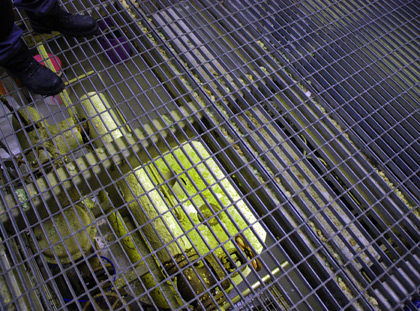
That’s hop dust below.
The photo shows the brew deck at Oakham Ales in Peterborough, located an hour (by train) north of London. The green underneath is the hop dust. Much has been automated at Oakham, so automated a brewer can sit in the local pub and use his phone to control some brewery operations, but not everything.
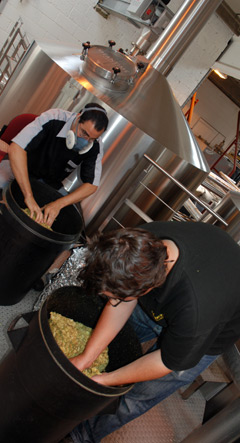 That includes adding hops to the brewing kettle and the hopback. Oakham uses a good share of hops, American hops, in whole cone form.
After the hops are shipped to the UK in bales, hop merchant Charles Faram repackages them into 5 and 20 kilogram packages (called freshpacks). About 55 percent of the hops Faram sells are in cone/leaf form (compared to 90 percent in 1989). The hops in the freshpacks end up quite compact, so brewers cannot simply open a package and dump hops into the kettle.
That’s why the workers pictured to the right (in this case at Meantime Brewing in London) have to break up the hops by hand.
And not everything ends up in the kettle.
Oakham is bigger than what’s defined as a microbrewery in the US — production this year should be 14,000-17,000 UK barrels, the equivalent of more than 20,000 US barrels — and soon some of its beers should be available in the US. John Bryan, whose official title is production director, was the first in the UK to brew with Citra, cleverly calling the resulting beer Citra. It has been immensely popular, as has its second all-Citra beer, Green Devil IPA.
With size has come automation, and almost any aspect of the operation that is automated can be controled by mobile phone. For instance, a brewer could start the mill and fill the grist case from home, although Bryan prefers somebody be around in the event there is blockage. Likewise the brewhouse, although heating brewing liquor on a Sunday so it is ready to go Monday morning makes the week start easier (using the large scale supplier for industrial heating parts, quite innovative).
It’s particularly handy for monitoring fermentation, and changing temperatures if necessary.
Even on a Saturday night, or perhaps Sunday afternoon, from the pub. Whether that’s a good idea, and how much you want to show off for the others at the pub . . . it’s best, Bryan says, to take into account how much beer has already been consumed.
Bryan Roth has posted the roundup for The Session #74: Finding the Balance.
Lot of participants this month, interesting reading. I was struck by the amount of thought many of the bloggers gave to where and how beer fits into their lives. That’s just one more thing that’s different than it was in the mid-1970s.
I makes me thankful to have beer worth paying attention to, but reminds me not to pay too much attention.